

Luzocephalus was an Early Triassic temnospondyl. Its type species is known from the Luza River basin in European Russia. Skulls from East Greenland document a second species with different proportions in the snout and nostrils.
Quick facts
| Group | Temnospondyls, stereospondyls |
|---|---|
| Age | Early Triassic |
| Region | Europe: Kirov Oblast, Russia. North America: East Greenland |
| Type species | Luzocephalus blomi |
| Scientific name | Luzocephalus |
| Diet | Unknown |
What can the fossils tell us?
PIN 3784/1 came from Kirov Oblast. A review of Eastern European amphibians places it in the Vokhma Horizon.
The East Greenland snout is shorter in front of the eyes and its nostrils are narrower. These differences help distinguish the species.
The skull gives the head outline. Body proportions and skin colour are unknown.
The find from Kirov Oblast
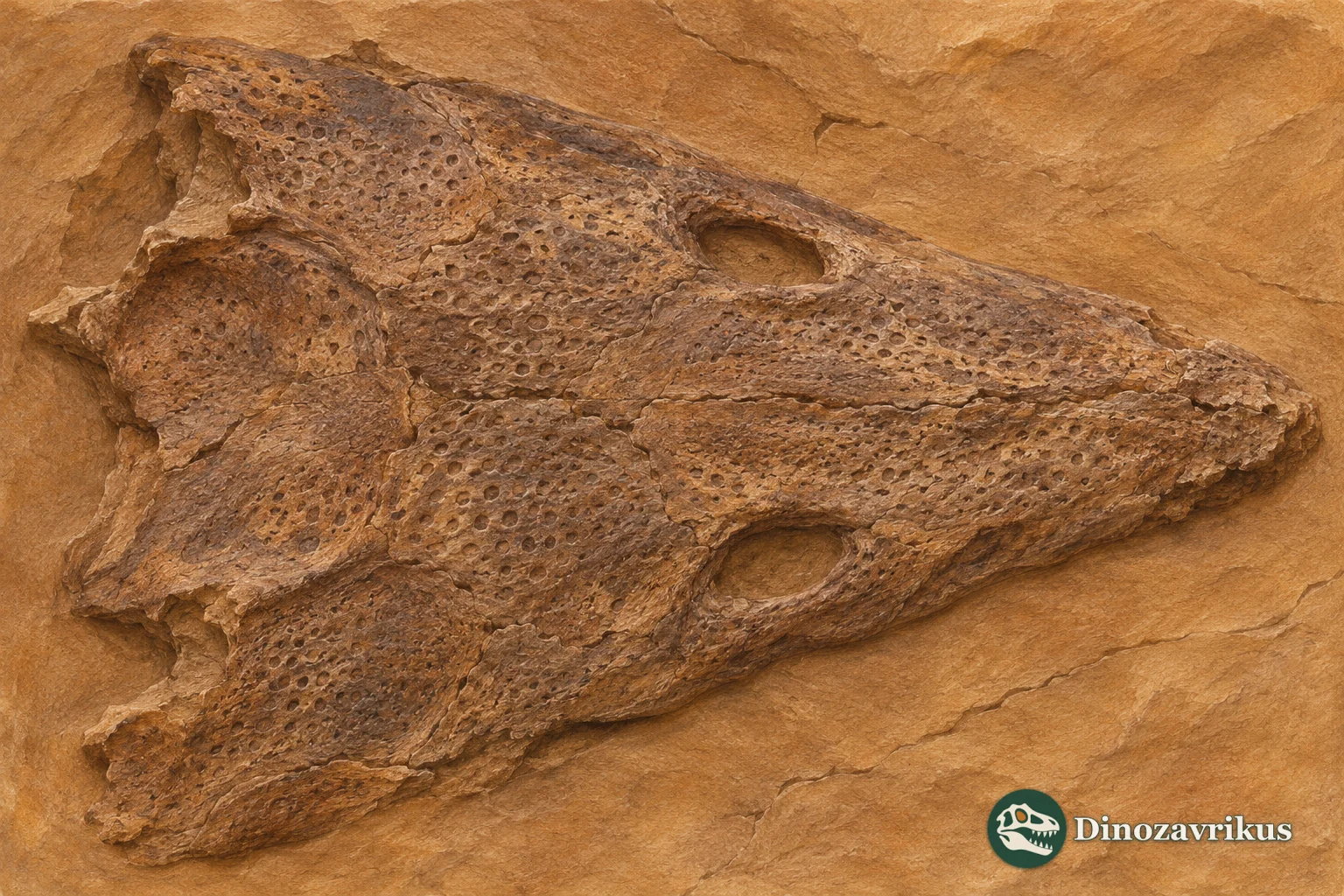
In 1980 Mikhail Shishkin named Luzocephalus blomi from the incomplete skull PIN 3784/1. It came from the Luza locality. A revision of Early Triassic amphibians from Eastern Europe assigns the fossil to the Vokhma Horizon. One redescription recorded a skull length of about 17 cm along the midline. In outline the skull is wedge-shaped and wider at the rear.
Two species distinguished by skull proportions
East Greenland preserves the Early Triassic species L. kochi. Gunnar Säve-Söderbergh described that species in 1935, before the genus Luzocephalus was named. The Russian species has a longer section in front of the eye sockets and wider nostrils. Researchers also compare the courses of the sensory grooves on the skull roof.
Where it sits among temnospondyls
Shishkin originally erected a family for the genus. Later studies compared it with animals such as Lydekkerina. Several features also occur in other early stereospondyls, so the broader temnospondyl placement is better established than its precise relationships.
The type skull provides an approximate head shape. It leaves the animal’s total length, skin pattern and diet unresolved.
Frequently asked questions
Where was the type species found?
It came from Early Triassic rocks at the Luza locality in Kirov Oblast, Russia.
What is PIN 3784/1?
It is the incomplete skull on which Shishkin based the type species in 1980.
How did the East Greenland species differ?
The section of its skull in front of the eyes was shorter and the nostrils were narrower.
How large was Luzocephalus?
The type skull is about 17 cm long along the midline. The specimen does not give a reliable total body length.