

Lyrocephaliscus euri was a long-snouted temnospondyl from the Early Triassic of Spitsbergen. Later preparation of a fossil nodule added parts of the axial skeleton and shoulder girdle to the evidence. The ancient amphibian catalogue places it among other temnospondyls, while its early Triassic marine setting sets it apart from many better-known relatives.
Quick facts
| Name | Lyrocephaliscus euri (Wiman) |
|---|---|
| Group | Trematosaurian temnospondyl; internal placement varies among analyses |
| Age | Early Triassic; Spitsbergen beds are generally Olenekian |
| Locality | Spitsbergen, Svalbard archipelago |
| Main material | Skulls and scattered postcranial elements |
| Key study | 1983 anatomical revision of the skull, axial skeleton and shoulder girdle |
| Body length | Not established from the incomplete material |
| Catalogue | Ancient amphibians |
What can the fossils tell us?
Fossil skulls document head proportions and bony anatomy. They support comparisons with other trematosaurs, but do not establish total body size.
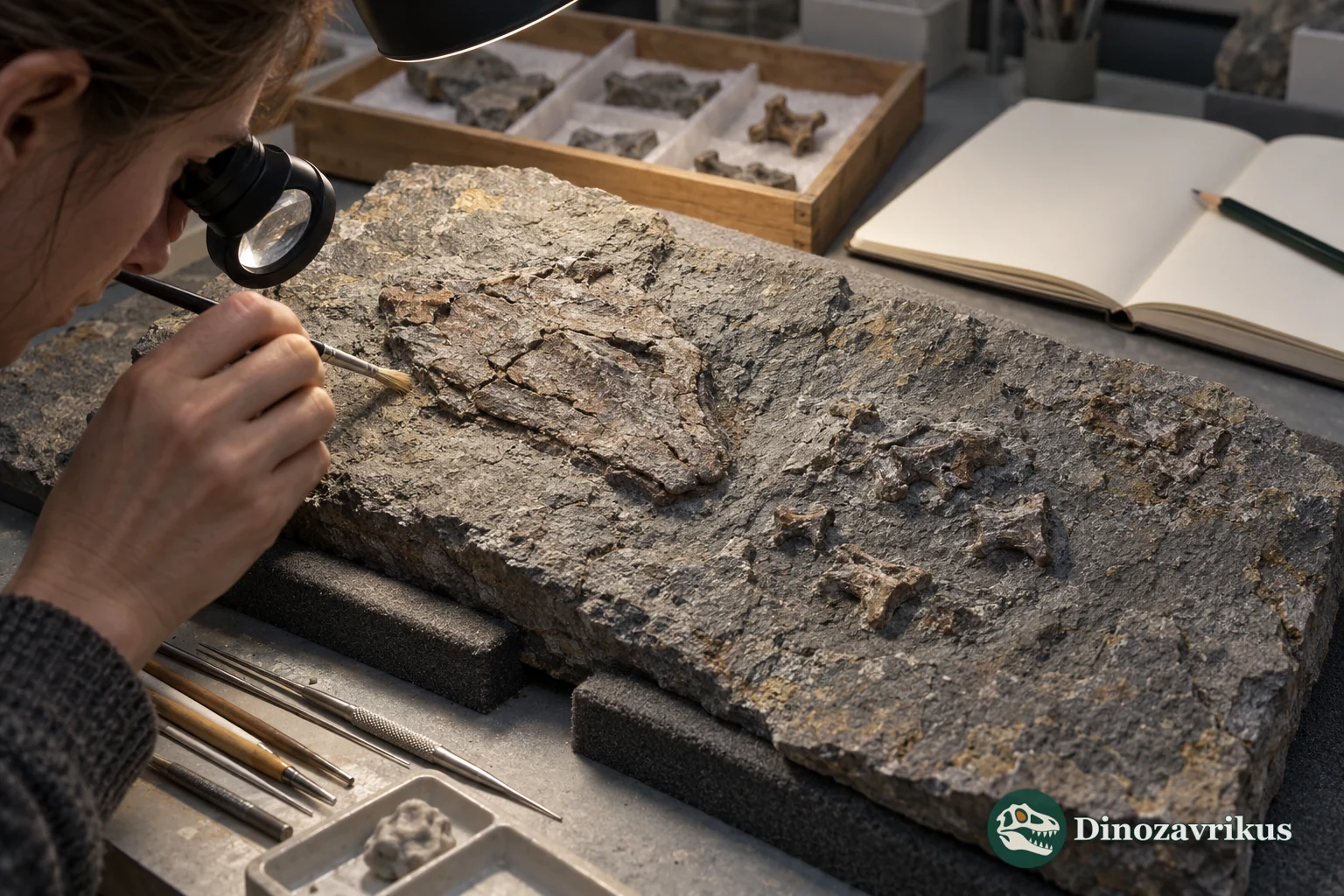
Mazin and Janvier used formic-acid preparation on an Early Triassic Spitsbergen nodule containing a skull and some postcranial elements. It refined the occiput, vascular canals and shoulder anatomy, but did not reveal a complete articulated skeleton.
Pleurocentra found with other vertebral components confirmed the primitive rhachitomy of trematosaurs. This is evidence about axial anatomy, not a direct measure of swimming performance.
Early Triassic Spitsbergen deposits include marine vertebrate faunas. Geology describes where remains accumulated; it does not preserve a hunt or measure the salinity experienced by an individual.
The name and its history
Early material was described as Lyrocephalus euri. The genus name was later changed to Lyrocephaliscus because Lyrocephalus was already in use for another animal. Older literature therefore contains both combinations; the change does not represent two different species.
Spitsbergen temnospondyl skulls had been studied since the early twentieth century. In 1983, Jean-Michel Mazin and Philippe Janvier published a detailed anatomical account of L. euri. They examined a nodule from Lower Triassic deposits in which a skull was preserved with several associated bones. Formic-acid preparation helped expose elements hidden in the matrix and refine earlier descriptions.
What has been preserved
The known remains include skulls and scattered parts of the postcranial skeleton. The most informative published find is a skull with some associated bones, not a complete articulated skeleton. The anatomical study described the occipital region, the course of the carotid arteries and collateral vessels, parts of the axial skeleton and the shoulder girdle.
The revision corrected details in earlier interpretations. In particular, the authors rejected a previously reported stapedial foramen in trematosaurs. Pleurocentra found with other vertebral components helped identify a rhachitomous condition. This is a conclusion about bone anatomy; by itself it does not reveal how flexible the body was or how quickly the animal swam.
Relationships and diagnostic limits
Lyrocephaliscus is placed among trematosaurs, a group of temnospondyls with several Early Triassic lineages. Its long, narrow snout resembles that of other aquatic trematosaurs, including Aphaneramma, but a shared outline alone does not demonstrate close relationship. Classification depends on combinations of skull characters and on which taxa are included in a phylogenetic analysis.
Species identification relies heavily on the skull because most limbs, trunk and tail are not connected to it in a complete skeleton. Isolated bones should not automatically be assigned to the genus just because they resemble those of other trematosaurs. A reliable referral needs diagnostic anatomy or close association with an identified skull.
Early Triassic Spitsbergen
Early Triassic beds on Spitsbergen preserve diverse marine vertebrates. Reviews of marine ecosystem recovery place Lyrocephaliscus among trematosaurs associated with coastal and marine faunas. This context makes an aquatic life plausible, but it is not equivalent to stomach contents, swimming traces or a direct salinity measurement.

The most cautious reconstruction shows an animal capable of moving in water and probably taking aquatic prey. The long snout and teeth are consistent with seizing fish, but no stomach contents or coprolites confidently assigned to this species are known. Skin colour, soft tissues, swimming speed and reproduction cannot be read from the bones.
Size and reconstruction
The available material does not support a dependable total length or mass. Such estimates would require body and limb measurements or a substantially complete skeleton. Comparing one skull with more complete relatives can offer a rough guide, but may conceal differences in proportions between species.
Directly known are skull shape and details of the vertebrae and shoulder girdle. An aquatic life in a marine or coastal system is a reasonable inference. Skin colour, soft tissues, exact body outline and a particular hunting scene are artistic choices. The illustrations here show possible appearance and setting; they are not depictions of fossil specimens.
Frequently asked questions
When did Lyrocephaliscus live?
It is known from Early Triassic deposits on Spitsbergen, generally associated with the Olenekian stage.
Why do older books call it Lyrocephalus?
The species was first combined with Lyrocephalus. The genus name changed to Lyrocephaliscus because Lyrocephalus was already occupied.
Was it a marine animal?
Its fossils come from a marine Early Triassic context and its anatomy is consistent with an aquatic life. Exact salinity and behaviour are not directly known.
Is a complete skeleton known?
No. Skulls and some associated skeletal elements are described, but no complete articulated specimen is known.