

Macrocollum itaquii lived in what is now southern Brazil about 225 million years ago. The preserved skeletons show how individual vertebrae lengthened to produce a long neck. Their internal structure documents air-filled spaces inside some of the bones long before giant sauropods appeared.
Quick facts
| Group | Sauropodomorphs (Unaysauridae) |
|---|---|
| Age | Late Triassic (early Norian) |
| Region | South America (Rio Grande do Sul, Brazil) |
| Diet | Exact diet unknown |
| Type species | Macrocollum itaquii |
| Holotype | CAPPA/UFSM 0001a, an almost complete skeleton |
| Locality | Wachholz site, Agudo, Candelária Sequence |
| Estimated length | About 3.5 m |
| Cervical vertebrae | Nine |
What can the fossils tell us?
In the fourth cervical vertebra, the centrum is about six times longer than the height of its front end. The neck comprises nine vertebrae.
Scans of CAPPA/UFSM 0001b trace cavities in the back of the neck and front of the trunk. They are evidence that extensions of air sacs entered some bones.
The association is consistent with the animals having stayed together. The find preserves where they were buried and gives little information on the usual size of a group.
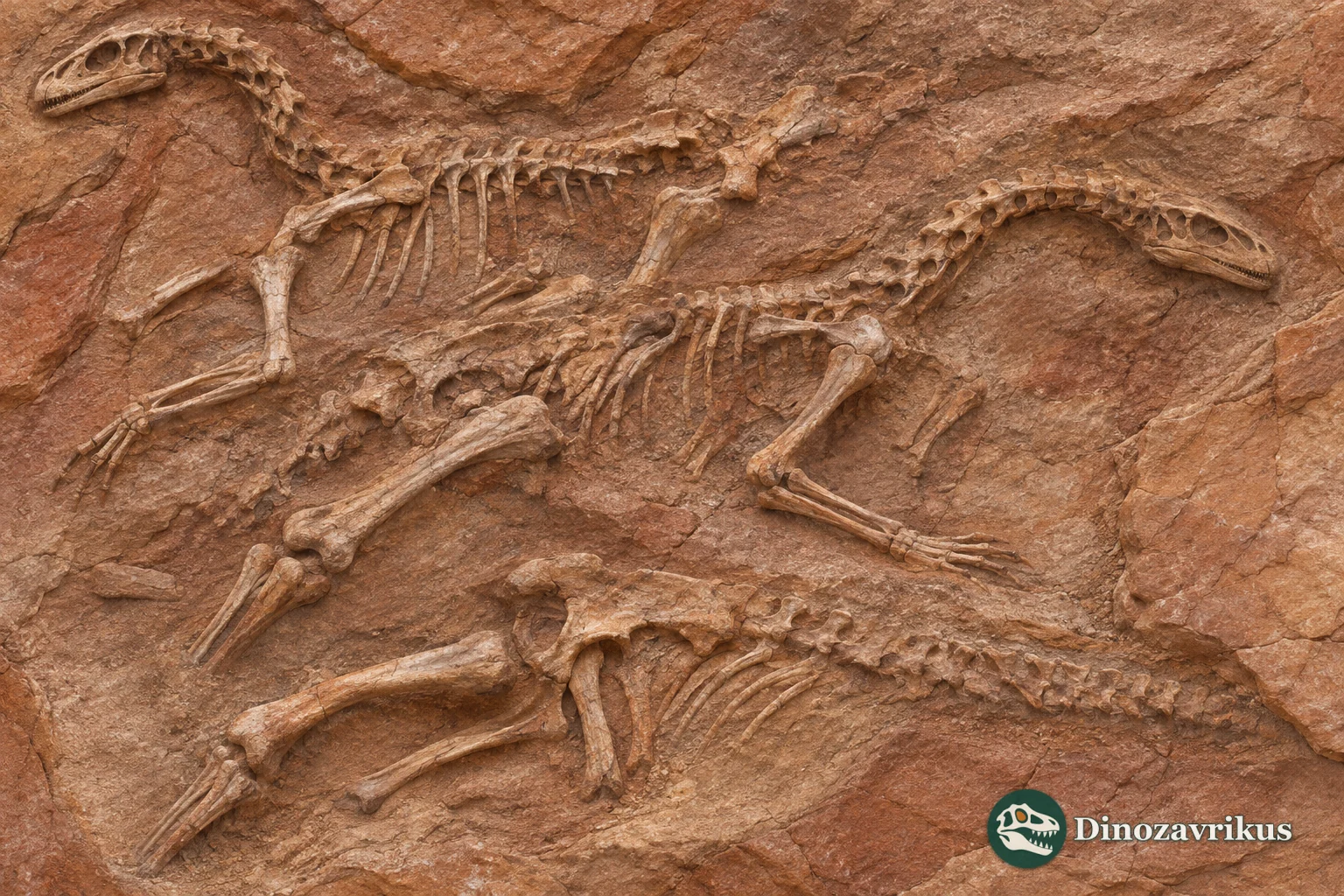
Three skeletons buried close together
Rodrigo Temp Müller, Max Cardoso Langer and Sérgio Dias-da-Silva described Macrocollum in 2018. The genus name combines Greek and Latin roots meaning long neck. The species honours José Jerundino Machado Itaqui for his role in creating the Quarta Colônia palaeontological centre.
The holotype, CAPPA/UFSM 0001a, is an almost complete articulated skeleton. A second specimen preserves a skull and much of the skeleton. A third lacks the skull and neck. They come from the Wachholz site near Agudo. The age of about 225.4 million years comes from correlated strata at a nearby site.
The original description interpreted the close association as possible evidence of group behaviour. It establishes that the three individuals were buried close together. Their behaviour before burial remains open to interpretation.
Nine elongated cervical vertebrae
The centrum of the fourth cervical is about six times as long as the height of its front joint surface. The equivalent ratio in the earlier Brazilian Buriolestes is about 2.5. The 2026 description of the axial skeleton counted nine cervicals. The length of the bones accounts for the elongated neck.
The nearly complete material supports an estimated body length of about 3.5 m. The skull was roughly half the length of the thigh bone, and the shin was shorter than the thigh. Comparisons place Macrocollum and Unaysaurus in a lineage of early sauropodomorphs that preceded the emergence of giant sauropods.
Air chambers and feeding anatomy
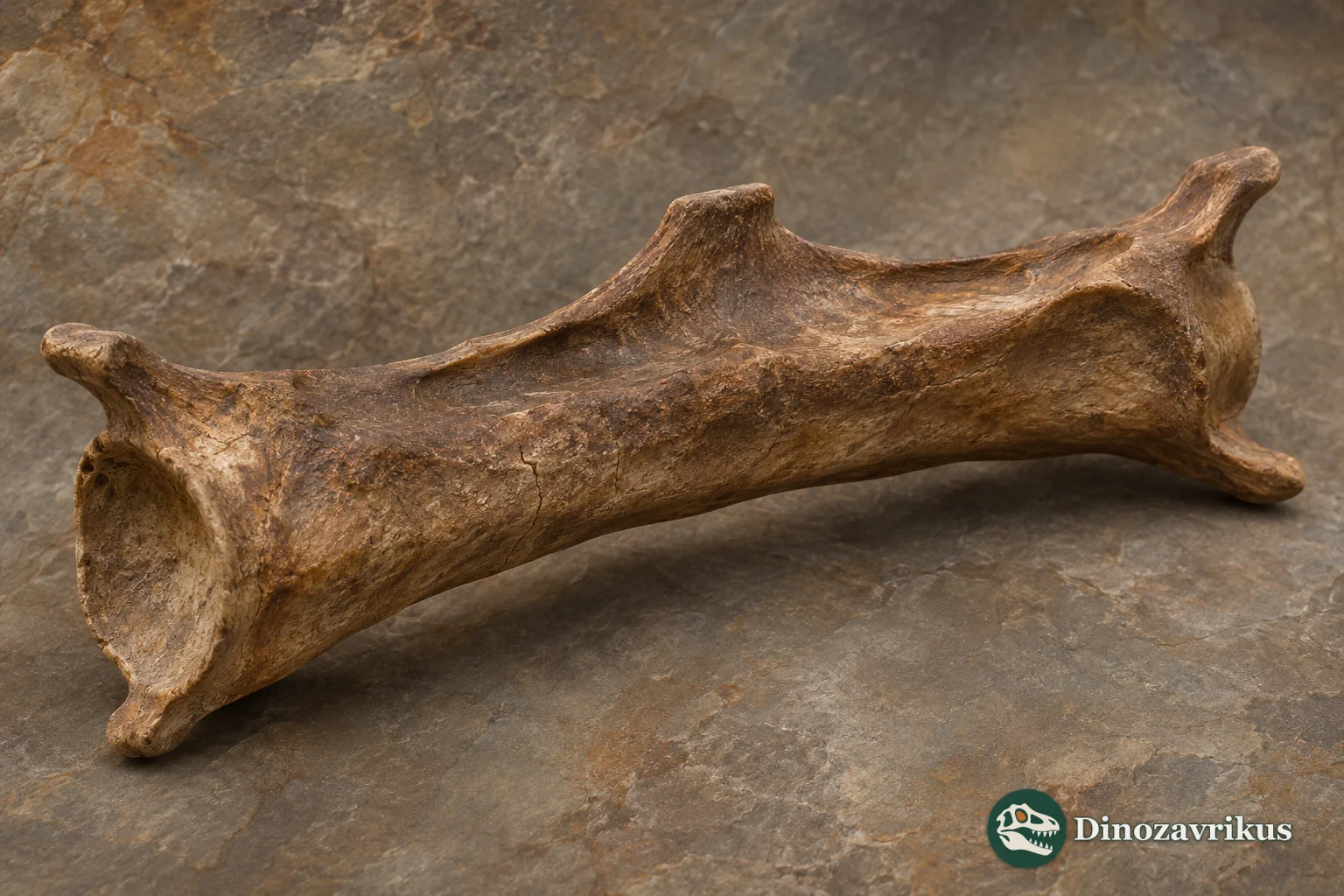
Micro-CT scans of CAPPA/UFSM 0001b showed internal chambers in a posterior cervical vertebra and an anterior dorsal vertebra. Comparable features were absent from the examined bones in the front of the neck, rear of the trunk and tail. The shape of the chambers and their openings provide evidence for air-sac diverticula entering parts of the spine.
Most tooth crowns widen above the base and carry coarse denticles along their edges. Their overlap and cutting edges are consistent with processing plant matter. The teeth leave open how much of the diet came from plants. The long neck may have made it possible to feed at a wider range of heights.
Frequently asked questions
Where was Macrocollum found?
The type series came from the Wachholz site near Agudo, in Rio Grande do Sul, Brazil. It lay in the Triassic Candelária Sequence.
Did the long neck contain more vertebrae?
Nine cervical vertebrae have been identified. The length of the individual bones produced the long proportions.
How were air spaces detected?
Micro-CT scans revealed cavities within the fossils and showed how the cavities connect to openings in the bones.
Do the three skeletons establish that Macrocollum lived in herds?
They show that three individuals were buried close together. That is compatible with group behaviour, while the usual size and composition of groups are unknown.