

Mahavisaurus was an Early Triassic temnospondyl from north-western Madagascar. It had a short, wide snout and fields of small rounded teeth on the palate. Skulls from individuals of different sizes record changes in shape and sensory grooves as the animal grew.
Quick facts
| Group | Temnospondyls, rhytidosteids |
|---|---|
| Age | Early Triassic |
| Region | Africa: north-western Madagascar |
| Type species | Mahavisaurus dentatus |
| Scientific name | Mahavisaurus |
| Diet | No direct evidence |
What can the fossils tell us?
The type specimen MNHN.F.MAE3037 and other fossils preserve parts of the skull roof, palate and jaws.
The skull called Lyrosaurus was compared with larger skulls. Intermediate specimens help explain the differences as changes during growth.
The tooth patches were suited to crushing hard material. The skull cannot establish which animals Mahavisaurus actually ate.
The Iraro material
Jean-Pierre Lehman named Mahavisaurus dentatus in 1966. Its type specimen, MNHN.F.MAE3037, came from near the village of Iraro in the Ankitokazo Basin. It was found in the Middle Sakamena Group, which is Early Triassic at the site. Other specimens from the basin preserve further parts of the skull and lower jaw.
A short snout and widely spaced eyes
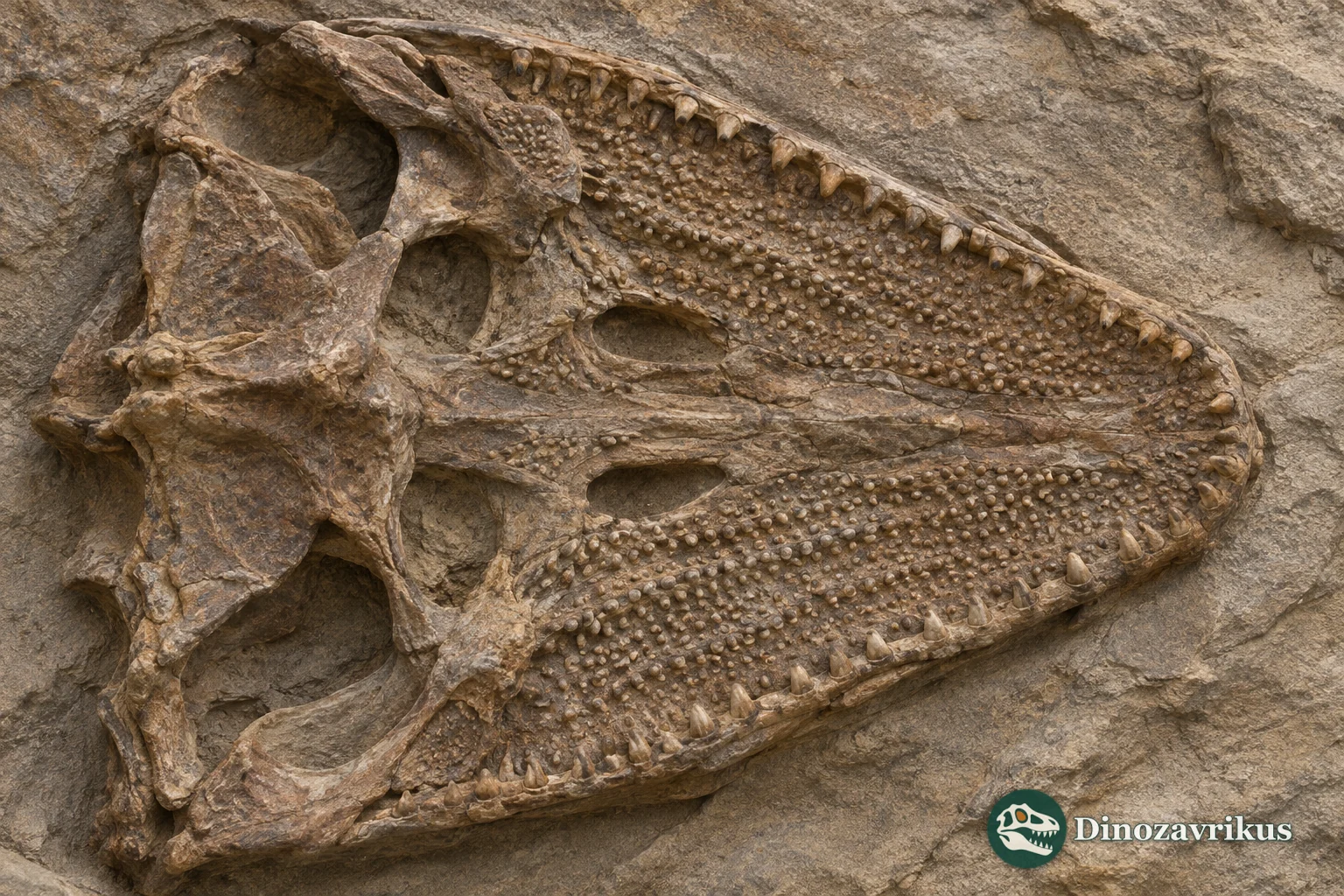
The skull is broadly trapezoidal, with a rounded front. The nostrils sit towards the front corners. The sockets face sideways and are partly visible from above. The skull roof has meandering ridges and pits. Related temnospondyls such as the Australian Deltasaurus also preserve traces of bone ornament.
Where Lyrosaurus fits
Lehman’s 1966 study gave one small skull the name Lyrosaurus australis. In 2014 researchers examined nine specimens, including both holotypes. The lateral-line grooves are deeper and more continuous on small skulls. On large skulls they are shallower and interrupted. Intermediate-sized specimens bridge the differences.
The revision treats Lyrosaurus as a young Mahavisaurus. The skull grew deeper and more vaulted, while the snout remained short in relation to the rest of the head.
How the teeth might have worked
Sharp marginal teeth and large palatal fangs could have held moving prey. Small rounded teeth formed dense patches on the palate and inner lower jaw. The authors of the revision proposed that these patches could crush invertebrate shells or hard fish scales. The proposal comes from tooth shape and arrangement. The exact diet remains unknown.

Frequently asked questions
Where was Mahavisaurus found?
In the Ankitokazo Basin of north-western Madagascar. Its type specimen was found near Iraro.
Why is Lyrosaurus interpreted as a juvenile?
Skulls of intermediate size show gradual changes in sensory grooves and skull shape. The small Lyrosaurus skull fits that series.
What was unusual about its palate?
Several palatal bones supported dense patches of small rounded teeth, alongside rows of larger teeth.
What did Mahavisaurus eat?
Its teeth could hold live prey and crush hard material. The fossils do not establish its exact diet.