

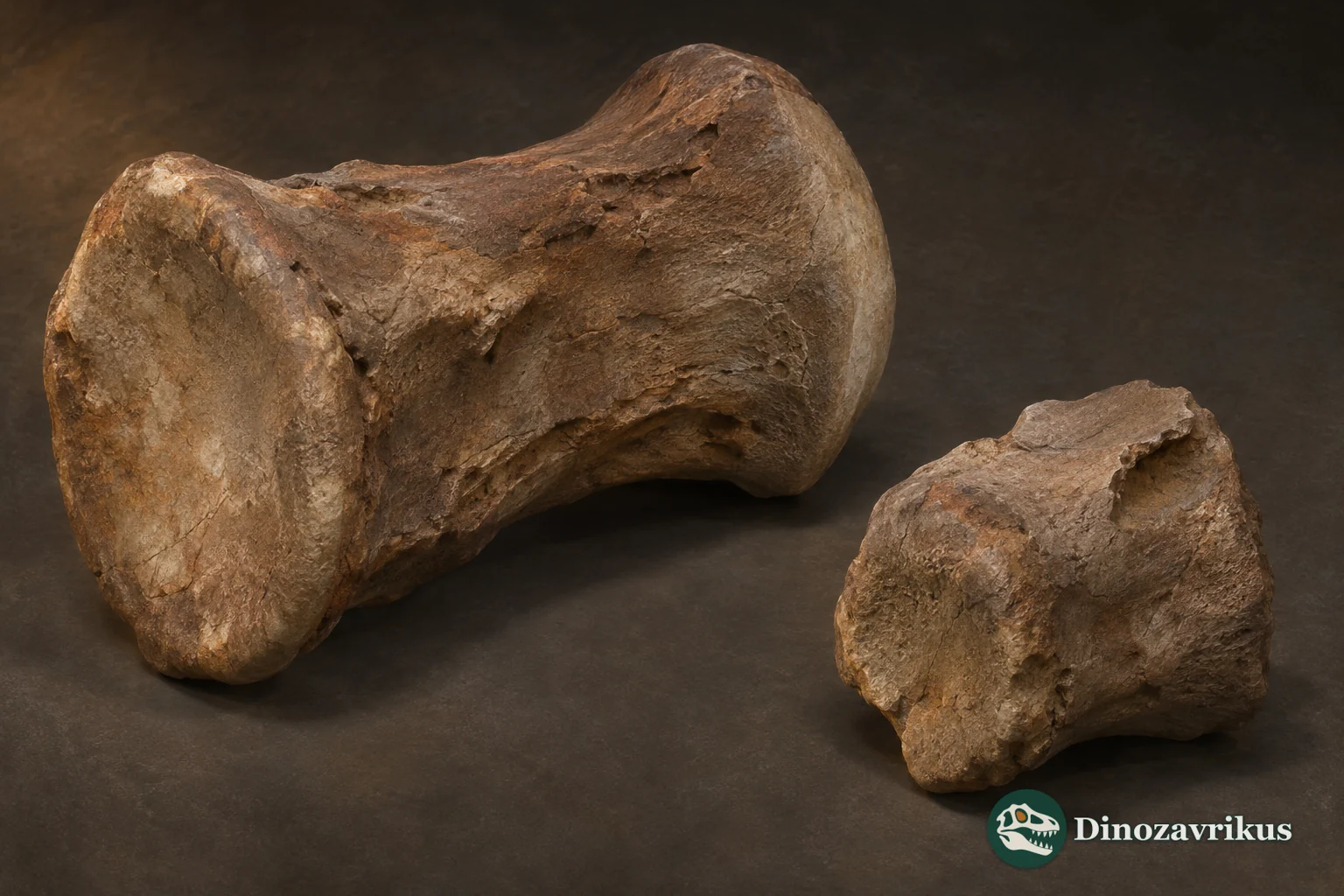
Malarguesaurus florenciae lived in what is now Mendoza, Argentina, during the Late Cretaceous. Its best-known bones come from several parts of the tail. The rear joint surfaces are nearly flat on some vertebrae and markedly convex on others. That combination helps palaeontologists compare it with other sauropods.
Quick facts
| Group | Sauropods (Titanosauriformes) |
|---|---|
| Age | Late Cretaceous |
| Region | South America (Mendoza Province, Argentina) |
| Diet | Herbivore |
| Type species | Malarguesaurus florenciae |
| Holotype | IANIGLA-PV 110 |
| Locality | Quebrada Norte, Paso de las Bardas |
| Geological unit | Los Bastos Formation in the revised local stratigraphy |
What can the fossils tell us?
The back of the centrum is nearly flat in vertebrae from the front and middle of the tail. In several vertebrae from nearer the tip, it forms a pronounced convex surface.
The type material is catalogued as IANIGLA-PV 110. Three additional bones from about 600 metres away are catalogued as IANIGLA-PV 111.
The original description placed the fossil bed in the Portezuelo Formation. The local revision assigns these rocks to the Los Bastos Formation and dates them to the early to middle Coniacian.
The finds at Paso de las Bardas
Bernardo González Riga and his team collected the bones at Quebrada Norte in southern Mendoza in 2005. Florencia Fernández Favarón found the first bone and is honoured in the species name. The genus name refers to the district of Malargüe. González Riga, Elena Previtera and Cecilia Pirrone published the description online in 2008 and in print in 2009.
The holotype includes tail vertebrae, chevrons from beneath the tail, ribs and limb fragments. At Cerro La Torre, about 600 metres south of Quebrada Norte, the team recovered two vertebrae from farther back in the tail and part of a fibula. These bones were referred to the same species on anatomical grounds.
Joint surfaces and sauropod relationships
The centra from the front and middle of the tail are shallowly concave at the front and almost flat at the back. In more distal vertebrae the front socket and rounded rear projection are better developed. This joint fits together much like a ball and socket.
In several titanosaurs, including Mendozasaurus, strongly convex rear surfaces appear closer to the base of the tail. Their distribution helps put an isolated vertebra in context. The original analysis placed Malarguesaurus close to the base of the titanosaur lineage. Its exact position among titanosauriforms varies with the taxa and characters used in the analysis.
Why two formations appear in the literature
The original paper assigned the fossil horizon to the upper part of the Portezuelo Formation. Later work on the Neuquén Group in southern Mendoza used the name Los Bastos Formation for this interval at Paso de las Bardas. The different names reflect revisions to local stratigraphy at the same fossil locality.
Frequently asked questions
Which bones were used to name Malarguesaurus?
The type material contains vertebrae and chevrons from the tail, ribs and parts of limb bones.
Where were the additional bones found?
They came from Cerro La Torre, around 600 metres south of the type locality at Quebrada Norte.
Why is Malarguesaurus compared with titanosaurs?
Some of its tail joints have a socket and a rounded projection like those in titanosaurs. Researchers compare how those joints and other features vary along the tail.
How long was Malarguesaurus?
The known skeleton is too fragmentary to establish a dependable body length.