

Maledictosuchus was a Jurassic marine crocodyliform in the family Metriorhynchidae. A Spanish skull preserves its narrow snout and the pits that received teeth from the opposite jaw. A younger fossil from Mexico was described as a second species.
Quick facts
| Type species | Maledictosuchus riclaensis |
|---|---|
| Group | Metriorhynchid thalattosuchian |
| Age | Middle Callovian in Spain, Kimmeridgian in Mexico |
| Localities | Ricla, Spain, and Oaxaca, Mexico |
| Type skull length | About 55 cm |
| Estimated body length | About 3 m for the Spanish specimen |
What can the fossils tell us?
The fossil preserves the proportions of the head. Total body length comes from scaling comparisons with other metriorhynchids.
Reception pits reveal an interlocking bite. A diet of small, agile prey is inferred from the skull and teeth.
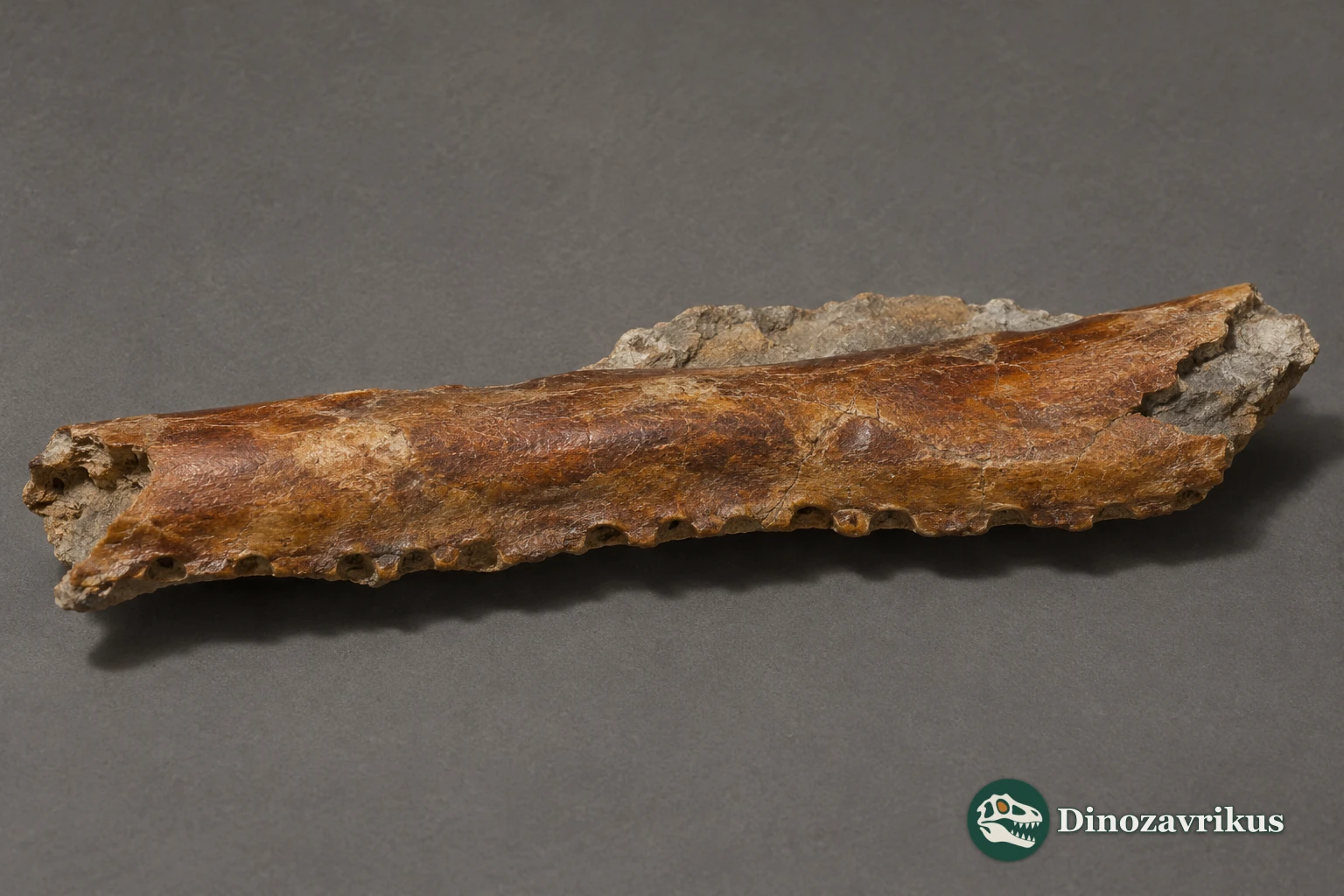
The 20 cm fragment preserves toothed portions of the snout. The teeth have cutting edges and the frontal bone differs from the Spanish specimen.
The Ricla crocodile
C. Gonzalbo, C. Laplana and M. Soria discovered the fossil near Ricla, in Zaragoza Province, in 1994. They were surveying the area in advance of construction for a high-speed railway. The bones were preserved in dark limestone nodules in marine deposits of middle Callovian age.
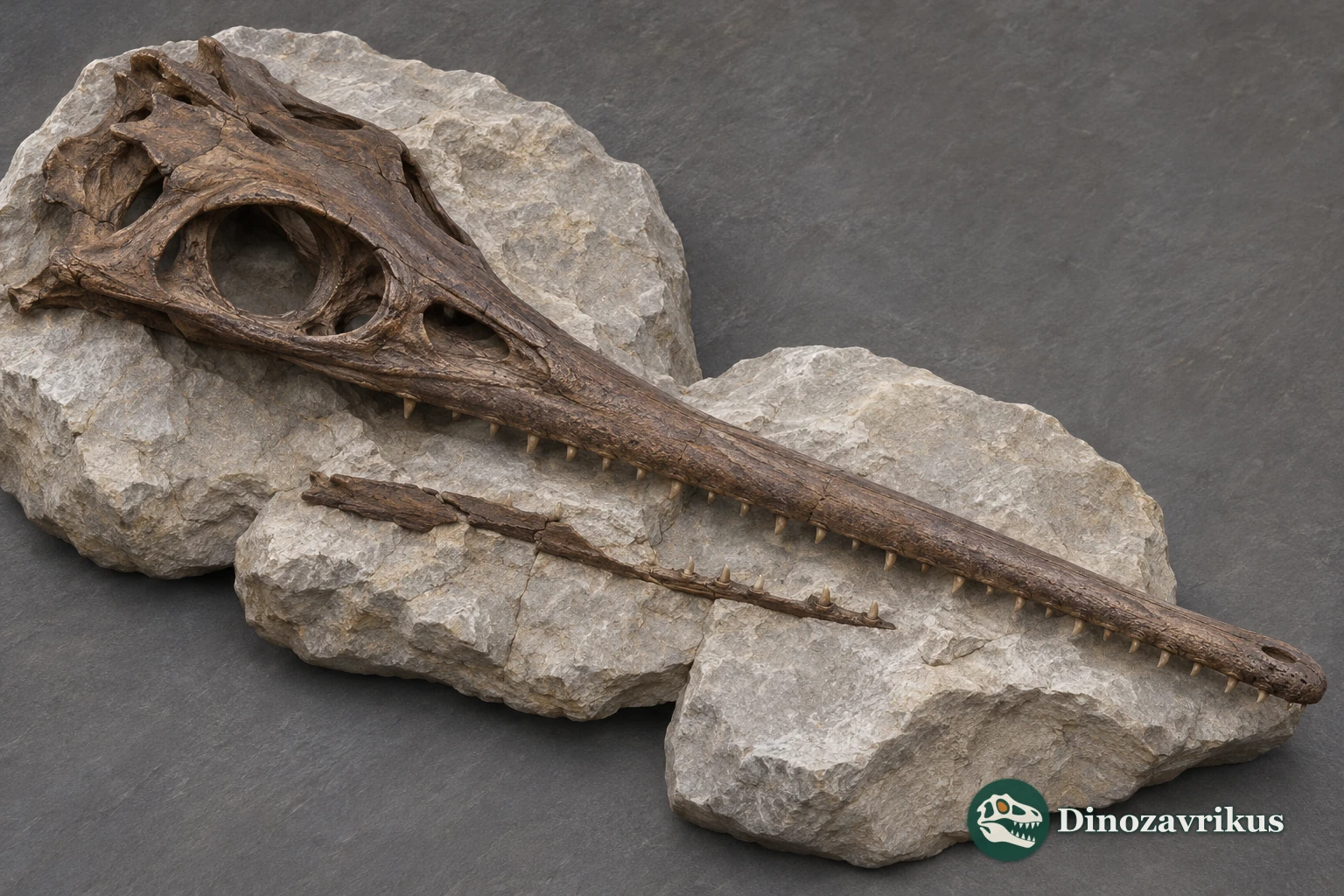
The Palaeontological Museum of the University of Zaragoza holds MPZ 2001/130. It includes a nearly complete skull, the front of the lower jaw where its branches meet, and three vertebrae. The skull had been identified as Metriorhynchus before Jara Parrilla-Bel and colleagues established a separate genus in 2013.
A narrow muzzle and interlocking teeth
The snout measures about 38 cm, accounting for roughly 69% of the distance from the tip to the occipital condyle. It is slender, with nearly vertical sides and no expansion at the tip. A bony partition divides the external nostrils, which sit back from the front of the snout.
Teeth of the Spanish species lean forwards and fit into small pits between those in the opposite jaw. The narrow muzzle and interlocking teeth suggest a diet that included small, agile prey such as fish. Later marine relatives such as Cricosaurus share features of the snout and the retracted nostrils.
The analysis in the original description placed Maledictosuchus on an early branch of Rhacheosaurini. These metriorhynchids combined narrow muzzles and numerous teeth with other features associated with taking small prey at sea.
Estimating the size of the Spanish animal
The distance from the snout tip to the occipital condyle is about 55 cm. The authors used this measurement and proportions from related metriorhynchids to estimate a total length of about 2.95 m. Bone fusion in the skull and vertebrae supported their interpretation of the individual as anatomically mature. The limb and tail shapes in life reconstructions come from related fossils.
A second species from Oaxaca
Jair Barrientos-Lara, Jesús Alvarado-Ortega and Marta Fernández named Maledictosuchus nuyivijanan in 2018. It is based on IGM 4863, a 20 cm fragment of the snout from the Kimmeridgian marine deposits of the Sabinal Formation near Tlaxiaco, Oaxaca.
Compared with the Ricla skull, the Mexican specimen has a wider and more rounded anterior process of the frontal bone. Its tooth crowns carry two cutting edges that are absent from the Spanish species. The find extended the recorded geographic and temporal range of the genus.
Frequently asked questions
How long was Maledictosuchus?
Scaling from the skull gives a total length of about three metres for the Spanish specimen. The Mexican fragment does not support an equivalent estimate.
Why was it called Maledictosuchus?
The name means ‘damned crocodile’. The authors chose it in reference to earlier unsuccessful attempts to study the Ricla fossil in detail.
What might it have eaten?
A narrow snout and interlocking teeth would help seize small, agile prey. Fish are a likely part of its diet.
Which species are known?
The type species is based on a Spanish skull. The second was named from a Mexican snout fragment with a differently shaped frontal bone and distinct cutting edges on the teeth.