

Maomingosuchus was a long-snouted crocodilian known from Eocene deposits in southern China and northern Vietnam. The Chinese species had a short rounded snout tip. The Vietnamese one had a pointed tip that projects farther ahead of the nostril. Fossils from Thailand extend the known distribution of the genus without establishing a named species there.
Quick facts
| Type species | Maomingosuchus petrolicus, also published as Maomingosuchus petrolica |
|---|---|
| Group | Long-snouted crocodilians described as tomistomines |
| Age | Eocene, possibly extending into the Early Oligocene |
| Localities | Maoming, China, Na Duong, Vietnam, and Krabi, Thailand |
| Vietnamese specimen | GPIT-PV-31657, skull, jaws and postcranial bones |
| Vietnamese skull length | 54.6 cm |
What can the fossils tell us?
A series of skulls revealed differences from the living false gharial, including the position of the nasal bones and palate sutures.
The snout makes up about 72 percent of skull length. Postcranial bones were scattered nearby without duplication.
The Thai material preserves parts of a skull and lower jaw. It was referred to Maomingosuchus without a species name.
How the Chinese species received a new name
The Chinese species was named Tomistoma petrolica in 1958. In 2017 Hsi-Yin Shan and colleagues compared the type with skulls from the Late Eocene Maoming Basin of Guangdong. The nasal bones do not reach the external nostril. The shape of the skull table and the position of sutures on the palate also help distinguish these fossils from the living false gharial.
The authors named Maomingosuchus for the basin. The 2017 paper used the combination Maomingosuchus petrolica. The description of the Vietnamese species uses the spelling Maomingosuchus petrolicus for the same Chinese species.
A pointed snout from Na Duong
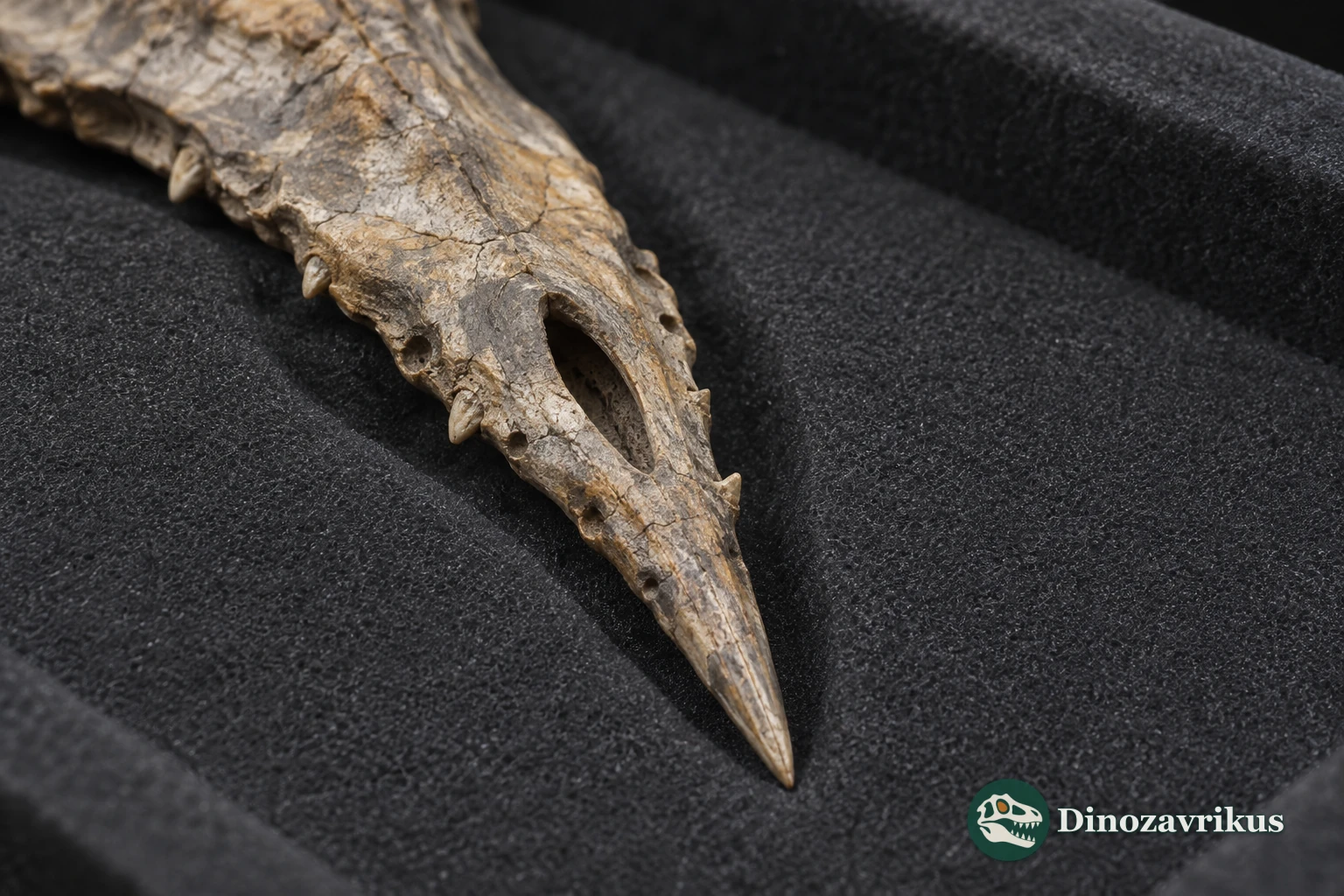
Tobias Massonne and colleagues described M. acutirostris in 2022 from the Na Duong coal mine in northern Vietnam. Its type, GPIT-PV-31657, came from bed 80, assigned an age range of about 39–35 million years ago. The skull is 54.6 cm long, with around 72 percent of its length taken up by the snout.
The premaxillae project in front of the external nostril and form a sharp tip. The same section is shorter and rounder in the Chinese species. The lower jaws remained articulated with the skull. Bones of the rest of the body were spread over about four square metres. Similar sizes, close association and no repeated elements support their assignment to one animal.
Waterways and dispersal
Coal-bearing sediment at Na Duong also preserves fish and turtle remains from the lake and its surroundings. The long narrow jaws would have suited catching mobile prey in water. The fossils do not directly show which animals it ate.
A partial skull and jaw from the lignites of Krabi, peninsular Thailand, were described as Maomingosuchus sp. The three basins document a broad Asian distribution for the group. Work on these fossils and the younger Sutekhsuchus shows that related questions have to be tested across several long-snouted lineages. The relative dates of the fossils and their positions on the family tree inform proposed dispersal routes.
Frequently asked questions
Why do papers use both petrolica and petrolicus?
The earlier combination used petrolica. The 2022 paper uses petrolicus for the same type species.
What is the meaning of acutirostris?
It refers to the acute snout tip, elongated in front of the nostril relative to the Chinese species.
Why is the Thai fossil labelled sp.?
The remains were assigned to the genus without a species name.
How were the scattered bones linked to one animal?
They were found in a small area, matched in size and contained no duplicated elements.