

Martinectes bonneri was a short-necked polycotylid plesiosaur from the Campanian Western Interior Seaway. Two important specimens preserve different parts of its anatomy: one is an almost complete postcranial skeleton without a skull, while another includes a skull and additional bones. The species was first named in Trinacromerum, later assigned to Dolichorhynchops, and separated as Martinectes in a 2024 revision.
Quick facts
| Type species | Martinectes bonneri |
|---|---|
| Age | Late Cretaceous, Campanian |
| Localities | Wyoming and South Dakota, United States |
| Holotype | KUVP 40002, an almost complete postcranial skeleton without the skull |
| Additional specimen | KUVP 40001, with a skull, jaws and additional skeletal material |
| Estimated length | About 4.95 m in one 2026 digital reconstruction; model-dependent |
Evidence guide
KUVP 40002 is an almost complete postcranial skeleton but lacks the skull. KUVP 40001 preserves a skull and parts of the axial skeleton, girdles and limbs. They are complementary fossils, not one composite individual.
Adams described bonneri as Trinacromerum bonneri in 1997. It was later referred to Dolichorhynchops. Clark, O'Keefe and Slack established Martinectes in 2024 and reassigned the species based on comparative anatomy and phylogenetic results.
The fossils document a plesiosaur skeleton with four paddle-like limbs. The skull and postcranial material come from different specimens, so details must be attributed to the correct individual.
A 2026 digital reconstruction estimated KUVP 40002 at about 4.95 m and 1,272 kg. These are outputs of a model, not measurements of a fully preserved living animal.
Two skeletons from the Western Interior
Adams named the species Trinacromerum bonneri in 1997. Holotype KUVP 40002 preserves nearly the whole postcranial skeleton but no skull. A second specimen, KUVP 40001, supplies a skull and lower jaws together with parts of the cervical series, limb girdles and limb bones. Each fossil answers different anatomical questions; they should not be illustrated or described as if all bones belonged to one animal.
The fossils came from marine deposits in Wyoming and South Dakota associated with the Campanian Western Interior Seaway. Locality records and formation assignments identify where the specimens were buried, but do not show that they lived in one group or died at the same time. The age belongs to the surrounding strata, not to a direct measurement of an individual animal.
Why the genus name changed
The species was initially described in Trinacromerum, then combined as Dolichorhynchops bonneri. In 2024, Clark, O'Keefe and Slack erected Martinectes for this species. Their comparison linked it with Unktaheela and ROM 29010 through a set of shared characters that they did not find in Dolichorhynchops. In their analysis, the restricted genus Dolichorhynchops retained other species, including its type species, D. osborni.
This is a revision of classification, not the discovery of a new skeleton or a sudden change in the animals' history. A species name may move when researchers reassess which anatomical traits diagnose a genus and which fossils share them. The history is easiest to follow alongside the profiles of Dolichorhynchops and Trinacromerum, while keeping each specimen and taxonomic opinion distinct.
Anatomy, body size and movement
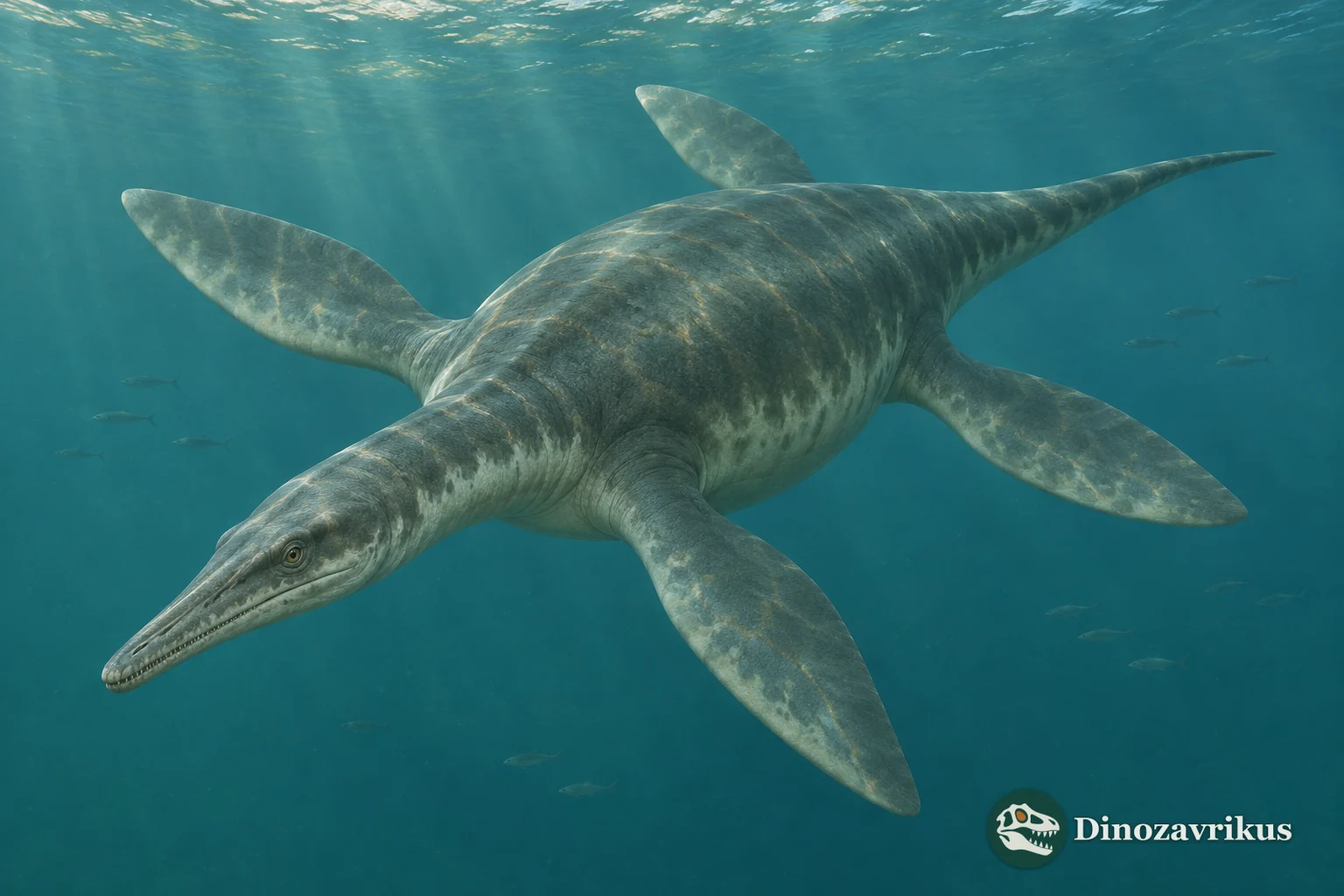
The fossils place Martinectes among Polycotylidae, a plesiosaur family with a relatively short neck and an elongated skull. The incomplete skull and the nearly complete postcranial skeleton come from separate individuals. As a result, reconstruction of the complete body must combine evidence carefully and identify which regions were actually found together.
A 2026 digital reconstruction estimated the length of KUVP 40002 at about 4.951 m and its mass at roughly 1,272 kg. Those figures are outputs of a reconstruction model based on the skeletal record and inferred proportions. They are useful quantitative estimates, but they are not direct measurements of a complete skeleton, and small changes in the reconstructed body outline can alter mass estimates.
Four paddle-shaped limbs indicate the broad plesiosaur swimming apparatus. Bone proportions do not record a precise stroke sequence, swimming speed or hunting manoeuvre. Hydrodynamic models can test possible movements, but the living animal's exact performance remains an inference.
The Campanian sea and limits of inference
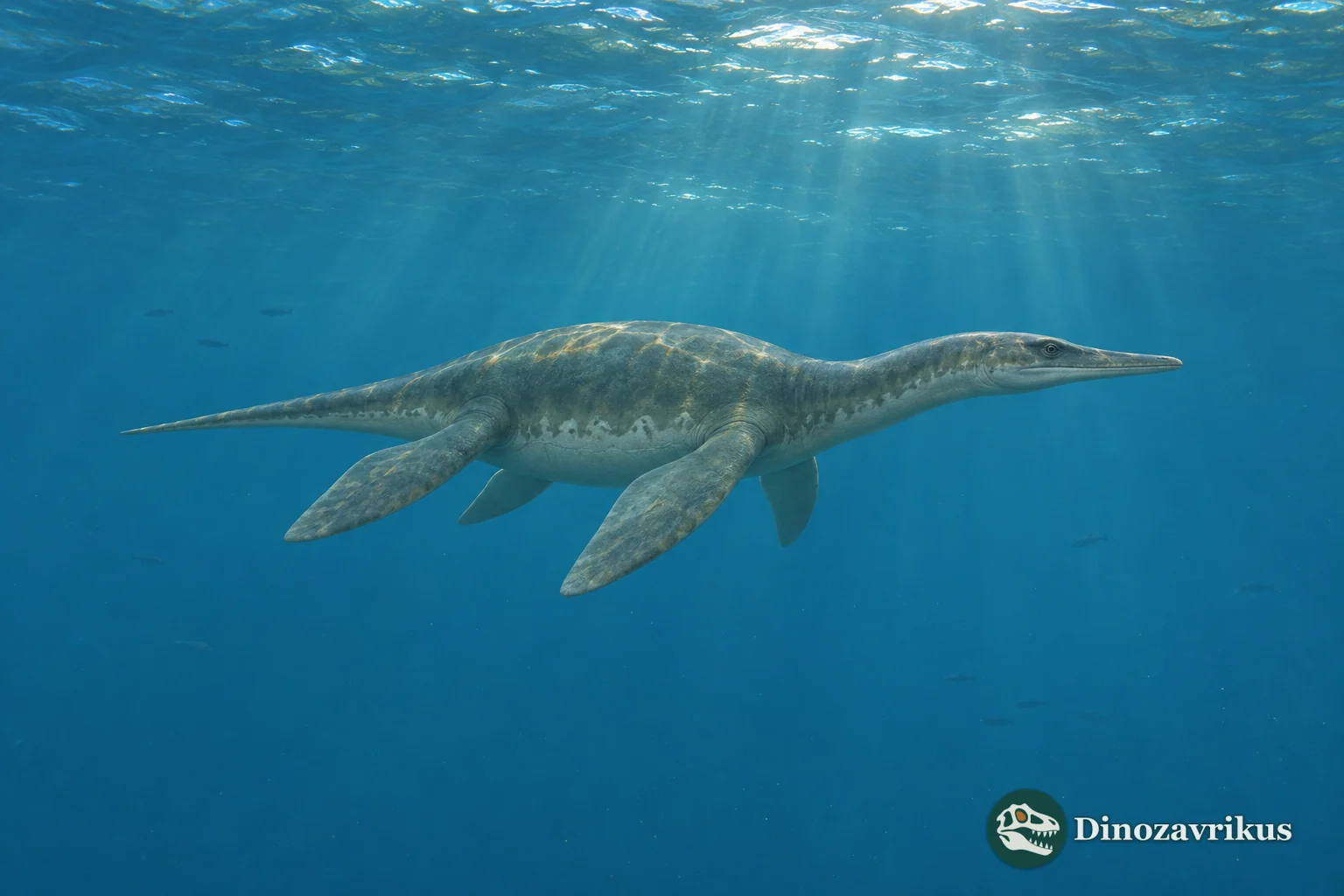
The Western Interior Seaway covered much of central North America during parts of the Late Cretaceous. Its marine deposits preserve fishes, invertebrates and several marine reptile groups. This context places Martinectes within a marine ecosystem; it does not by itself identify a particular prey item or show an interaction with every fossil found in the same formation.
The elongated skull and teeth can inform functional hypotheses about prey capture, but the available fossils do not provide a direct menu for the species. No evidence described here establishes skin colour, social behaviour or exact diving depth. Those details belong to reconstruction unless further direct evidence is discovered.
Martinectes matters both as a fossil animal and as a case study in taxonomic revision. The two specimens expand the anatomical record, while the 2024 work changes the genus assignment. Keeping those strands separate makes the description more precise than treating every older combination as a different species.
Frequently asked questions
Why was Martinectes once called Dolichorhynchops bonneri?
The species was described in Trinacromerum in 1997 and later transferred to Dolichorhynchops. A 2024 revision established Martinectes for bonneri.
Which fossils are assigned to Martinectes bonneri?
KUVP 40002 is an almost complete postcranial skeleton without a skull. KUVP 40001 preserves a skull and additional skeletal material; it is a separate individual.
How large was Martinectes?
One 2026 digital reconstruction estimated the KUVP 40002 individual at about 4.95 m long. This is a model-based estimate rather than a direct measurement of a complete skeleton.
Was Martinectes a dinosaur?
No. It was a marine plesiosaur in the family Polycotylidae, a different reptile lineage from dinosaurs.