

Matuku was a heron that lived in New Zealand roughly 19–16 million years ago. Its remains come from St Bathans in Central Otago, where Miocene deposits preserve a rich ancient lake fauna. Seven bones identify it as a heron, but do not yet establish which major living branch of the family was its closest relative.
Quick facts
| Family | Ardeidae |
|---|---|
| Region | Otago, South Island, New Zealand |
| Age | Early Miocene, about 19–16 million years ago |
| Described material | Seven bones from multiple individuals |
| Species named | Scofield, Worthy and Tennyson, 2010 |
What can the fossils tell us?
The left tarsometatarsus NMNZ S.50003 was collected on 9 January 2007. Its missing portions were considered when estimating total length.
Two quadrates and the front of a lower jaw were included in the description. There is no complete skull, but the evidence is not limited to legs.
The morphological analysis did not recover a well-supported position among the principal modern heron groups. Matuku should not simply be identified as a bittern.
Found in 2007, named in 2010
The holotype of Matuku otagoense was collected on 9 January 2007 at locality HH4 on Home Hills Station, on the true left bank of the Manuherikia River. R. Paul Scofield, Trevor Worthy and Alan Tennyson named the bird in a paper published in 2010. Matuku is a Māori word for heron, while the species name refers to Otago.
The specimen, NMNZ S.50003, is held at Te Papa in Wellington. It is a left tarsometatarsus preserving the lower end, shaft and part of the upper end. The bone was fragmented in the rock and had to be assembled and consolidated during laboratory preparation.
Six additional specimens from HH4, HH1a and HH1b include another tarsometatarsus, part of a right coracoid from the shoulder girdle, two left quadrates from the skull, the second neck vertebra and the front portion of a lower jaw. The repeated left quadrates demonstrate that more than one individual is represented. These are scattered remains, not a single articulated skeleton.
A relatively short and robust foot
The preserved length of the type tarsometatarsus is 92.6 mm, with a complete length estimated at approximately 98 mm. The latter is a reconstruction of one bone’s length, not a measured standing height. The authors considered Matuku a medium-sized heron; their description does not provide a secure body-mass estimate.
Compared with the elongated tarsometatarsi of many living herons in Ardea and Egretta, the bone is relatively short and robust. Its joints, grooves and openings allow more informative comparisons than a general resemblance in silhouette. A short tarsometatarsus alone does not demonstrate flightlessness or permanent occupation of dense vegetation.
The researchers compared 50 morphological characters. Anatomy supports assignment to the heron family, but their analysis did not establish a well-supported relationship with one of the main living branches. Matuku therefore cannot confidently be presented as an early bittern or a direct ancestor of a particular modern heron.
The shores of a large Miocene lake
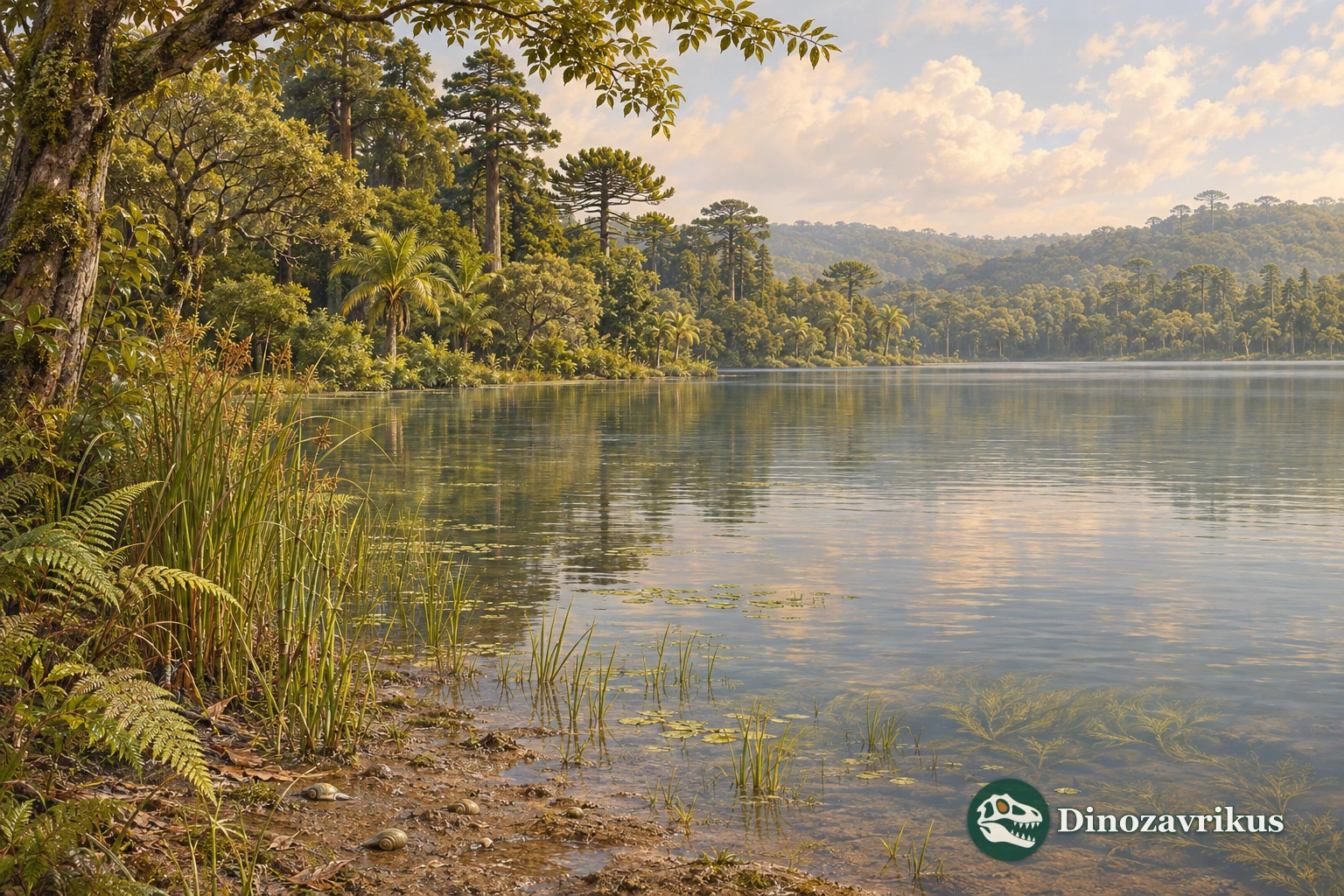
The bones come from the Bannockburn Formation, deposited in the ancient Lake Manuherikia system. The lake has been estimated to cover approximately 5,600 square kilometres. A warm climate supported forests containing palms, conifers and southern beeches, while shallow margins provided habitats for numerous waterbirds.
Ducks, including Manuherikia, belonged to the same broader assemblage. The presence of both herons and ducks illustrates the diversity of the lake fauna, but does not mean that they shared identical diets. By comparison with other herons, Matuku probably sought small aquatic animals in shallow water. No stomach contents or equivalent direct evidence identify its particular prey.
Parts of the jaw, neck, shoulder girdle and leg provide a basis for a cautious general heron reconstruction. Feathers and their pigmentation are unknown, so the colours in the illustration are artistic choices. Its lakeside pose similarly represents a plausible scene rather than a documented behavioural event.
Frequently asked questions
Is Matuku the living Australasian bittern?
No. This profile concerns the fossil genus Matuku, named from Miocene bones. A similar word occurs in Māori names for living herons, but that does not make them the same species.
Is the bird known only from one leg?
No. The original description includes seven bones, with skull elements, a neck vertebra and part of the shoulder girdle as well as foot bones.
How tall was Matuku?
A precise standing height is unavailable. It was described as a medium-sized heron; the estimate of about 98 mm applies only to the type tarsometatarsus.
Why does it matter for New Zealand’s history?
The fossils establish herons in the country’s Early Miocene lake fauna. Matuku’s closer relationships with living heron groups remain unresolved.