

Megacephalosaurus eulerti was a large pliosaurid in the Cretaceous sea that covered what is now Kansas. Its type specimen preserves a nearly complete skull more than 1.5 metres long and a limited amount of anterior cervical material. Re-examination of a museum fossil once labelled as another pliosaur led to the description of a new genus in 2013. The skull is directly measurable, while the animal’s total length is a comparison-based estimate.
Quick facts
| Type species | Megacephalosaurus eulerti |
|---|---|
| Group | Pliosaurid plesiosaur |
| Age | Late Cretaceous; middle Turonian |
| Locality | Fairport area, Russell County, Kansas, USA |
| Formation | Fairport Chalk Member, Carlile Shale |
| Holotype | FHSM VP-321, large skull and anterior cervical material |
| Adult skull | More than 1.5 metres long |
| Estimated total length | About 6–9 metres in the 2013 study; not directly measured |
Evidence guide
Holotype FHSM VP-321 preserves a nearly complete large skull with the mandible and some anterior cervical elements. Cranial features distinguish it from Brachauchenius, but do not directly measure the missing body.
Found in 1950, the material was initially identified as a mosasaur and later labelled Brachauchenius lucasi. Re-examination of photographs and further preparation revealed distinctive cranial anatomy; the new genus was formally described in 2013.
The type material includes anterior cervical elements, including double-headed cervical ribs. The limited postcranial record does not establish the exact proportions of the trunk, paddles or tail.
The 2013 authors suggested a total length of about 6–9 metres by comparing skull proportions with other pliosaurids. They noted that body proportions are difficult to reconstruct from an incomplete skeleton, so this is not a direct measurement.
The holotype is from the Fairport Chalk Member of the Carlile Shale, about 12 metres above the Fencepost Limestone. Its early middle Turonian age follows the stratigraphic position and regional correlation, not a direct date on the bone.
A museum fossil that waited for a closer look
The fossil was discovered in 1950 near Fairport in Russell County, Kansas. The 2013 description credits Frank and Robert Jennrich with finding it and George F. Sternberg and others with assisting the excavation. Landowner Otto C. Eulert donated the material to the museum. The Sternberg Museum now catalogues the type specimen as FHSM VP-321.
The bones were first mistaken for a mosasaur and later labelled Brachauchenius lucasi. In 2007, researchers revisited photographs of the original find and further prepared the specimen. Additional cranial details showed that the fossil did not fit the existing identification. Kenneth Schumacher, Kenneth Carpenter and Michael Everhart formally named Megacephalosaurus eulerti in 2013. The species name honours Eulert, who donated the fossil.
The skull and the limited neck material
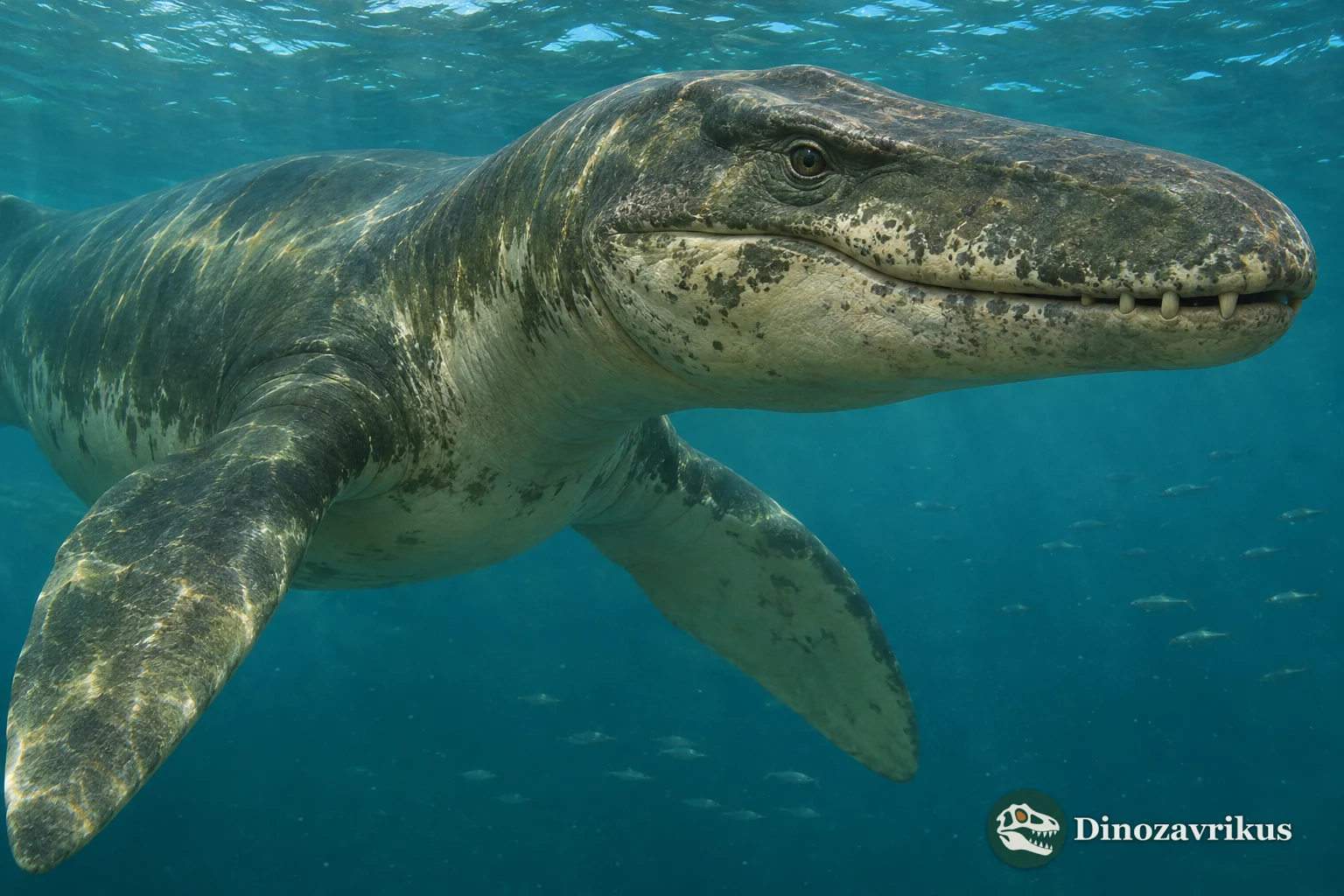
Holotype FHSM VP-321 consists of a nearly complete skull with the lower jaws and associated anterior neck elements. The adult skull exceeds 1.5 metres in length. The authors distinguished it from Brachauchenius using a combination of features in the skull roof and palate. The anterior cervical material includes double-headed cervical ribs, another directly observable anatomical feature.
A referred specimen, USNM 50136, is a fragmentary skull about 1.75 metres long. Its precise locality is unknown, and a Kansas origin has been reported rather than securely documented. It should therefore remain separate from the type locality record; its dimensions cannot turn the holotype into a complete measured skeleton.
Why the genus was separated from Brachauchenius
The early museum label reflected an initial interpretation of a fossil that had not yet been fully prepared or compared. Later work exposed more of the skull, allowing researchers to compare the palate and skull roof with the type material of Brachauchenius. The distinctive character combination supported a separate genus and species.
Later phylogenetic analyses have not resolved every relationship among pliosaurids. A 2019 study noted that relationships within the group can remain unstable across different character sets. That uncertainty does not erase the diagnostic anatomy of Megacephalosaurus, but it does mean the genus should not be assigned a single unquestioned position on an evolutionary tree. Compare its robust skull with the different evidence available for long-necked plesiosaurs such as Elasmosaurus and Libonectes.
How large was the animal?
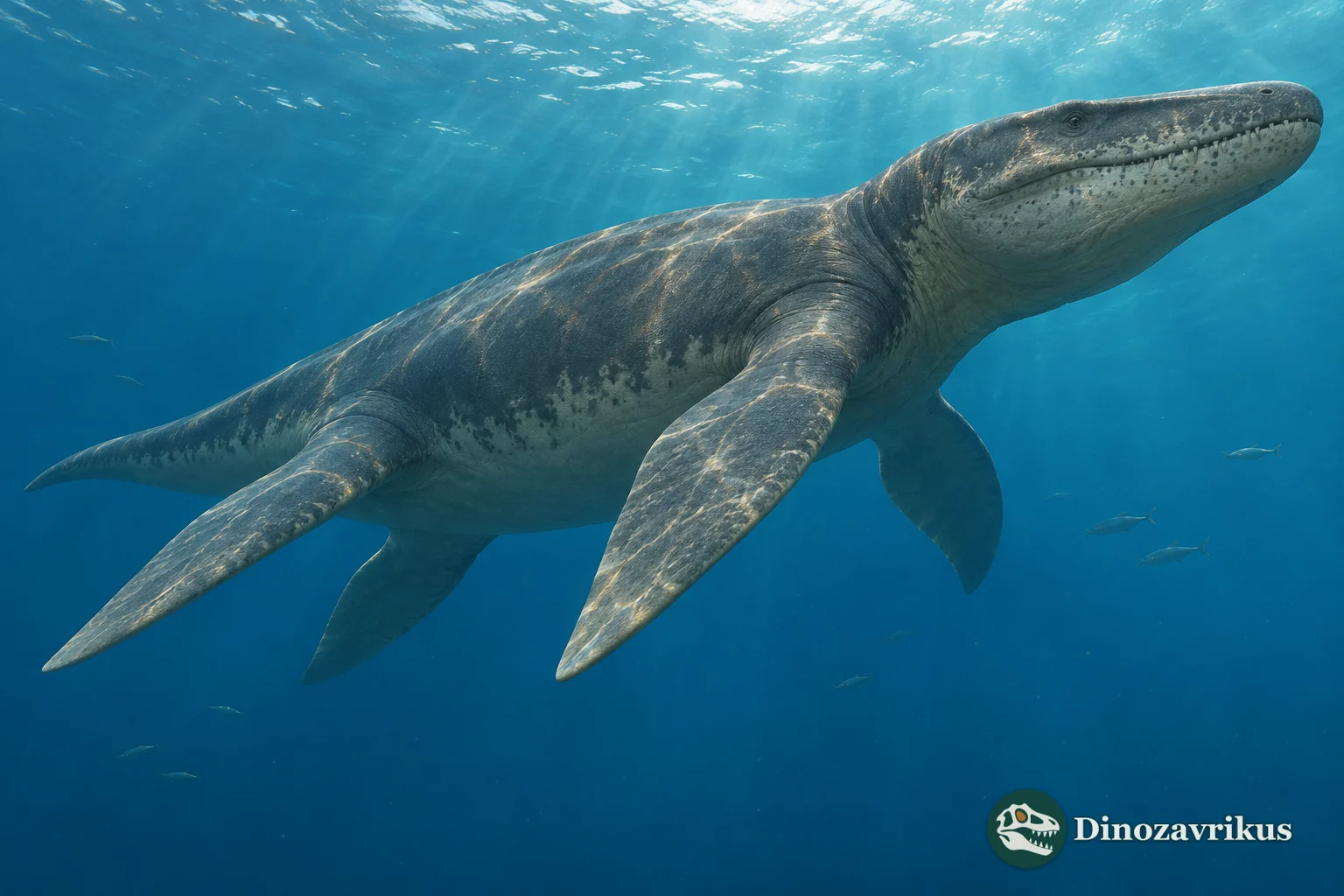
The most secure size measurement belongs to the skull, which is longer than 1.5 metres in the adult type material. Schumacher and colleagues proposed a total body length of roughly 6–9 metres by comparing skull proportions with other pliosaurids. They cautioned that reliable body proportions are difficult to determine from incomplete skeletons. The range is therefore a published comparative estimate, not a tape measurement of an intact Megacephalosaurus.
No direct body mass, exact paddle proportions or complete trunk outline can be established from the known fossils. Nor do they preserve colour or soft tissues. Sharp teeth and the robust skull are consistent with a predatory marine reptile, but no associated prey or stomach contents identify what this species ate.
A pliosaur in the middle Turonian sea
The type locality lies in the Fairport Chalk Member of the Carlile Shale, about 12 metres above the Fencepost Limestone. Regional stratigraphy places it in the early part of the middle Turonian Stage, during the Late Cretaceous. The age comes from the rock sequence and its correlation, not a direct radiometric date on the fossil.
At that time, the Western Interior Seaway extended across central North America. The Kansas fossil documents a large pliosaurid in that marine setting, but it does not reveal how far the individual travelled, its swimming performance or its preferred prey. Growth, reproduction and pathologies have not been established for the known material.
Frequently asked questions
Where was the type fossil found?
It was discovered near Fairport in Russell County, Kansas, in the Fairport Chalk Member of the Carlile Shale. The type specimen is held by the Sternberg Museum as FHSM VP-321.
Why was it first identified as Brachauchenius?
The fossil was initially known from limited views and preparation. Re-examination of photographs and further preparation revealed skull differences, leading to the formal description of a separate genus in 2013.
How long was Megacephalosaurus?
The adult type skull is more than 1.5 metres long. The 2013 authors estimated a total length of about 6–9 metres by comparison with other pliosaurids, but a complete skeleton is not known.
What did it eat?
Its robust skull and teeth are consistent with a predatory marine reptile. No stomach contents or prey preserved with the fossil identify a particular diet.