

Megacerops was a large late Eocene perissodactyl known from abundant fossils in western North America. Its massive skull carried a pair of bony bosses above the nose. Although often pictured as a two-horned rhinoceros, it was not a rhino: it belonged to the separate family Brontotheriidae.
The familiar name Brontotherium, used in older books and museum displays, is generally treated as a synonym of Megacerops in revisions of the Chadronian brontotheres. This profile follows the later genus name while explaining that history. It belongs in the ancient mammal catalogue as a distinct late Eocene lineage.
Quick facts
| Scientific name | Megacerops coloradensis Leidy, 1870 and related species |
|---|---|
| Historical name | Brontotherium Marsh, 1873; generally treated as a synonym of Megacerops |
| Group | Perissodactyla, family Brontotheriidae |
| Age | Late Eocene, Chadronian North American land-mammal age |
| Range | Western North America, including the United States and southern Canada |
| Main deposits | Chadron Formation, White River Group |
| Known remains | Skulls, jaws, teeth, vertebrae, pelvis and limb bones |
| Diet | Herbivorous; dental anatomy indicates plant processing |
What can the fossils tell us?
Nineteenth-century workers erected several genera from skull and tooth differences. Later revisions grouped much Chadronian material in Megacerops, while species-level questions still depend on type specimens and stratigraphic context.
Fossil skulls show paired frontonasal bony appendages and expanded cheek arches. They record bone shape and variation, not the soft covering or exact function of the structures.
Brontothere molars have a characteristic enamel-ridge pattern. Teeth and limb anatomy support classification and plant processing, but do not preserve a complete menu or seasonal feeding pattern.
Large samples show variation in boss size and skull proportions. Sexual dimorphism and individual variation may explain some differences; behaviour cannot be read directly from a single skull.
Why Brontotherium is called Megacerops
Nineteenth-century paleontologists collected many skulls and bones from rich North American deposits. With fewer comparative specimens than researchers have today, they often interpreted differences in teeth, skull proportions or bony bosses as evidence for separate genera. Names including Brontotherium, Menodus, Titanotherium and Brontops accumulated.
Joseph Leidy established Megacerops in 1870; Othniel Charles Marsh introduced Brontotherium in 1873. Later revisions grouped much of the late Eocene Chadronian material under the earlier available name Megacerops. Museum databases may preserve old identifications as synonyms or historical determinations. A specimen label reading “Brontotherium” therefore does not necessarily identify a separate genus under current usage.
The genus-level interpretation does not settle every species question. Some names are based on fragmentary material, and the diagnostic value of skull and tooth differences has been revised. A robust identification compares type specimens, geological layers and large samples rather than relying on one horn shape.
Skull, bosses and teeth
The skull combined a relatively short face with an elongated rear portion and broad, powerful cheek arches. Two bony bosses rose from the frontonasal region, giving the animal its characteristic paired outline. The bones are fossil evidence; the soft covering over them and their exact appearance in life are not preserved.
The bosses vary in size and shape. Early workers used this variation to name additional species and genera. Large samples from related horizons changed the interpretation: age, sexual dimorphism and individual variation could account for some of the differences. Larger bosses may have been more common in males, but that is an inference from a population pattern, not a reliable sex assignment for every skull.
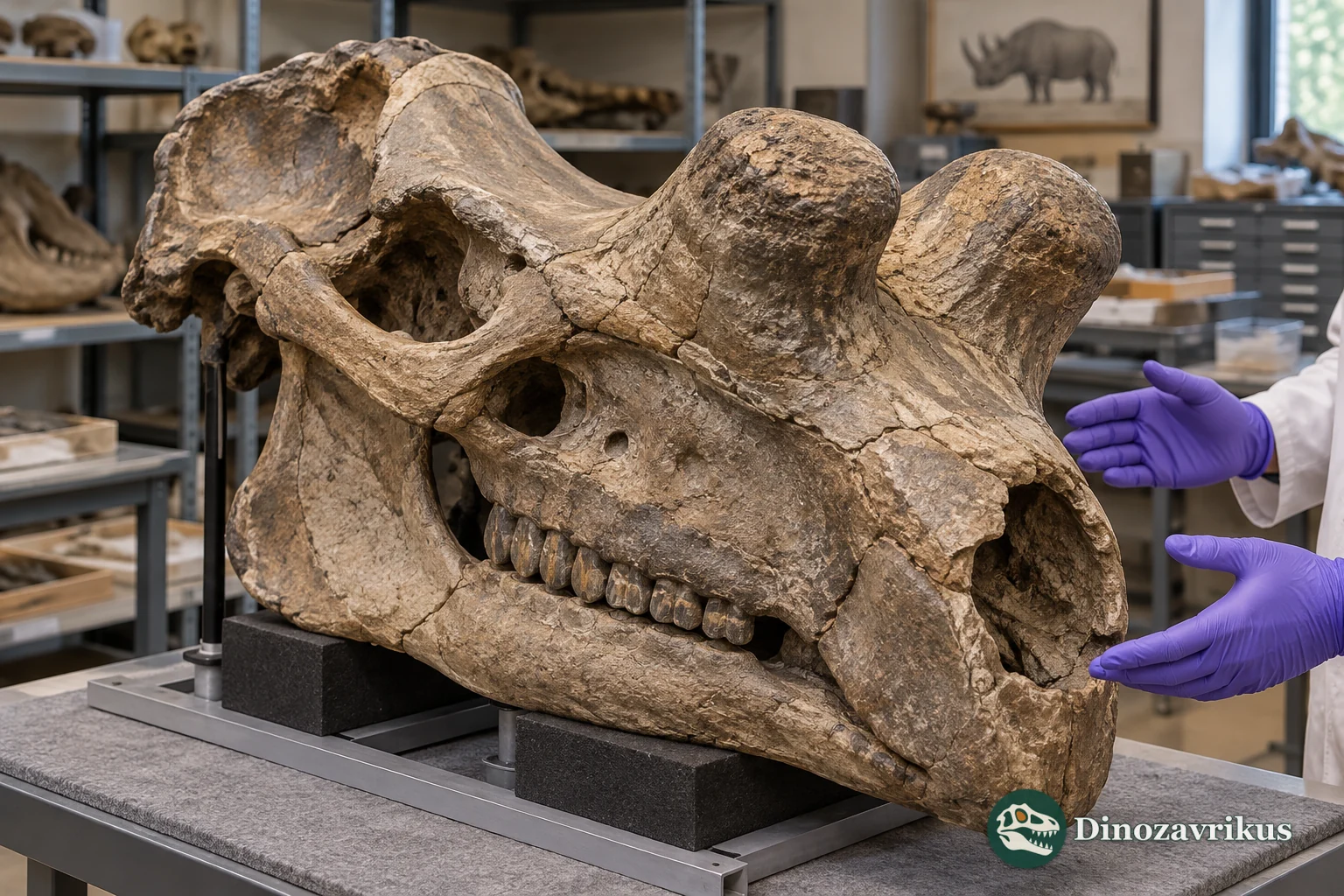
Teeth support the placement of brontotheres among perissodactyls and indicate processing of plant food. Their upper molars have a characteristic pattern of enamel ridges. Dental anatomy, jaw structure and limb proportions help reconstruct feeding, but they do not preserve a precise list of plants or seasonal preferences.
Age, localities and collections
Megacerops is especially associated with the late Eocene Chadron Formation of the White River Group. Numerous remains come from Nebraska, South Dakota, Wyoming and neighbouring areas. A Smithsonian National Museum of Natural History collection record for Megacerops coloradensis includes a complete skull, teeth and parts of the vertebral column, pelvis and limbs. The record places the material in the Chadron Formation and documents collection by John B. Hatcher in Sioux County, Nebraska, in 1887.
A museum record describes a particular object and its known provenance; it does not mean that all bones assigned to the species were found together. Some early expedition material has imprecise horizon data. Modern revisions therefore compare specimens with locality and stratigraphic information rather than assembling every similar bone into a single skeleton or population.
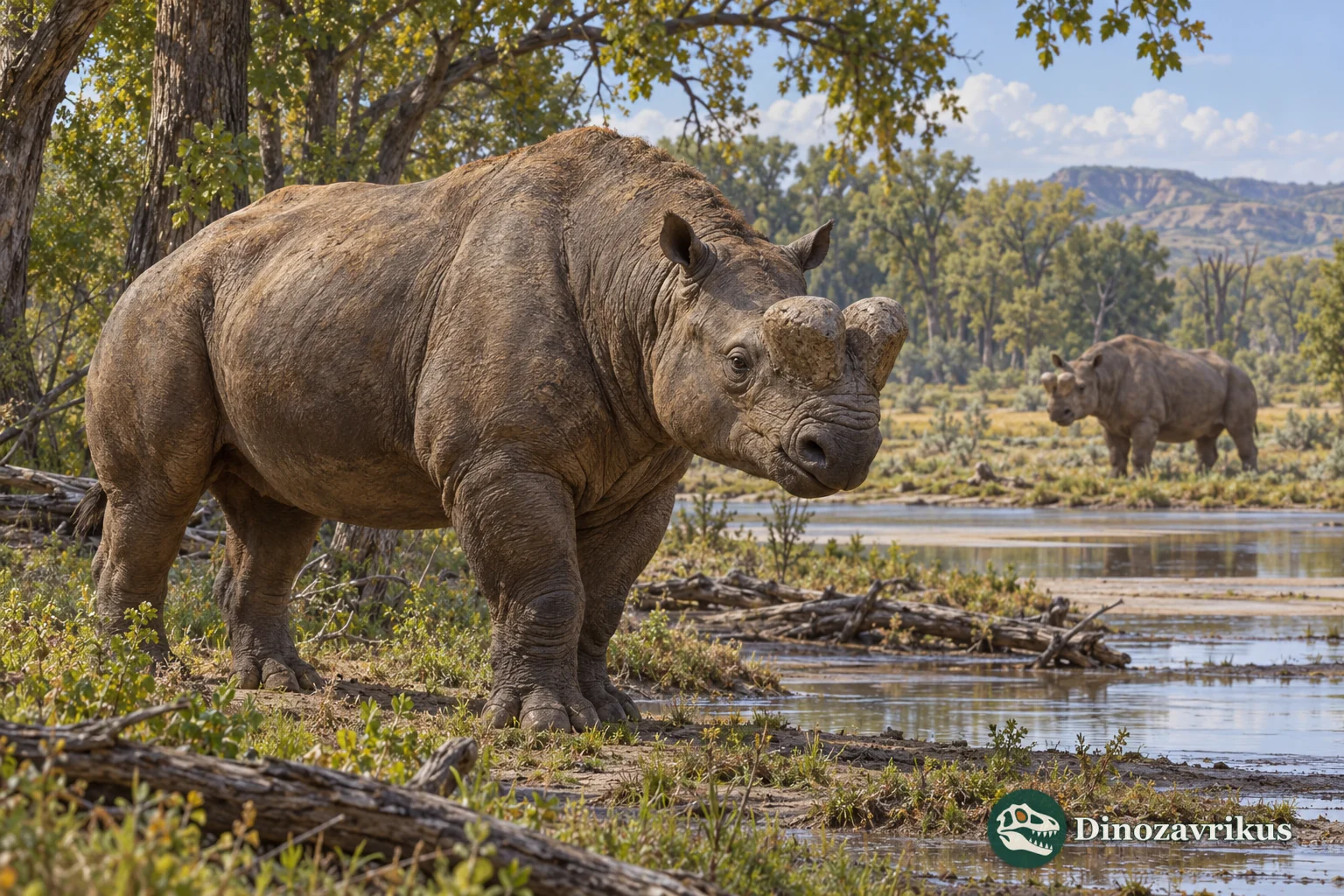
North American brontotheres disappeared near the Eocene–Oligocene transition. Megacerops is regarded as the last large representative of its North American branch. The timing coincides with major environmental changes, but chronology alone does not establish one cause for the genus’s disappearance.
Size and possible behaviour
Megacerops is often described as elephant-sized. The comparison conveys the mass of late brontotheres, but exact height and body mass depend on the species and skeleton being reconstructed. A skull or limb bone gives measurements of that element; whole-body estimates rely on comparison and allometric models.
A heavy trunk, robust limbs and plant-processing teeth fit a large herbivore. The evidence does not establish whether individuals lived alone or in groups. Healed injuries and variation in the bosses have been discussed in connection with contact between adults; the structures may have played roles in display or competition. Such interpretations remain hypotheses because fossils do not preserve the interactions themselves.
Megacerops formed one branch of a diverse perissodactyl history. The early brontothere Eotitanops was much smaller and lacked massive bosses, but the sequence of fossils does not prove that it was a direct ancestor. The old picture of one steady transformation from a small horse-like animal to a giant horned form has been replaced by a branching pattern with contemporaneous lineages of different sizes and anatomy. This branching history is part of the wider story of the Palaeogene.
Frequently asked questions
Are Brontotherium and Megacerops the same?
In a widely used revision of late Eocene North American brontotheres, Brontotherium is treated as a junior synonym of Megacerops. Older publications and collection records may use both names for related material.
Was Megacerops a rhinoceros?
No. It was a perissodactyl, but it belonged to the distinct family Brontotheriidae, not Rhinocerotidae. Its broad resemblance comes from its massive body and prominent skull bosses.
What were the paired bosses used for?
The exact function is unknown. Display or competition between adults are possible explanations based on variation and comparisons with living hoofed mammals, but these are inferences rather than direct observations.
Was Megacerops an ancestor of modern horses?
No. It belonged to an extinct perissodactyl branch. Its relationship to horses is distant within the order, not a direct ancestor–descendant relationship.