

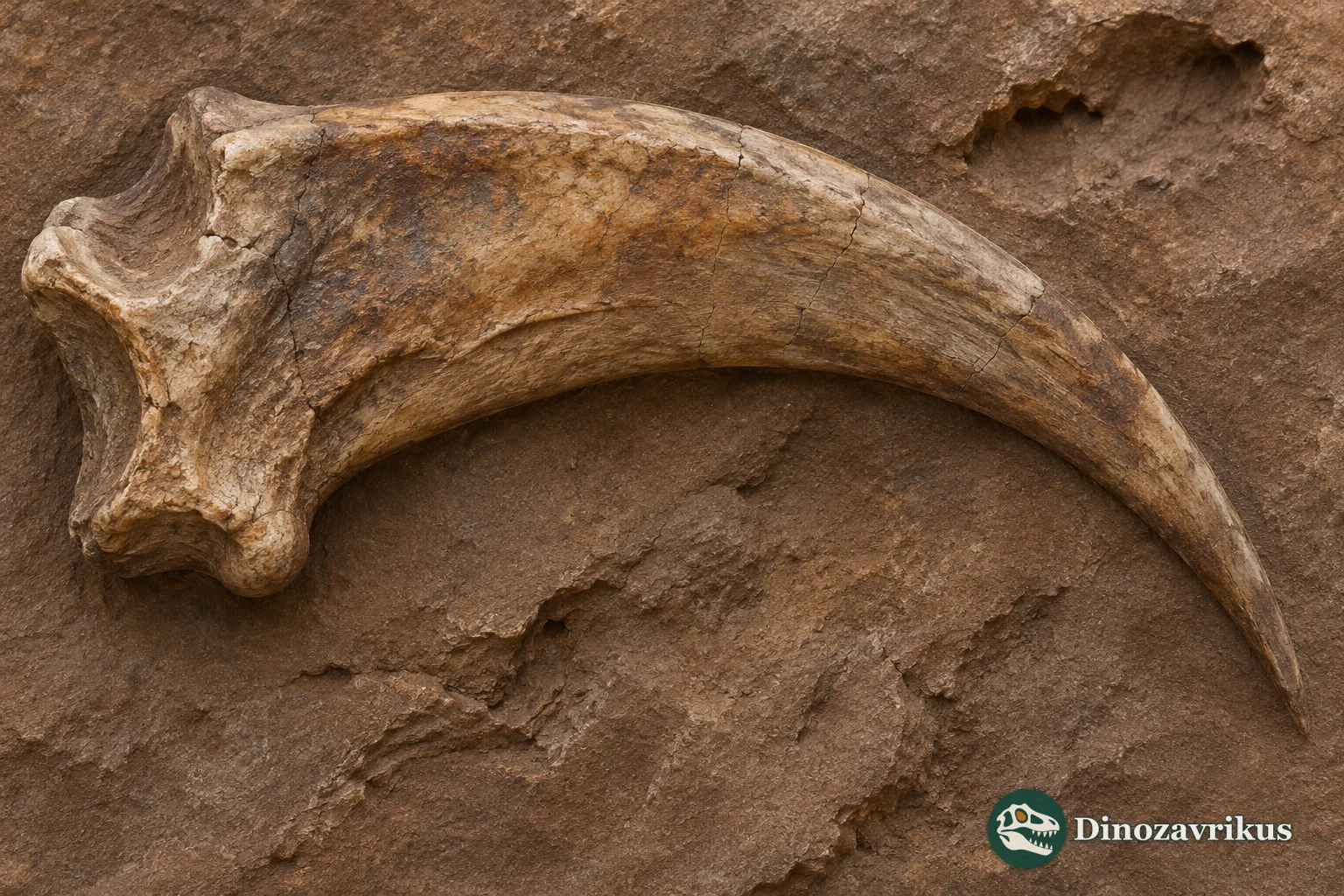
Megaraptor was a large predatory dinosaur from Late Cretaceous Patagonia. For years its most recognisable bone seemed to be a giant version of the sickle-shaped toe claw found in dromaeosaurs. The discovery of a forearm with an articulated hand changed the reconstruction. The corresponding claw was still attached to the innermost digit of the hand.
Quick facts
| Group | Theropods, megaraptorids (Megaraptoridae) |
|---|---|
| Age | Late Cretaceous (late Turonian to early Coniacian) |
| Region | South America (Neuquén Province, Argentina) |
| Diet | Carnivorous theropod |
| Type species | Megaraptor namunhuaiquii |
| Holotype | MCF-PVPH 79, four disarticulated skeletal elements |
| Deposits | Portezuelo Formation |
What can the fossils tell us?
The bones of forearm MUCPv 341 remain together. The matching ungual occupies the first finger. The preserved articulation does not reveal how the animal used the claw to grip prey.
The partial skull of MUCPv 595 preserves part of the elongated snout and bones from the skull roof. Adult skull proportions may have changed as the animal matured.
Microscope sections of the young skeleton contain growth marks and signs of active growth. Its estimated length captures an early stage of growth. Maximum adult size remains uncertain.
The original claw from Neuquén
Fernando Novas established Megaraptor namunhuaiquii in 1998 using MCF-PVPH 79 from Sierra del Portezuelo, now housed at Museo Carmen Funes in Plaza Huincul. The holotype contains a right ulna, a finger bone, part of the third metatarsal and the large bony claw core. Its position on the animal originally had to be inferred from the shape of an isolated element.
Novas attributed the claw to the second toe. Jorge Calvo, Juan Porfiri and colleagues described a second specimen, MUCPv 341, in 2004. On the north shore of Lago Los Barreales, the ulna, radius and hand had survived in articulation in red clay. The matching claw at the end of the first finger overturned the original placement.
The inside of the hand
The first metacarpal and the base of the first finger are unusually long. The bony first claw is compressed from side to side, with a narrow underside. A sheath covered the bone in life and its full extent is unknown. Australovenator has similar enlargements on the inner side of its hand but differs in details of the finger bones and their joints.
Such claws could have helped injure or hold prey. Neither their shape nor their joints preserve the sequence of movements during an attack. Fish, turtles and crocodyliform fossils from the same quarry document nearby animals. Their presence alone leaves the actual diet unresolved.
From a small skull to adult proportions
A partial skeleton named MUCPv 595 supplied the first substantial skull material. Porfiri and colleagues described its long snout and surviving bones from the roof of the skull in 2014. Sections of bone under the microscope showed that the animal was still growing. The authors estimated that it was about six years old.
The youngster's shoulder blade measures 19.8 centimetres. The corresponding bone in the larger MUCPv 341 is 44.3 centimetres long. Scaling the young specimen against Allosaurus gave an estimated length of around three metres, while the paper cited nine to ten metres for large material such as the holotype. Both lengths depend on how missing parts of the body and tail are reconstructed.
The river deposits and a disputed family tree
The Portezuelo Formation preserves deposits from rivers crossing what is now northern Patagonia. At the Los Barreales quarry, titanosaurs and smaller dinosaurs such as Unenlagia occur in the same beds. Some bones assigned to MUCPv 341 lay a few metres away from the articulated hand. The authors associated them by anatomy and size, so the connection is less direct for those isolated pieces.
Megaraptor gave its name to the Megaraptoridae. Researchers have placed this family near allosauroids or among coelurosaurs, including proposed positions near or within Tyrannosauroidea. The juvenile skull supplied new evidence favouring coelurosaur affinities. Comparisons of the hand and the use of different analytical datasets explain why the broader relationship remains open to debate.
Frequently asked questions
When did Megaraptor live?
Its material comes from the Late Cretaceous Portezuelo Formation in Neuquén. The fossil-bearing beds are assigned to the late Turonian and early Coniacian.
Where was its largest claw?
It grew on the first finger of the hand. An articulated forelimb from Lago Los Barreales preserves the position directly.
Was Megaraptor a dromaeosaur?
The original claw was compared with dromaeosaur toe claws. Further fossils place Megaraptor in its own family of predatory dinosaurs, the Megaraptoridae.
What makes adult length difficult to estimate?
The large specimens preserve only parts of the skeleton. The relatively informative skull belongs to a growing individual, and estimates of adult length must fill in large missing sections.