

Mehliella jeffersonensis is the name of a fossil trackway from Cretaceous rocks near Golden, Colorado. A surviving cast records the left hind foot, with four toes. Historical drawings also show forefoot impressions and a groove attributed to the tail.
Quick facts
| Type of fossil | Footprint trackway |
|---|---|
| Age | Early Cretaceous |
| Locality | Near Golden, Colorado, United States |
| Rock unit | Dakota Group sandstone |
| Measured footprint | 23.5 × 15 cm in the cast |
| Probable maker | Crocodyliform of unknown genus |
What can the fossils tell us?
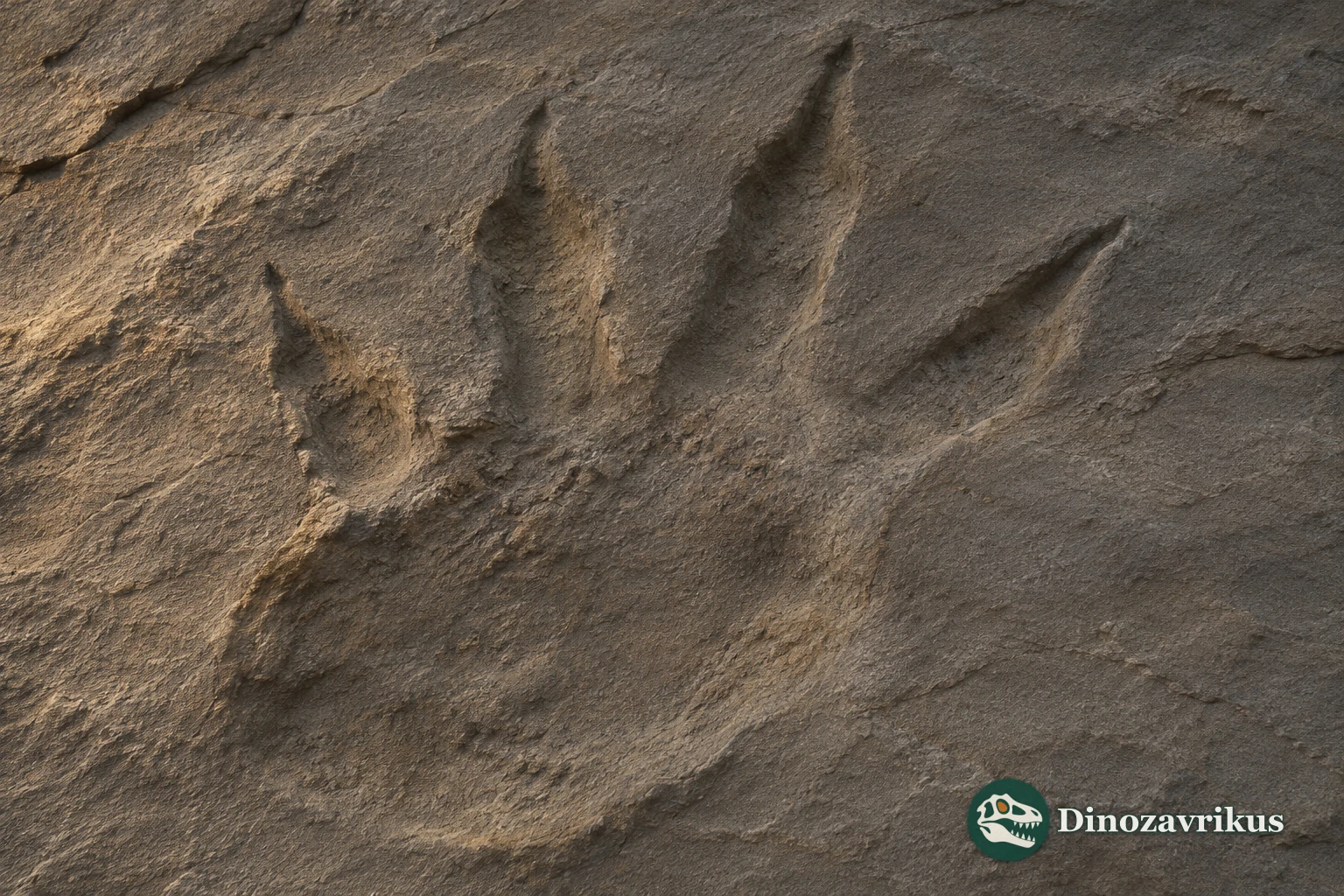
Four toes are visible. The impression reproduced in the cast is 23.5 cm long and 15 cm wide.
The drawings include forefoot and hind-foot tracks and a long groove. The pattern provides evidence of how the animal moved across the sediment.
The original description put the beds high in the Dakota sandstone succession. A correlation with the Muddy Formation is possible.
How the trackway acquired its name
Maurice Mehl described the trackway from near Golden in 1931 as Walteria jeffersonensis. The genus name was already in use for a sponge. Embrik Strand published the replacement name Mehliella in 1932. Both names refer to the same form of trace fossil.
The first description and the surviving cast preserve different parts of the evidence. The historical drawings show the arrangement of the tracks. The relocated cast allowed researchers to measure a single impression independently.
Reading the preserved impression
The cast preserves a left hind-foot impression with four toes. It measures 23.5 cm long and 15 cm wide. The rest of the trackway is studied through the early figures, which record forefoot and hind-foot impressions and a groove running between them.
The sequence of forefoot and hind-foot impressions was interpreted as walking, with the tail sometimes touching the surface. In the Jurassic track form Hatcherichnus, some impressions may instead record discrete contacts with the bed in shallow water. The positions of the marks are important to both interpretations.
The beds and the trackmaker
Mehl recorded the tracks in the upper part of the Dakota sandstone succession. A more recent assessment suggested that the bed could belong to the Muddy Formation, which records rivers, coastal plains and estuaries in the region. The original specimen’s position cannot be fixed more precisely from the surviving locality information.
The shape and arrangement of the footprints support a crocodyliform trackmaker. Assigning the track to a genus named from bones would require a much more direct connection. A single footprint also provides a limited basis for estimating total body length.
Frequently asked questions
Was Mehliella the name of an animal?
It is an ichnogenus, a name for a particular form of trace fossil. The biological genus of its trackmaker is unknown.
How large is the surviving footprint?
The cast of the left hind-foot impression measures 23.5 cm long and 15 cm wide.
Why is the name Walteria sometimes used?
That was the original name for the trackway. It had already been used for a sponge, so Mehliella was introduced in 1932 as a replacement.
Where were the tracks found?
They were described near Golden, Colorado, from the upper part of the Cretaceous Dakota sandstone succession.