

Meiolania was a genus of extinct turtles from Australia and islands of the southwest Pacific. Its skull carried prominent bony horns, while rings of bone protected its tail. The best-known species, Meiolania platyceps, lived on Lord Howe Island during the Pleistocene. These striking bones reveal anatomy, but they do not by themselves tell us how the animal behaved or what it ate.
Meiolania belongs in the Other fossil reptiles catalogue. The genus should not be confused with Ninjemys, a separate horned turtle that was once called Meiolania oweni.
Quick facts
| Scientific name | Meiolania Owen, 1886 |
|---|---|
| Type species | Meiolania platyceps Owen, 1886 |
| Group | Turtles, family Meiolaniidae |
| Age | Miocene to Pleistocene across the genus; species ranges differ |
| Range | Australia and southwest Pacific islands |
| Evidence | Skulls, shell bones, limbs, tail rings and fossil eggs |
What can the fossils tell us?
Richard Owen named Meiolania platyceps in 1886 from incomplete skull material from Lord Howe Island, now catalogued as BMNH R.675. Owen initially compared the animal with lizards; later anatomical work established that it was a turtle. The type fixes the species name, while the much larger comparative record comes from other individuals.
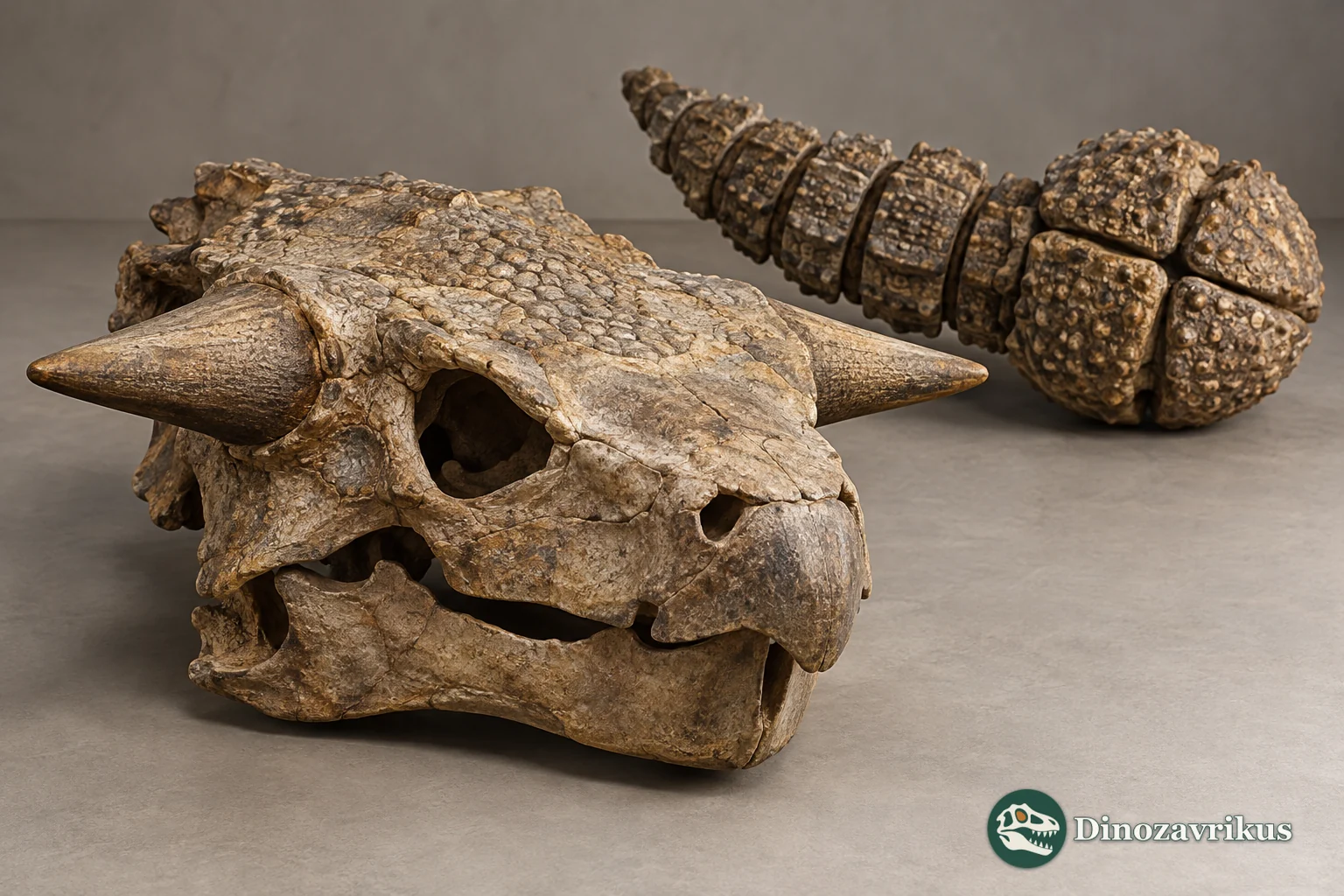
Cranial horns, bony tail rings and a spined terminal region are preserved in fossils. A near-complete shell reconstruction combines partial and disarticulated bones from several individuals. The bones establish the unusual anatomy but cannot reveal exactly how the horns or tail were used.
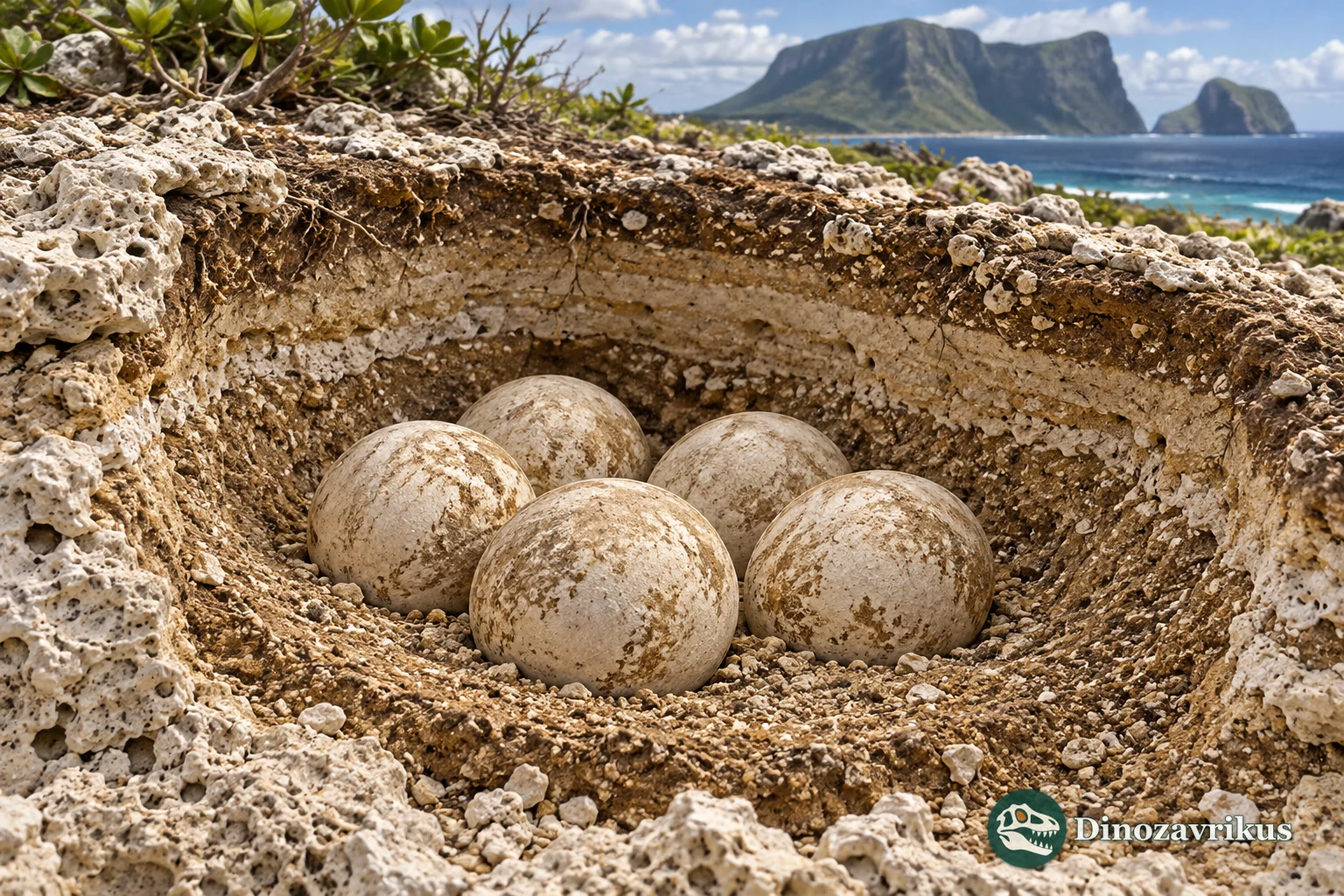
A fossil clutch assigned to Meiolania platyceps contains nearly spherical eggs about 5.4 cm across. Eggshell structure and at least two overlapping layers led researchers to infer a hole nest. The nest itself does not preserve egg-laying behaviour, typical clutch size or parental care.
Discovery and naming
Fossils from Lord Howe Island reached London after geological surveys of the island in the nineteenth century. Richard Owen named Meiolania platyceps in 1886 from an incomplete skull, specimen BMNH R.675. In the same paper he named M. minor, later treated as a junior synonym of M. platyceps. Thomas Henry Huxley recognised the material as a turtle and proposed Ceratochelys sthenurus for the type skull. Because it was based on the same specimen, that name is an objective junior synonym, not a separate species.
Owen first compared the horned skull with large lizards. Huxley’s recognition of turtle anatomy was followed by detailed studies of skull, vertebrae, shell and limbs. Eugene Gaffney’s monographs combined material from many specimens to document the best-known species. A reconstructed skeleton therefore represents a composite, not necessarily one articulated animal.
Species and taxonomic limits
M. platyceps from Lord Howe Island is the most completely known species. The Miocene M. brevicollis from northern Australia is based on fragmentary material, including a right squamosal as its type specimen. Fossils from Walpole Island in New Caledonia were named M. mackayi, but the limited material has made its distinctness difficult to assess.
The old name M. oweni does not refer to a currently accepted species of Meiolania. The Queensland turtle was separated as the genus Ninjemys. This history shows why every isolated horn or limb bone cannot be assigned confidently to the same species.
Age and localities
The genus spans Miocene to Pleistocene deposits, but this range combines different species and does not describe a single uninterrupted population. M. brevicollis comes from Miocene deposits on mainland Australia, whereas abundant remains of M. platyceps occur in Pleistocene calcareous sands and calcarenites on Lord Howe Island. Other island finds have their own dating and taxonomic uncertainties.
Some Lord Howe calcarenites formed from beach sand and reef-derived carbonate. Dating of coral and sand in one deposit points to beach formation during the last interglacial, about 136,000 years ago. That dates the sedimentary unit, not the exact death of every turtle fossil in it. Bones may have been moved and accumulated with other remains.
Skull, shell and tail
The skull carried several pairs of bony projections. The most conspicuous lateral horns arose near the back of the head, and their shapes varied across meiolaniids. The skull still had the beaked, toothless mouth of a turtle; the horns do not make it a lizard or a dinosaur.
Researchers reconstructed the shell of M. platyceps from separate carapace and plastron bones. It was domed, though less highly arched than the shells of many living land tortoises. Shell elements varied in thickness, with stronger margins around thinner central regions. A complete-looking shell is assembled from fossils of multiple individuals.
Vertebrae and bony rings protected the tail, which ended in a heavy spined region. These structures are direct fossil evidence. Whether they served in defence, display or interactions between individuals remains unknown; bones alone cannot demonstrate tail blows or horn-locking contests.
Size and movement
M. platyceps was larger than most living turtles. Shell bones and limb proportions indicate a broad-bodied animal with sturdy legs. Published total-length claims depend on how the reconstructed head and tail are counted, so a single precise body length is misleading. Measurements of preserved bones are more secure than a complete-body estimate.
Clawed feet and limb bones are unlike the flippers of sea turtles. The anatomy and fossil settings support a terrestrial way of life. How different meiolaniids reached distant islands is a separate question. A modern review considers a terrestrial ecology best supported, while the exact dispersal route of each population is not preserved.
Diet and island ecology
No preserved meal identifies the plants eaten by Meiolania. A beak and land-turtle anatomy are compatible with plant feeding, but the exact diet is unknown. Seeds or other organisms found nearby do not prove that they were food. The skull horns are not evidence of carnivory.
Lord Howe deposits contain M. platyceps remains alongside birds, land snails and marine organisms. This helps reconstruct the deposits and their setting, but it does not necessarily represent one living community at one moment. A coastal fossil bed can preserve a terrestrial turtle without implying that it lived in a lagoon.
Eggs, growth and reproduction
A fossil clutch from Lord Howe provides rare evidence of reproduction. The nearly spherical eggs measured about 5.4 cm across and had eggshell around 0.8 mm thick. Microscopy identified radiating acicular aragonite crystals. The authors assigned the clutch to the egg species Testudoolithus lordhowensis and linked it to M. platyceps.
At least two layers of eggs overlapped. Their arrangement and calculated gas conductance support the inference that eggs were buried in a hole nest. This is a research interpretation, not a directly observed nest. The usual clutch size, incubation time, growth rate and parental care remain unknown. Fossil bones include different sizes, but they do not provide a complete growth curve.
Extinction
The genus disappeared, but its final date cannot be assigned to one species from all localities. M. platyceps is known from Pleistocene Lord Howe deposits, where the ages of surrounding layers do not always directly date the bones. Postglacial sea-level rise may have changed island habitat area and access to shallow platforms, but it is a possible ecological factor, not a proven single cause.
There is no established evidence that people hunted M. platyceps on Lord Howe. Its disappearance should not automatically be attributed to hunting or explained using evidence from other Pacific meiolaniids. Each island population has to be considered separately.
Frequently asked questions
Was Meiolania a dinosaur?
No. It was an extinct turtle in the family Meiolaniidae. Its horns and armoured tail are unusual turtle anatomy, not dinosaur or lizard features.
What were Meiolania’s horns for?
The skull horns are preserved in fossils, but their function is unknown. Defence, display and interaction are hypotheses rather than directly observed behaviour.
Did Meiolania live in the sea?
Its limb bones and claws support a terrestrial lifestyle. Coastal calcarenites record where some remains were buried, not proof that the turtle was aquatic.
Are Meiolania eggs known?
Yes. A fossil clutch from Lord Howe Island was assigned to Meiolania platyceps. Its overlapping layers support a buried nest interpretation, but not a particular parental behaviour.