

Melkamter pateko was described from a broken but informative skull and a few associated bones at Queso Rallado in Patagonia. Its Early Jurassic age and the combined opening ahead of its orbit place it among the earliest known monofenestratan pterosaurs. The specimen is not a complete animal or proof of the exact moment when the group originated.
Quick facts
| Scientific name | Melkamter pateko, Fernandes, Pol and Rauhut, 2024 |
|---|---|
| Holotype | MPEF-PV 11530, partial cranium and associated bones |
| Locality | Queso Rallado, Chubut Province, Argentina |
| Rock unit | Lower Cañadón Asfalto Formation |
| Age | Toarcian, latest Early Jurassic |
| Wingspan | Not established from the preserved bones |
What can the fossils tell us?
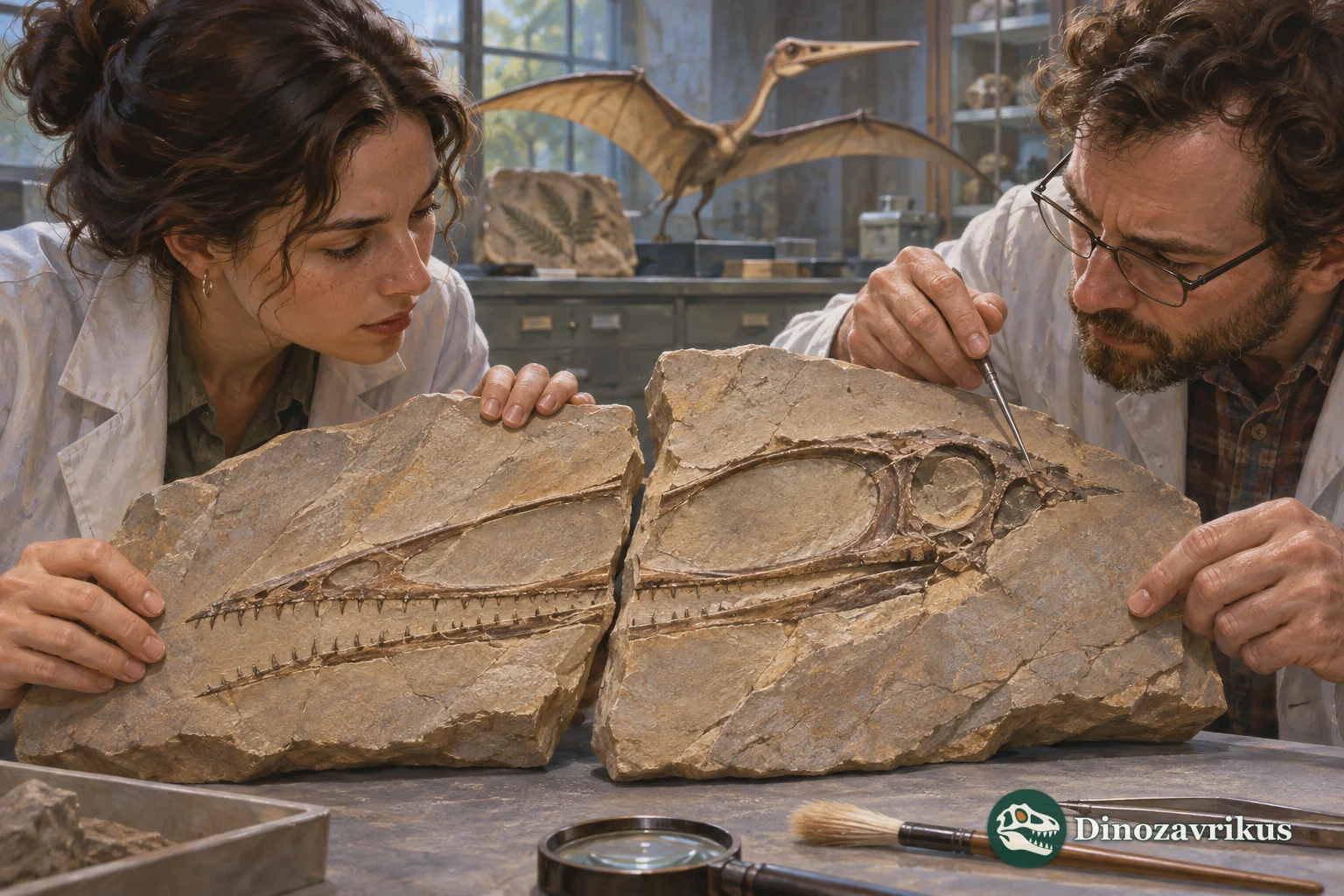
The right side of the skull is divided between a main slab and a counterslab; crushing obscures some details.
Two teeth, four dorsal vertebrae and one uncertain manual metacarpal accompany the skull. Complete wings and tail are absent.
The naris and antorbital fenestra form one opening. This and other characters support placement in Monofenestrata.
The Toarcian occurrence is the oldest known monofenestratan in the 2024 study, not a direct date for the origin of the lineage.
A find in Chubut
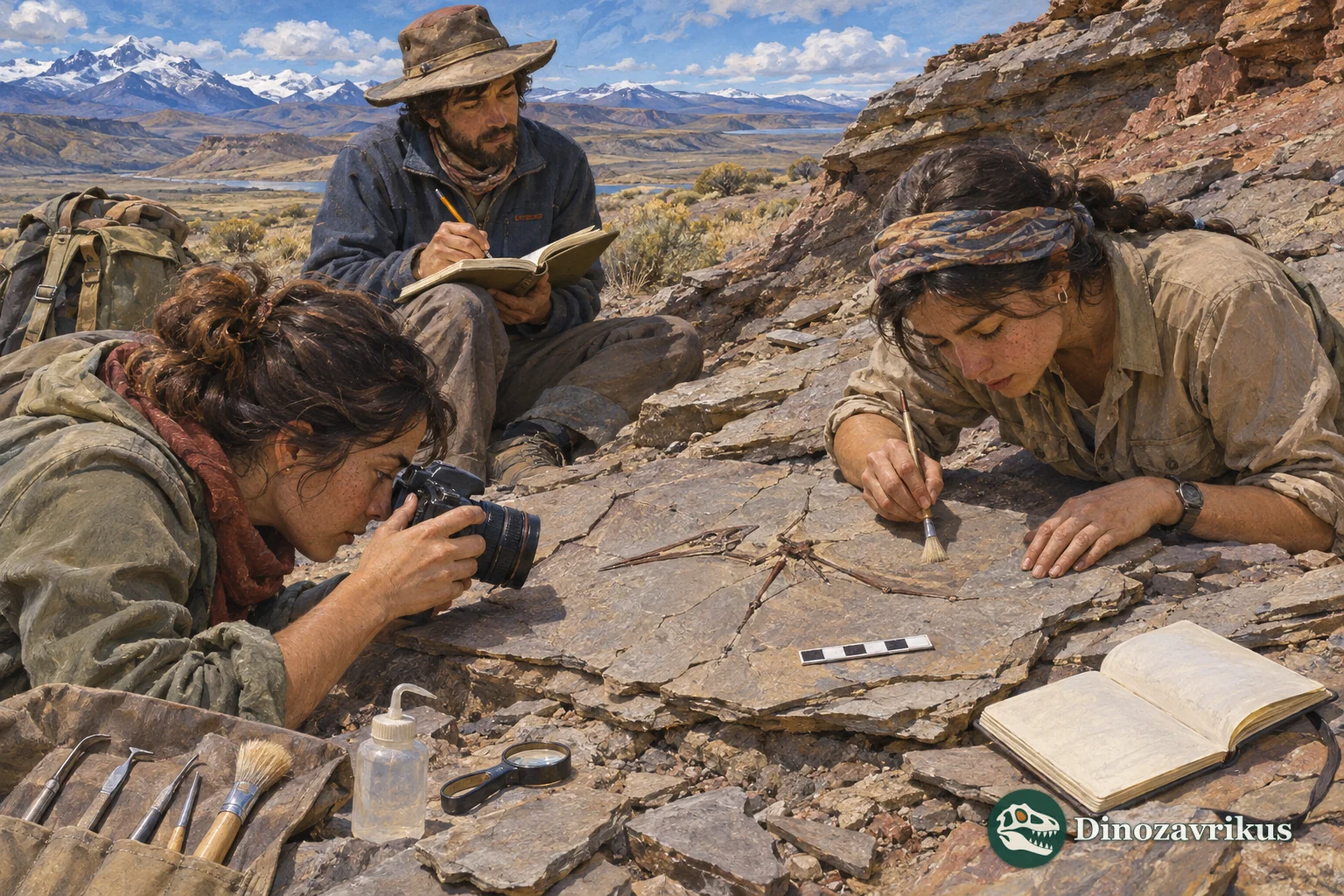
MPEF-PV 11530 came from Queso Rallado near Cerro Cóndor in Chubut Province, Argentina, and is held at the Museo Paleontológico Egidio Feruglio in Trelew. Alexandra Fernandes, Diego Pol and Oliver Rauhut named the genus and species in 2024. Words from Tehuelche supply the name, with the species epithet also recalling the locality and the fossil's fractured state.
The thin silicified mudstone belongs to the lower Cañadón Asfalto Formation, dated to the Toarcian, the latest stage of the Early Jurassic. In the authors' comparison, the specimen predates the previously oldest known monofenestratan by at least eight and probably ten million years. This compares fossil occurrences, rather than dating the lineage's first ancestor precisely.
What the slab preserves
The holotype contains a partial right cranium and counterslab, two associated teeth, four dorsal vertebrae, one metacarpal that could be from finger I, II or III, and unidentifiable fragments. Computed tomography and ultraviolet light helped the authors inspect details of the crushed material.
Although the cranium retains its front and rear extent, the skull roof, occiput and other walls are missing. Its preserved length from snout tip to quadrate is about 13.1 centimetres. This is a cranial measurement, not body length. No complete wing finger or tail permits direct wingspan or tail-length measurement.
The combined opening ahead of the eye
The external naris and antorbital fenestra meet to form a single nasoantorbital opening. A small remnant of the maxilla's ascending process no longer reaches the bones above it. Two phylogenetic analyses using cranial characters recovered Melkamter within early Monofenestrata but outside true pterodactyloids.
Darwinopterus is a later monofenestratan known from more of its skeleton. Rhamphorhynchus illustrates a different long-tailed pterosaur line. A long tail is plausible for Melkamter, but this individual's tail has not been found. Comparison with another Patagonian taxon from the same formation is limited where their preserved bones do not overlap.
What remains unknown
The two teeth establish a toothed animal, but not a specific menu. Colour, body covering, flight performance and preferred habitat cannot be measured from this slab. Living restorations use broader knowledge of early pterosaurs and landscape, while the fossil itself establishes a more limited anatomical and temporal record.
Frequently asked questions
Where was Melkamter discovered?
At Queso Rallado near Cerro Cóndor in Argentina's Chubut Province, in the lower Cañadón Asfalto Formation.
How old is the fossil?
The containing strata are Toarcian, at the end of the Early Jurassic. It was the oldest known monofenestratan occurrence in the 2024 analysis.
Which bones survive?
A partial cranium on a slab and counterslab, two associated teeth, four dorsal vertebrae, a metacarpal and small fragments.
Can its wingspan be measured?
No. The holotype does not preserve the complete wing bones needed for a direct span measurement.