

Mesonyx was a large mesonychid mammal that lived in western North America during the Eocene. Its skull, teeth and limb bones are known from several localities, and the genus is especially associated with M. obtusidens from Wyoming. The animal was not a wolf, a hoofed predator or a whale: it belonged to Mesonychia, an extinct branch of placental mammals whose exact relationships have changed as new anatomical and molecular evidence accumulated.
A nearly complete skeleton collected by Princeton's 1886 expedition near Twin Buttes helped make the animal familiar. The original description also makes an important qualification: some parts were missing and the mount included bones from other individuals. Mesonyx belongs in the ancient mammal catalogue, but its fossils do not establish that it was a direct ancestor of whales.
Quick facts
| Scientific name | Mesonyx Cope, 1872 |
|---|---|
| Representative species | M. obtusidens |
| Group | Mesonychia, Mesonychidae |
| Age | Middle Eocene; species and localities differ |
| Range | Western North America |
| Key locality | Twin Buttes, Wyoming |
| Key material | Skulls, teeth, vertebrae and limb bones; one historic composite mount |
| Diet | Animal tissue is supported by the teeth; exact prey is unknown |
What can the fossils tell us?
Skulls and jaws preserve the long rostrum, cheek teeth and jaw joints. They identify feeding anatomy, but skull length alone is a poor guide to total body mass.
Pointed canines and shearing cheek teeth support an animal-based diet. They do not identify a particular prey species or distinguish hunting from scavenging.
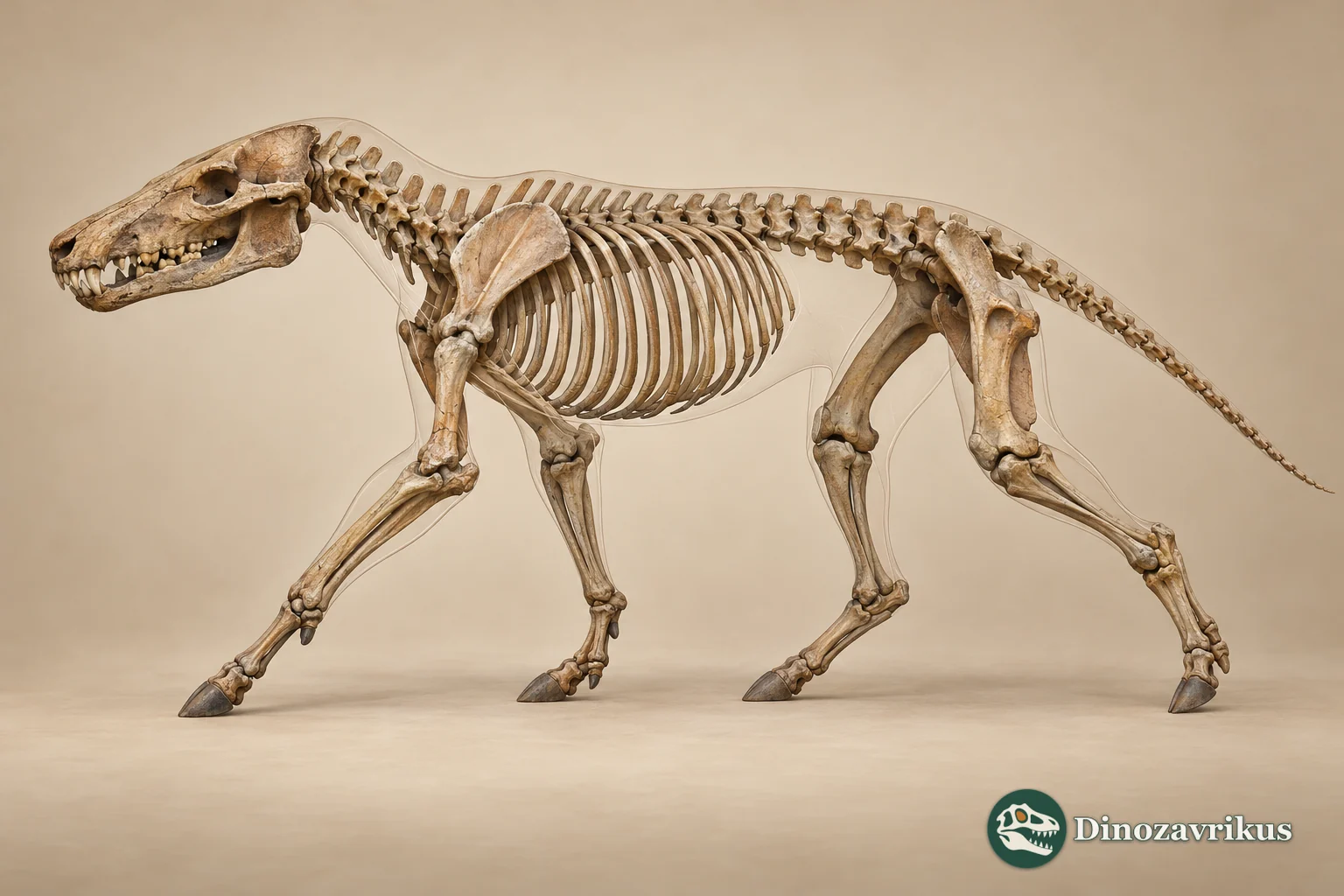
The 1886 Twin Buttes skeleton was unusually complete for its time, but Scott noted missing parts and supplements from other individuals. It is not one intact individual.
Elongated distal limb bones and hoof-like terminal phalanges have been used to infer a digitigrade stance. They do not measure running speed or prove a specific gait.
Names, expeditions and the Twin Buttes skeleton
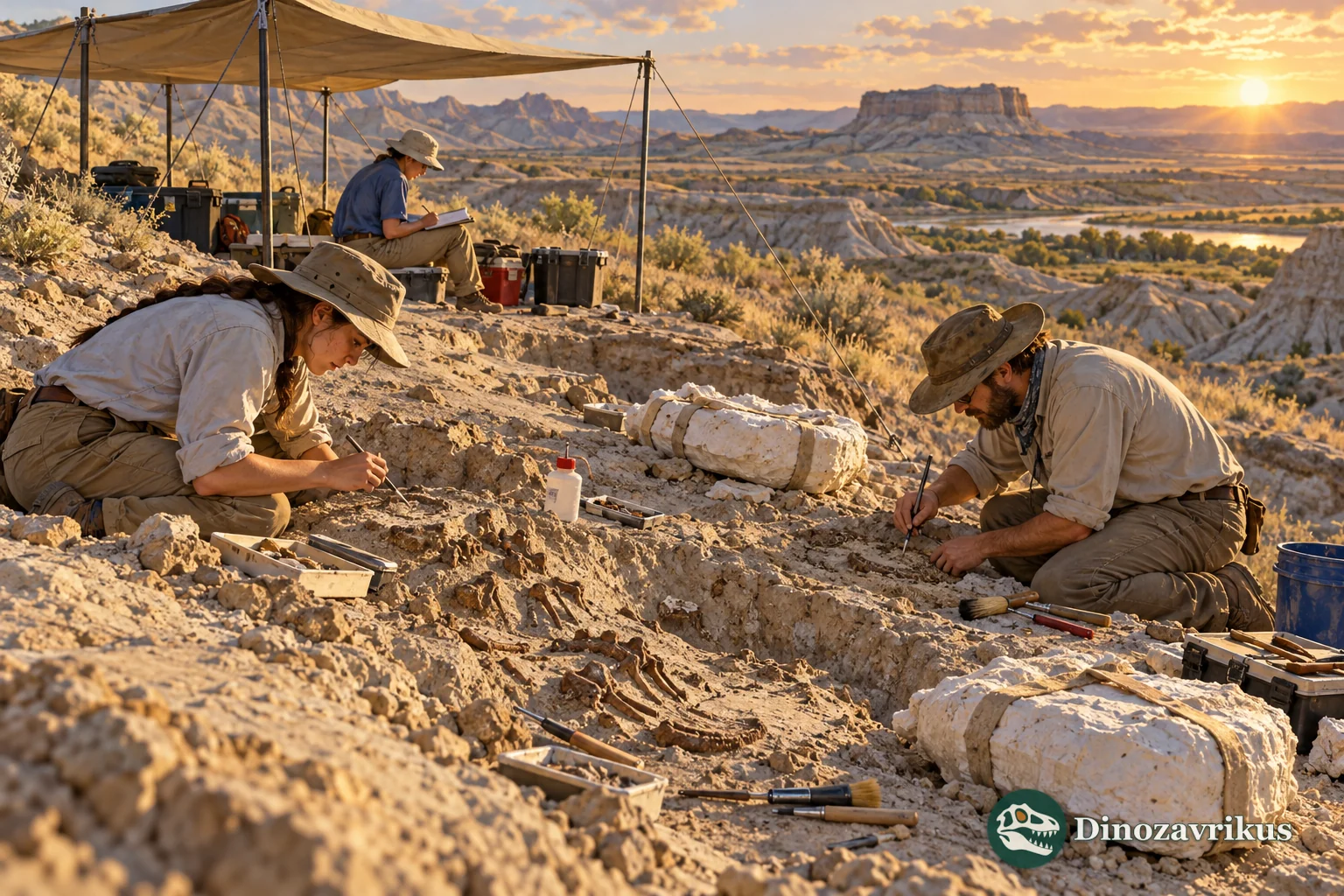
Edward Drinker Cope named Mesonyx in 1872. The genus became better known after the Princeton Scientific Expedition of 1886 collected a remarkably informative specimen of M. obtusidens near Twin Buttes in Wyoming. William Berryman Scott described the material in 1888. He recorded that the skeleton was nearly complete for a fossil mammal of its era, while also noting missing elements and the use of bones from other individuals to fill some gaps.
That distinction matters when looking at a mounted skeleton or a reconstructed outline. A composite display can show a plausible body plan, but the bones need not all come from one animal. A later Smithsonian record for M. obtusidens documents a separate partial skull, broken teeth, limb elements and vertebrae from Wyoming. It is useful comparative material, not the Princeton expedition's type specimen.
Skull, teeth and what they imply about food
The skull was long and robust, with strong jaws and differentiated teeth. Canines could seize or puncture, while the cheek teeth had cutting edges suited to processing animal tissue. This combination supports carnivory in a broad sense. It does not reveal a fixed menu, the size of prey, or whether an individual obtained every meal by hunting rather than scavenging.
Teeth are also among the main tools for identifying mesonychids, but isolated crowns can be difficult to compare. Wear removes details, and similar functional demands can produce similar tooth shapes in unrelated mammals. The newer fossil record has therefore prompted reassessment of which species truly belong in Mesonyx and which assignments need more complete diagnostic material.
How complete was the skeleton?
The Twin Buttes specimen is important because it brought several parts of the skeleton together, allowing researchers to discuss proportions beyond the skull. Yet “nearly complete” should not be mistaken for “perfectly preserved as one individual.” Scott's description distinguished missing bones and supplementary material from other individuals. Later museum specimens add independent evidence, but each has its own degree of completeness and collection history.
Locality and rock unit also matter. M. obtusidens is associated with the middle Eocene Bridger Formation and nearby western Wyoming records. Research on the Washakie Formation has cautioned that dependable records and species assignments can be narrower than older genus-wide lists suggest. Fossils from different basins should not automatically be combined into one population or one exact age.
Limbs, posture and movement
Postcranial bones provide evidence that is absent from an isolated skull. Scott discussed proportions of the forelimb and hind limb, including elongated lower limb segments and hoof-like terminal bones. These features have been interpreted as consistent with a digitigrade or partly digitigrade stance. They help constrain how the animal bore weight, but do not supply a measured running speed or a reliable animation of its gait.
Popular images sometimes make Mesonyx look like a modern wolf. That resemblance is a convenient artistic shorthand, not a close evolutionary relationship. Its body outline, coat, colour and precise foot posture are reconstructed from incomplete material and comparisons. No skin impression or trackway currently fixes those details for the famous Twin Buttes individual.
Was Mesonyx an ancestor of whales?
Mesonychids were once proposed as close relatives or possible ancestors of whales because both groups share some broad anatomical features, including aspects of the ankle and teeth in early discussions. The hypothesis was influential before decisive early whale fossils and molecular phylogenies were available. It should not be repeated as a settled family tree.
Modern evidence places cetaceans within Artiodactyla, alongside hippos and other even-toed mammals, while Mesonychia is generally treated as a distinct extinct lineage. The precise branching pattern can vary among analyses and fossil samples, but no accepted result makes Mesonyx a direct whale ancestor. Similarities are evidence to test in a phylogeny, not proof of a direct chain.
Evidence and reconstruction
| Level | What belongs here |
|---|---|
| Direct evidence | Skulls, jaws, teeth, vertebrae and limb bones from multiple Eocene Wyoming specimens |
| Strong inference | Predominantly animal-based feeding and a terrestrial weight-bearing posture |
| Uncertain | Exact prey, running speed, complete species range and the detailed relationship of Mesonychia to other placental mammals |
| Reconstruction | Coat, colour, soft tissue, exact stance and the scene around the animal |
Frequently asked questions
What was Mesonyx?
It was an Eocene mesonychid mammal from the extinct group Mesonychia, known especially from western North America.
Was the Twin Buttes skeleton one complete animal?
No. Scott described an unusually complete skeleton but noted missing elements and supplementary bones from other individuals.
What did Mesonyx eat?
Its canines and shearing cheek teeth support a diet that included animal tissue, but the fossils do not identify exact prey or the balance of hunting and scavenging.
Was Mesonyx a direct ancestor of whales?
No accepted evidence establishes that. Whales are placed within Artiodactyla, while Mesonychia is a separate extinct lineage.