

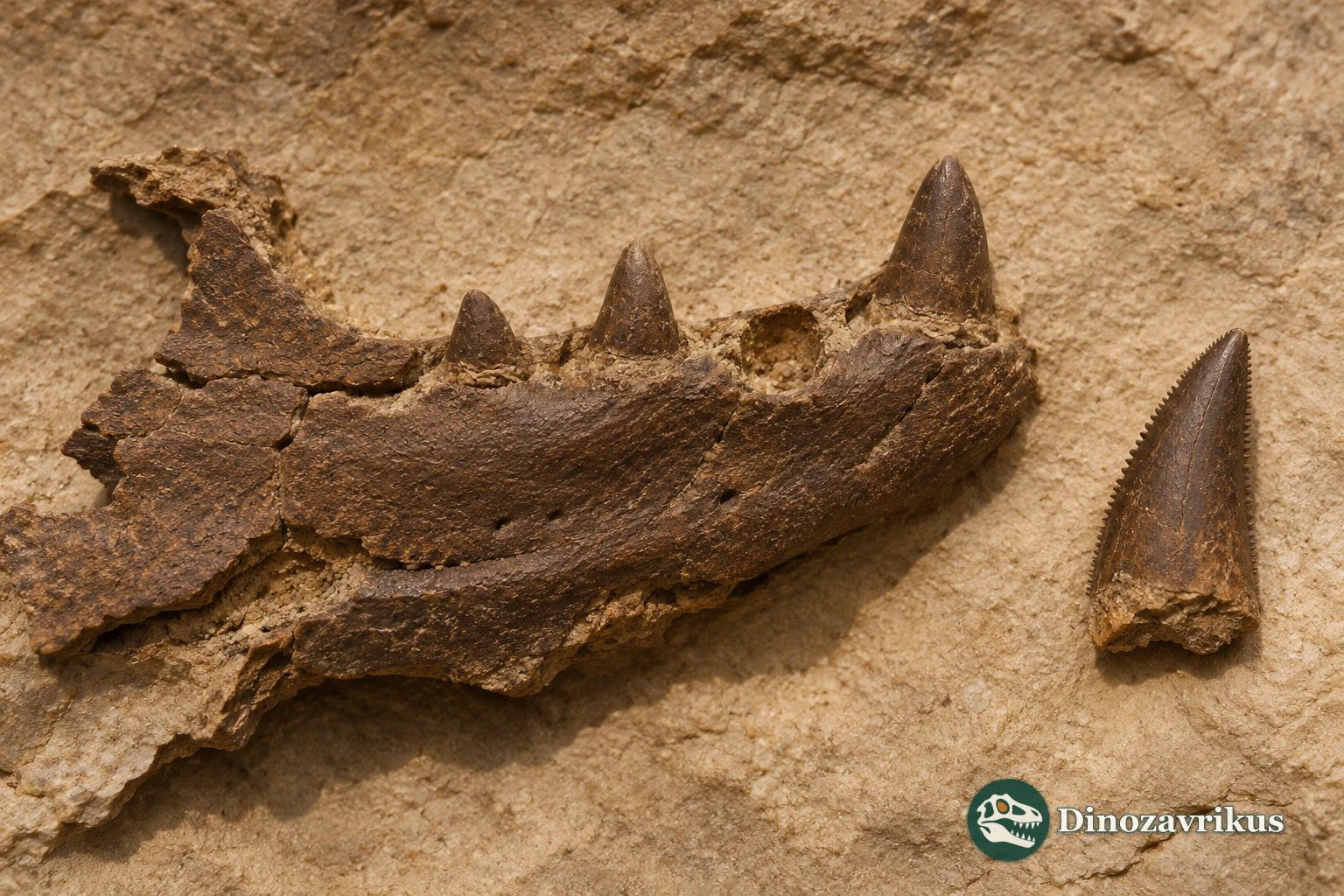
Miadanasuchus oblita was a crocodyliform from north-western Madagascar. Its fossils come from the Maastrichtian Maevarano Formation. The most informative specimens preserve parts of the jaws and snout, including large teeth with finely serrated edges.
Quick facts
| Species | Miadanasuchus oblita |
|---|---|
| Group | Notosuchia, probably Peirosauridae |
| Age | Late Cretaceous, Maastrichtian |
| Locality | Maevarano Formation, north-western Madagascar |
| Material | Parts of skulls and jaws, teeth and a vertebra |
What can the fossils tell us?
The name Trematochampsa oblita dates to 1979. New fossils allowed the genus Miadanasuchus to be erected in 2009.
The fourth and tenth positions stand out in the published reconstruction. Crown shape and serrations support a carnivorous diet.
DMNH EPV.136311 includes the rostrum and part of the braincase. These bones allow more detailed comparison with other Maevarano crocodyliforms.
How the genus was recognised
Éric Buffetaut and Philippe Taquet described the species in 1979 as Trematochampsa oblita. E. L. Rasmusson Simons and Gregory Buckley examined additional material and erected the genus Miadanasuchus in 2009. The name refers to the Miadana Hills, where some of the fossils were recovered.
Described remains include pieces of the tooth-bearing bones of the lower jaw, parts of the skull roof and a vertebra. A later comparative study also examined DMNH EPV.136311, a snout with part of the braincase. A phylogenetic analysis of skeletal characters placed Miadanasuchus within Peirosauridae, a branch of Notosuchia.
What the teeth say about feeding
The reconstructed upper jaw has four tooth positions in the premaxilla and twelve in the maxilla on each side. There are seventeen in the lower row. The crowns are mostly conical with small serrations along their cutting edges. Their size and shape support carnivory without identifying particular prey.
Maevarano sediments accumulated in a setting with pronounced wet and dry seasons. The same formation yielded broad-snouted Mahajangasuchus, which has been interpreted as semiaquatic. Skull and tooth anatomy suggest Miadanasuchus spent more of its time on land.
Frequently asked questions
On which island was Miadanasuchus discovered?
Its fossils come from the Maevarano Formation in north-western Madagascar.
Why did the genus name change?
Additional fossils allowed researchers to distinguish the Madagascan species from Trematochampsa and name a separate genus.
What stands out in the tooth rows?
The crowns carry fine serrations, and the fourth and tenth lower tooth positions are particularly large.
Did Miadanasuchus hunt on land?
A mainly terrestrial way of life has been proposed from its skull and teeth. The fossils do not show exactly how it hunted.