

Microtuban altivolans is known from a crushed, incomplete postcranial skeleton from the Cenomanian of Lebanon. The skull is missing. Its wing bones offer anatomical comparisons, while conflicting information from a fossil dealer leaves the precise quarry uncertain.
Quick facts
| Scientific name | Microtuban altivolans, Elgin and Frey, 2011 |
|---|---|
| Holotype | SMNK PAL 6595, incomplete postcranial skeleton |
| Region | Northern Lebanon; exact quarry unverified |
| Age | Cenomanian, Late Cretaceous |
| Material | Neck, shoulder and wing elements; no skull |
| Growth | Osteologically immature individual |
What can the fossils tell us?
SMNK PAL 6595 preserves postcranial bones; its jaws, teeth and crest cannot be described.
The fourth wing-finger phalanx is about 1.1% of total wing-finger length in the original measurements, not evidence of flight height.
A dealer named Hâqel and later Hjoûla. The authors preferred Hjoûla from the matrix without a petrographic test.
Several unfused elements indicate immaturity, so small specimen size is not necessarily adult size.
An incomplete skeleton
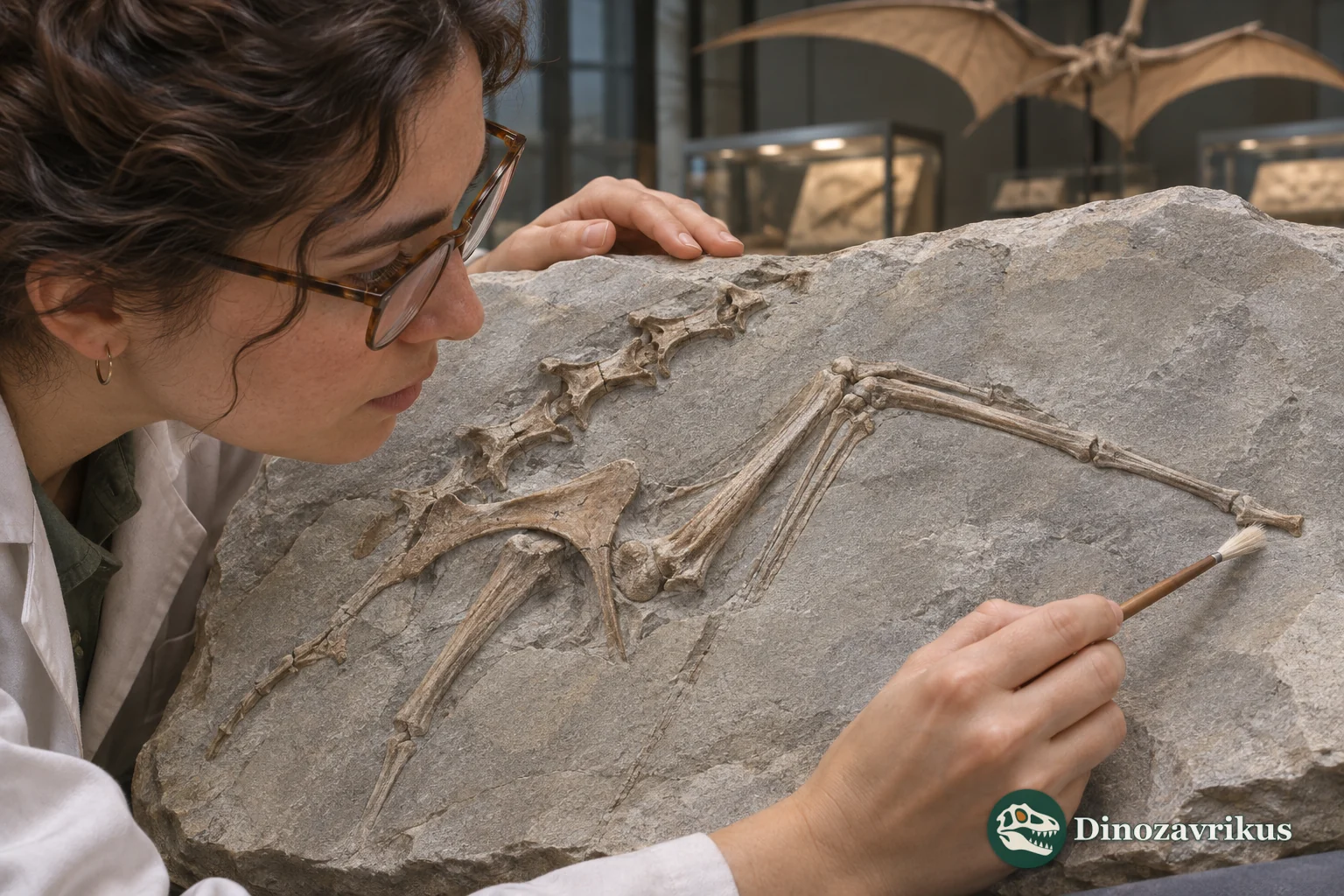
Ross Elgin and Eberhard Frey described holotype SMNK PAL 6595 in 2011. It is kept at the State Museum of Natural History Karlsruhe. Crushing and missing elements leave an incomplete postcranial skeleton, including parts of the neck, shoulder girdle and wing. There is no skull or direct evidence of its food.
The terminal fourth phalanx of the wing finger is exceptionally short, measured at about 1.1% of the finger's total length. The second-to-first phalanx ratio was 0.85. These measurements help compare bones; they do not demonstrate a flying altitude or a particular flight style.
Why the quarry is uncertain
A fossil dealer initially gave Hâqel as the locality and later reported Hjoûla. Both are northern Lebanese Cenomanian limestone sites. Elgin and Frey preferred Hjoûla because of the grey fine-grained matrix, but did not confirm the match by petrographic analysis. The exact quarry should therefore be treated as inferred, not documented by a field record.
The limestones accumulated in marine basins, describing preservation rather than proof that the animal lived permanently over the sea. Mimodactylus is another Lebanese pterosaur, known from a different specimen. Its head and diet cannot be transferred to Microtuban.
Growth and classification
Unfused cervicothoracic, shoulder and wing elements led the authors to identify an immature individual, despite developed texture in some bones. The known specimen's small size is therefore not a measured adult size for the species.
The genus was placed within Azhdarchoidea. More precise affinities with thalassodromids or chaoyangopterids remain difficult to resolve from incomplete material. Chaoyangopterus introduces one compared branch, but a comparison is not itself proof of close kinship. The absent skull reduces the available diagnostic characters.

What the artwork can show
The cover presents a generalized pterosaur in a Cretaceous coastal scene. Its head, colour, precise wing outline and behaviour are speculative. The species epithet altivolans means high-flying but does not record an observed altitude. The accompanying marine landscape represents a possible environment of fossil deposition, not a verified feeding site.
Frequently asked questions
Which Microtuban bones survive?
The holotype has incomplete neck, shoulder and wing elements. It lacks a skull and a complete body.
Which quarry produced the fossil?
The exact quarry is unknown. The authors favoured Hjoûla over Hâqel from the rock matrix after conflicting dealer reports.
Was the type specimen an adult?
Several unfused bones indicate an immature individual. Its size does not establish the species' adult dimensions.
Is its diet known?
No. The fossil lacks a skull and does not preserve direct dietary evidence.