

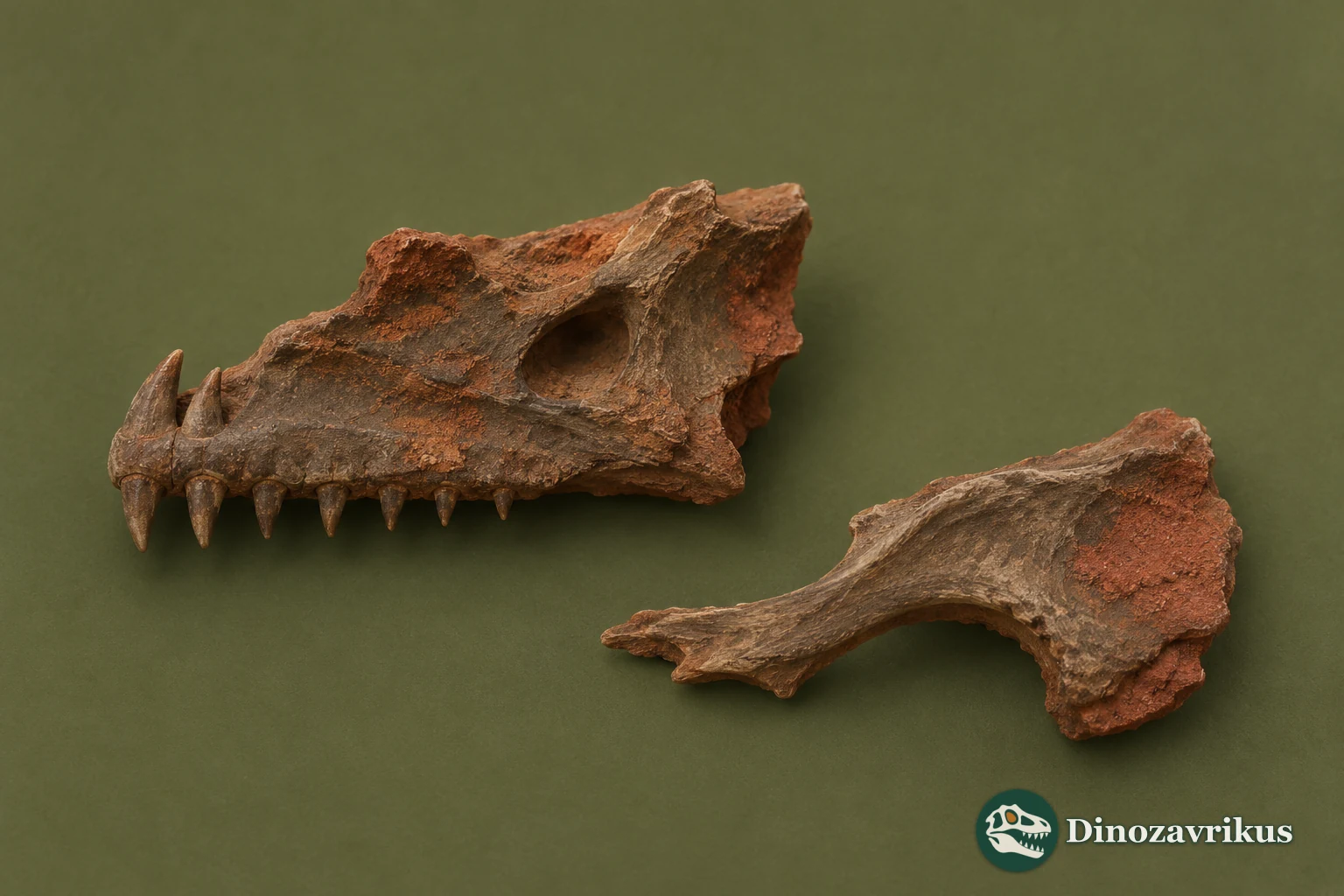
Mimeosaurus was an iguanian lizard from Late Cretaceous Asia. Its original description was based on part of a skull. Later finds revealed a short muzzle and a robust lower jaw, with two enlarged teeth at the front of each maxilla.
Quick facts
| Group | Iguanians (Iguania), priscagamids |
|---|---|
| Age | Late Cretaceous, Campanian |
| Region | Asia, Mongolia and China |
| Type species | Mimeosaurus crassus |
| Scientific name | Mimeosaurus |
| Diet | No direct evidence |
What can the fossils tell us?
AMNH 6655 preserves the left maxilla fused to the jugal. Incomplete skulls with lower jaws are known from Ukhaa Tolgod and Zos Wash.
The front teeth on the maxilla are enlarged. Much of the row is firmly fused to the crest of the jaw.
A fragmentary specimen from Tugrugeen Shireh was named as a second species. Researchers disagree about whether it is distinguishable from the type species.
New fossil material from the Gobi
Charles Gilmore named Mimeosaurus crassus in 1943 from material collected at Bayn Dzak in the Djadokhta Formation. Incomplete skulls from Ukhaa Tolgod and Zos Wash in Mongolia were later assigned to the same species, along with material from Bayan Mandahu in China. A well-preserved specimen from Zos Wash, IGM 3/76, clarifies the anatomy near the eye and at the front of the jaws.
A short muzzle and firmly anchored teeth
The maxilla is short and deep, while the premaxilla, the bone between the paired maxillae, is reduced. The second maxillary tooth is usually the largest. Much of the remaining row is relatively uniform and firmly fused to the crest of the jaw, an attachment called acrodonty. Priscagama had a longer muzzle and preserved more than one type of attachment along its tooth rows.
Clues to evolutionary relationships
Gilmore compared Mimeosaurus with chameleons. Later research included it among priscagamids based on its jaws and other cranial features. These include paired openings on the inner surface of the lower jaw and a strong outer ridge. Tooth attachment links Mimeosaurus with the acrodont branch of iguanians and provides one character among many for examining its relationships to living families.
Why a second species is disputed
The fragmentary skull PIN 3143/102 from Tugrugeen Shireh was named Mimeosaurus tugrikinensis in 1989. Other researchers could find no reliable way to distinguish it from M. crassus and treated it as a junior synonym. The prominence of the front teeth varies among better preserved specimens, making it difficult to separate species based on this feature alone.
Frequently asked questions
Was Mimeosaurus a chameleon?
Gilmore proposed that affinity. Later descriptions have generally placed the genus among extinct priscagamid iguanians.
What sets its teeth apart?
The first two teeth of each maxilla are conspicuously enlarged. The rest of the row is firmly attached to the crest of the bone.
Where did the holotype come from?
It was found at Bayn Dzak in the Mongolian Gobi. It is held at the American Museum of Natural History.
Do we know how long it was or what colour it was?
Most securely identified bones are from the head. They reveal the proportions of the snout but do not establish its body length or colour.