

Miniochoerus was a North American oreodont, a member of the extinct artiodactyl family Merycoidodontidae. Its fossils range from the late Eocene into the Oligocene, and include skulls as well as postcranial bones. One especially informative museum specimen, USNM V 136, is mounted with the skull and assigned to M. gracilis.
The genus is useful for studying how oreodont species changed through time and how paleontologists revise fossil classifications. Its record spans several named forms, but a chronological sequence is not automatically a family tree. Miniochoerus joins other fossil mammals in the ancient mammal catalogue; its known bones constrain anatomy more securely than exact mass or behaviour.
Quick facts
| Scientific name | Miniochoerus Schultz & Falkenbach, 1956 |
|---|---|
| Group | Merycoidodontidae, subfamily Miniochoerinae |
| Age | Middle Chadronian to early Whitneyan, roughly five million years |
| Range | Western North America |
| Key specimen | USNM V 136, a mounted M. gracilis skeleton with skull |
| Evidence | Skulls, jaws and postcranial bones |
| Body mass | No single well-supported genus-wide estimate |
What can the fossils tell us?
A phylogenetic revision measured skulls and mandibles while accounting for post-mortem distortion. This helps separate biological variation from deformation; a skull alone does not reveal coat, diet or behaviour.
The Smithsonian record for USNM V 136 identifies a mounted complete skeleton of M. gracilis with skull, collected in Nebraska. It provides an anatomical reference for one specimen, not a complete record of every species in the genus.
Stevens and Stevens traced four of five species from the middle Chadronian to earlier Whitneyan. This is a sequence in the fossil record, not proof of a direct ancestor–descendant chain.
The genus includes several species and unevenly preserved specimens. A measurement from one skull or skeleton should not be applied to all of them without a published method and specimen-level comparison.
A small branch of oreodont diversity
Clarence Schultz and Charles Falkenbach named Miniochoerus in 1956 during a major effort to classify oreodonts. The genus belongs to Merycoidodontidae and is placed in its own subfamily, Miniochoerinae. Oreodonts were extinct even-toed ungulates, not pigs, although some skulls can invite a superficial comparison with living hoofed mammals.
Species boundaries have shifted as researchers compared old museum collections. Margaret and James Stevens revised the Chadronian–Whitneyan oreodont record in 1996, measuring skulls and mandibles and explicitly considering distortion after burial. Their treatment recognised five species of Miniochoerus. Older combinations on collection labels therefore need to be read against later taxonomic revisions.
The oreodont Merycoidodon is a useful comparison within the same family, but related genera are not interchangeable. Similarity and stratigraphic order alone do not demonstrate direct ancestry.
Where and when it lived
Known records come from western North America. The Smithsonian’s USNM V 136 specimen was collected by C. A. Fisher in 1902 in Scotts Bluff County, Nebraska. Its museum record places it in the Brule Formation of the White River Group and the Orellan North American land-mammal age, an early Oligocene interval.
The broader genus spans the middle Chadronian through the earlier Whitneyan, approximately five million years in the regional chronology. Stevens and Stevens found that four of the five species fit within this sequence, while two species coexisted in the early Orellan. That overlap matters: the fossil record does not describe a simple replacement of one species by another.
The Chadronian, Orellan and Whitneyan are regional land-mammal ages. They help correlate North American fossil sites, but should not be treated as exact synonyms for the boundaries of international geological epochs. The site’s overview of the Cenozoic Era gives the wider context.
Skulls, jaws and a mounted skeleton
Unlike mammals known almost entirely from isolated teeth, Miniochoerus is represented by skulls, mandibles and postcranial remains. USNM V 136 is listed by the Smithsonian as a mounted complete skeleton of M. gracilis with skull. It gives researchers a rare view of several body regions in one individual and provides a useful reference for the genus.
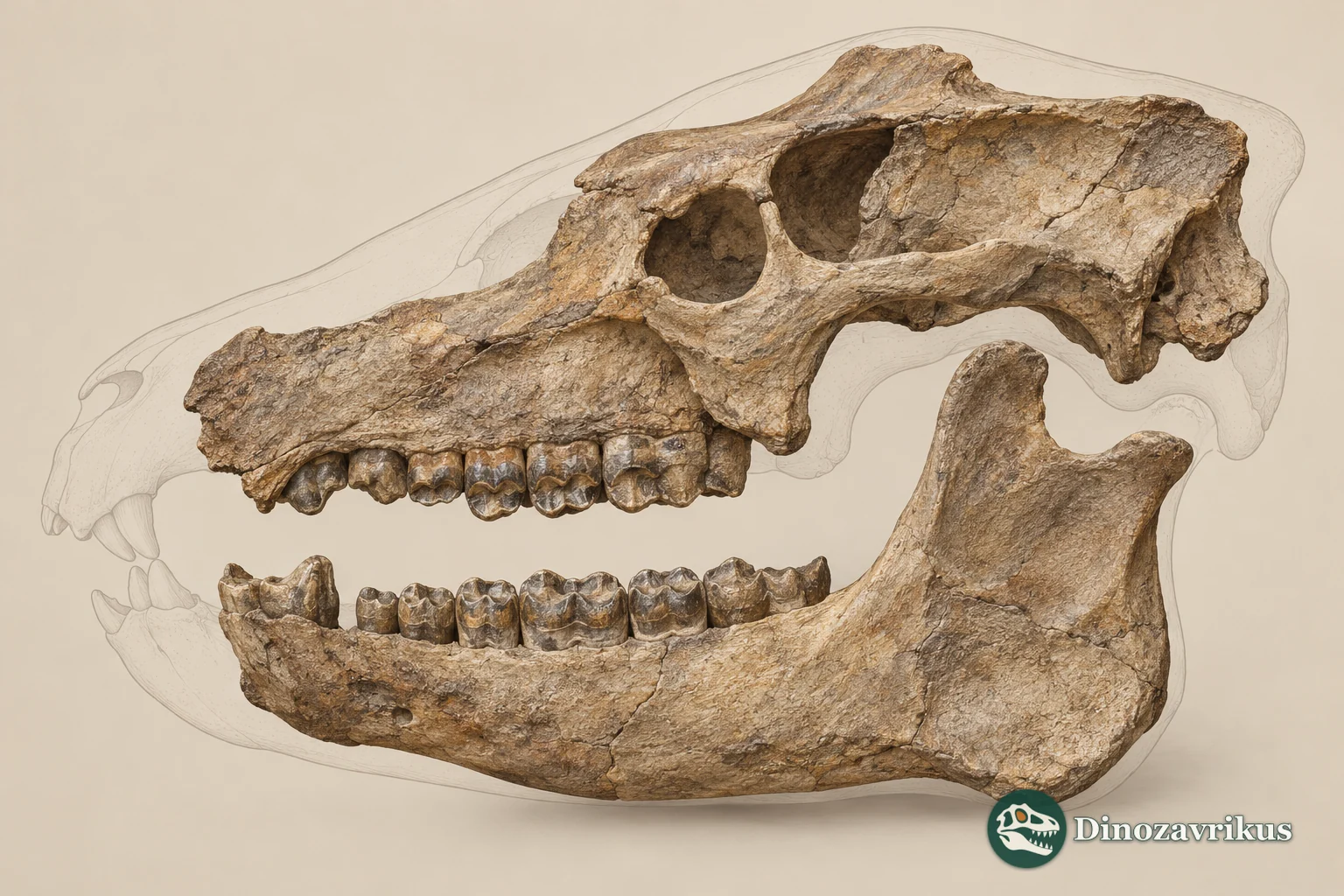
Taxonomic revision requires more than finding one distinctive outline. The Stevens study measured 18 cranial dimensions across suitable specimens and considered how compression and other post-mortem changes could alter skull shape. A flattened fossil can appear naturally broader or shorter than it was in life, so several measurements and comparisons help identify the signal that survives deformation.
A mounted specimen still cannot show soft tissues, fur, colour or a living animal’s routine. Joint surfaces and limb proportions can inform functional hypotheses, but they do not record a particular gait or social behaviour.
Size and diet need specimen-level evidence
Miniochoerus is commonly described as a small oreodont, but the sources checked for this profile do not support one reliable body-mass figure for the entire genus. The five recognised species span a long interval and are not represented by identical samples. A number derived from one specimen should not be generalized to all species without a transparent measurement and estimation method.
Its family placement identifies Miniochoerus as part of an herbivorous ungulate radiation, but it does not provide a detailed menu. Tooth wear, stable isotopes or other specimen-specific studies would be needed to distinguish feeding strategies or quantify plant choices. Related species may also have differed.
Likewise, four species arranged through time do not prove that each was the direct ancestor of the next. The revised sequence tracks fossil occurrences and relationships proposed in a phylogenetic analysis; direct descent is a separate claim that requires additional evidence.
Why the genus matters
Oreodonts were a prominent part of North American Paleogene faunas. Miniochoerus contributes both to that ecological record and to the history of classification: its skulls and skeletons let researchers compare more than teeth, while the modern revision shows how distortion and variation can complicate species names.
The strongest picture is therefore one of a multi-species oreodont lineage extending across several successive fossil intervals, with at least some overlap between species. The fossils are informative about anatomy and chronology. Exact body mass, habitual behaviour, coat and a literal ancestor–descendant sequence remain less certain.
Frequently asked questions
Was Miniochoerus a dinosaur?
No. It was an extinct artiodactyl mammal in the oreodont family Merycoidodontidae.
When did Miniochoerus live?
Its record extends from the middle Chadronian to the earlier Whitneyan, about five million years in North America’s regional land-mammal chronology.
Is a complete Miniochoerus skeleton known?
The Smithsonian lists USNM V 136 as a mounted complete skeleton of M. gracilis with skull. Other species and specimens are not all equally complete.
How large was Miniochoerus?
It is described as a small oreodont, but the sources reviewed do not support one body-mass estimate for every species. A precise value needs a specimen and method.