

Miracinonyx was a large North American cat whose long limbs inspired the nickname ‘American cheetah’. That name describes a resemblance, not membership in the African cheetah genus Acinonyx. A 2026 nuclear-genome study confirmed that late M. trumani is much closer to the puma lineage. Fossil skulls and partial skeletons reveal a longer history than a single late Ice Age animal.
This profile belongs in the ice-age animal catalogue. Sabre-toothed cats provide a contrasting felid comparison: Miracinonyx had no giant blade-like canines, and its long legs raise a different question about locomotion.
Quick facts
| Family | Felidae |
|---|---|
| Studied species | M. inexpectatus and M. trumani |
| Time | Late Pliocene and Pleistocene records |
| Region | North America, including Yukon |
| Material | Skulls and partial skeletons |
| Living sister lineage | Puma, supported by ancient genomes |
| Mass estimate | About 50 kg for one M. trumani from skull-length regression |
What can the fossils tell us?
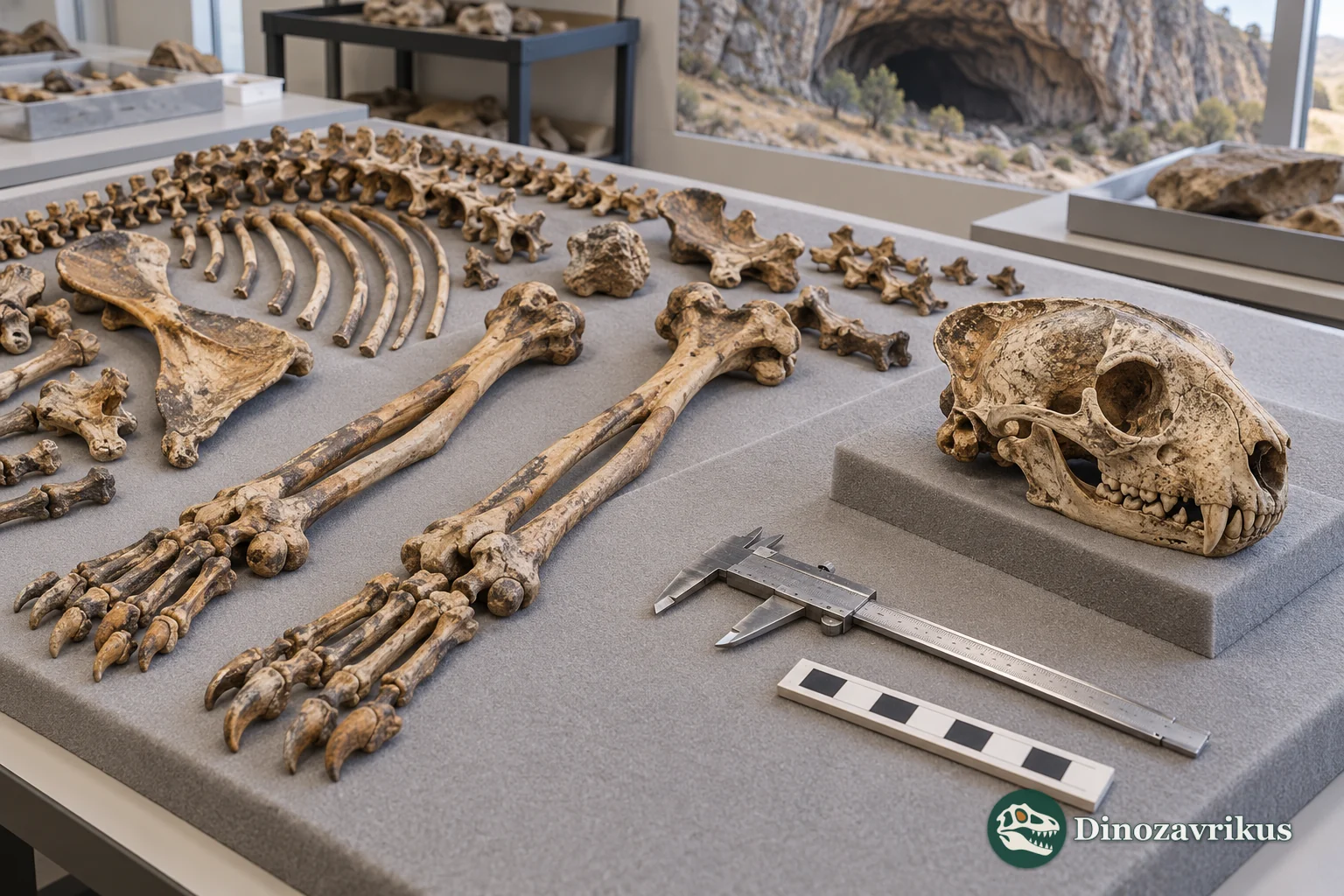
Associated skeletons and isolated limb bones show elongation, while skulls and teeth aid species comparison. Skeletal resemblance to cheetahs alone cannot measure running speed.
Nuclear paleogenomes from Wyoming and Yukon M. trumani place it beside Puma rather than within the living cheetah lineage. A divergence around 2.6 million years is a model estimate, not a fossil date.
Yukon isotope values are consistent with a stronger aquatic food-web contribution, whereas Wyoming samples fit varied terrestrial prey. Neither signature records a specific hunting event.
Names, caves and two species
The skull, mandible and partial postcranial skeleton of the late form came from Crypt Cave, Nevada, and were originally described in 1969 as Felis trumani. The cheetah-like North American cats were later placed in Miracinonyx, first as a subgenus and then as a separate genus by Blaire Van Valkenburgh, Frederick Grady and Björn Kurtén in 1990.
Their revision also examined a nearly complete older skeleton from Hamilton Cave in West Virginia. It used Cope's earlier species name for M. inexpectatus and compared the limbs, skull and teeth with living pumas and cheetahs. The proposed relationship between the early and late species remains an evolutionary inference, not a directly observed ancestry. Multiple partial M. trumani skeletons, including a juvenile, were recovered from Natural Trap Cave in Wyoming; a natural pitfall can collect animals from different times without implying social living.
Anatomy without a speedometer
Elongated distal limb bones distinguish Miracinonyx from ordinary pumas. A 2026 reassessment of museum fossils found limb measurements more reliable than most skull measurements for separating M. trumani from Puma concolor, and identified additional North American localities. A label assigned decades ago can therefore be revised by measurements.
Researchers CT scanned Natural Trap Cave skull KUVP-51277. Its virtual brain endocast showed a combination of features that was less specialised than that of a living cheetah, and the cat retained fully retractile claws. These observations caution against assigning it the modern cheetah's exact hunting behaviour or speed. The study's approximately 50 kg body mass came from a skull-length regression for one specimen, not a direct weighing of the species.

Yukon genomes and dietary breadth
Nuclear paleogenomes from Wyoming and Yukon individuals, approximately 23,000 and 31,000 years old, place M. trumani as a sister lineage to pumas. The estimated split around 2.6 million years ago is model-based. Yukon remains extended its confirmed range far north of the better-known cave sites.
Stable isotopes suggest a higher trophic position and possible contribution from anadromous fish in the Yukon sample; the Wyoming population appears to have had a more general terrestrial diet. Earlier models for Natural Trap Cave suggested pronghorn and other herbivores as important prey. Different places and samples need not share one menu. Isotopes cannot distinguish a captured fish from a fish-derived signal acquired indirectly through another animal, and the cover's plain coat is an artistic choice.
Frequently asked questions
Was Miracinonyx a true cheetah?
No. Its limbs converged on a cheetah-like form, but ancient genomes place M. trumani close to pumas.
Which species are best studied?
The older M. inexpectatus has a nearly complete Hamilton Cave skeleton; late M. trumani is known from skulls and partial skeletons across several regions.
Can its top speed be calculated from fossils?
No exact speed follows from bone proportions. They suggest running adaptations, while brain and claw anatomy caution against a simple modern-cheetah comparison.
Did Yukon Miracinonyx catch fish?
Isotopes are consistent with an aquatic food-web contribution, but they do not reveal whether an individual caught fish or obtained that signal indirectly.