

Misrichthys is a genus of carcharhinid sharks known from isolated Eocene teeth in Egypt and Tunisia. Its record is closely tied to the Fayum Depression, where finds come from several levels and formations. Tooth crowns help identify the genus, but no associated skeleton establishes its body outline or length.
Quick facts
| Group | Carcharhinid shark, order Carcharhiniformes |
|---|---|
| Type species | Misrichthys stromeri Case and Cappetta, 1990 |
| Known material | Isolated upper and lower teeth |
| Main regions | Fayum Depression, Egypt; Djebel el Kébar, Tunisia |
| Age | Middle to Late Eocene, including Bartonian and Priabonian records |
| Measured teeth | Up to about 14–20 mm in particular published samples |
| Body size | Total length and body proportions unknown |
What can the fossils tell us?
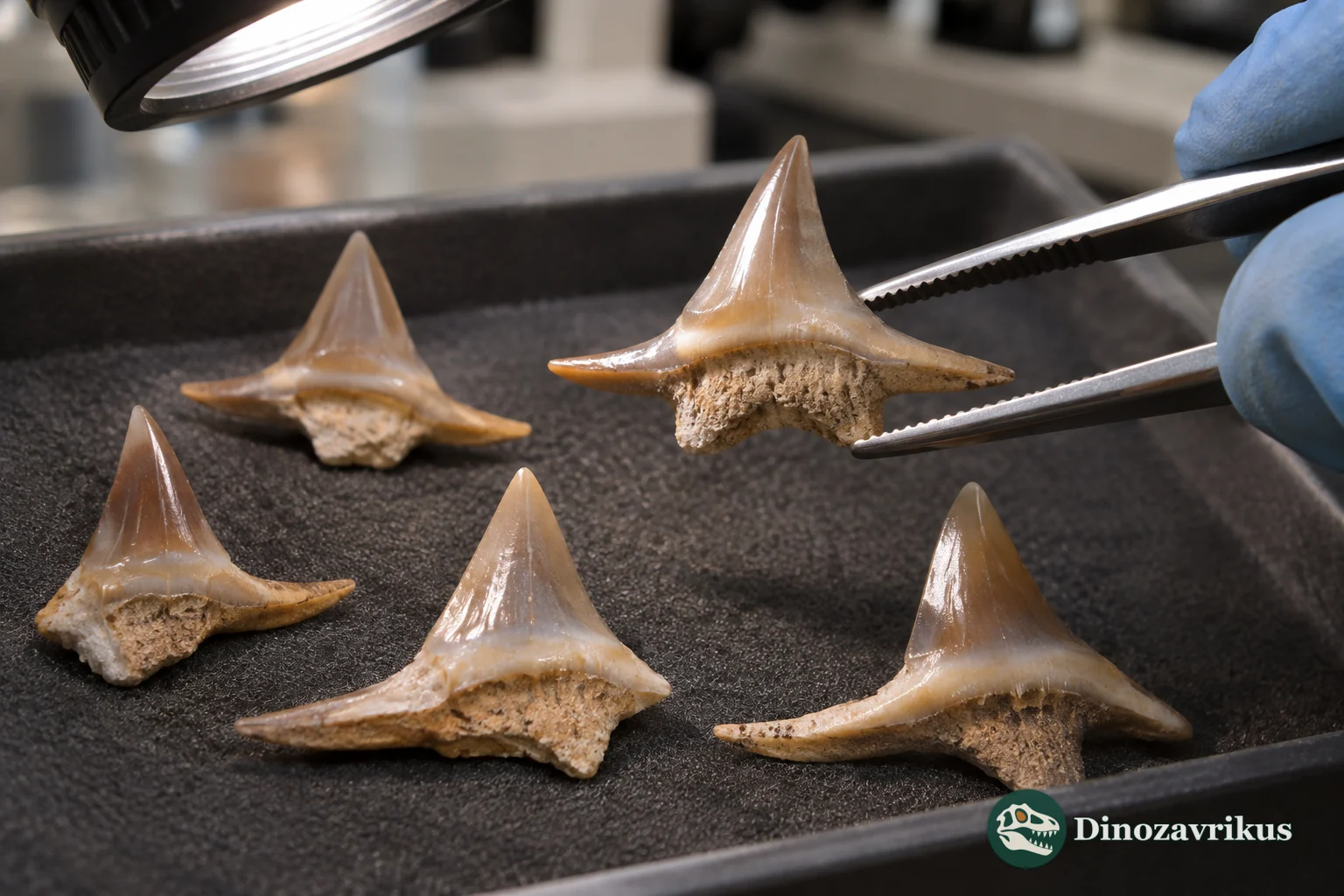
Upper teeth have triangular crowns that tilt distally in lateral positions and elongated blade-like heels. Smooth enamel and a notch near the distal heel help distinguish them; the isolated teeth do not preserve a complete jaw.
Underwood and colleagues recorded M. stromeri in several Fayum formations and noted its greatest abundance in Birket Qarun sandstones. Smaller teeth from the Midawara Formation may represent an unnamed species, but that proposal remains unconfirmed.
A few isolated teeth and crown fragments from Djebel el Kébar place the genus at least by the Middle Bartonian. The material is too scarce and too similar to the named species to support a formal new name.
From an indeterminate tooth to a named shark
Early twentieth-century Fayum accounts included some teeth as indeterminate Carcharias. In 1990, Gregory Case and Henri Cappetta reviewed shark and ray tooth assemblages from two Middle to Late Eocene formations and established the new genus and species Misrichthys stromeri. The earlier records remain useful in the history of research, but they are not equivalent to the later diagnosis based on comparative tooth characters.
The genus was described from teeth rather than an articulated skeleton. The publications consulted do not establish a single named collector for all of the type material or a verified museum number for a holotype. It is therefore more precise to refer to the original Fayum tooth material than to assign the discovery to a particular expedition or person.
How the teeth are recognized
Upper teeth have broad triangular crowns. In anterolateral and lateral jaw positions, the cusp inclines distally and the heels extend into blade-like shoulders. Their cutting edges are smooth, and a notch marks the transition between the distal cutting edge and heel. Lower anterior teeth are narrower and taller, with a robust root. These differences make jaw position important when an isolated tooth is compared with other sharks.
A Tunisian study described smooth enameloid on both upper and lower teeth and reported specimens up to about 14 mm high. An Egyptian 2022 sample included teeth up to 20 mm in total height. These values describe particular teeth in particular collections. They cannot be converted directly into the total length of the shark.
The Fayum record and a Tunisian extension
The 1990 review covered material from two Fayum formations. Later work assigned M. stromeri to several additional Middle and Late Eocene levels, including Midawara, Gehannam, Birket Qarun and Qasr el-Sagha. Underwood and colleagues reported the highest relative abundance in Birket Qarun sandstones. That pattern describes collected fossil assemblages, not a direct census of living sharks.
Rare, smaller teeth from the older Midawara Formation may represent a second species. Size alone cannot distinguish a separate species from a juvenile animal or a different tooth position, and the authors did not give this material a formal name. The possibility remains a research question, not a second established species.
In 2020, a small sample from lagoonal deposits at Djebel el Kébar in central Tunisia extended the genus beyond Egypt. The report includes isolated teeth and broken crowns and places the occurrence at least by the Middle Bartonian. The fossils were too few and not distinct enough to justify a new named species. They document a wider Tethyan record, but do not prove that every locality had the same water depth or salinity.
Feeding, habitat and the limits of reconstruction
Smooth cutting edges and inclined crowns are consistent with grasping and cutting prey. No stomach contents or securely associated feeding traces identify a particular meal for Misrichthys. A diet of small fish or other marine animals is a comparison-based possibility, not a direct fossil observation.
Some authors discussed whether Fayum occurrences could indicate tolerance of brackish or fresh water. A tooth in a sediment does not measure the salinity in which the animal lived. Later Tunisian and marine records broaden the environmental context but neither establish a freshwater lifestyle nor rule out occasional entry into estuarine settings. As with the Eocene shark Abdounia, teeth can preserve diagnostic evidence while leaving much of the animal's ecology uncertain.
Without associated bones, total body length, fin shape, colour, swimming speed, growth and reproduction remain unknown. The cover is a family-level artistic reconstruction rather than a measured portrait of M. stromeri. The internal tooth scene is also illustrative and does not reproduce a specimen from the type collection.
Frequently asked questions
Is a complete Misrichthys skeleton known?
No. The genus is described from isolated teeth; associated skeletal remains that establish its body shape are not known.
Where has Misrichthys been found?
Most records are from the Fayum Depression in Egypt. A small sample from Djebel el Kébar in Tunisia confirms a wider Eocene distribution.
How many named species are there?
One species, Misrichthys stromeri, is named. Smaller teeth have been discussed as a possible unnamed form, but no second species has been formally established.
How large was it, and what did it eat?
Total length is unknown. Tooth shape is consistent with cutting prey, but no fossil evidence identifies a specific diet.