

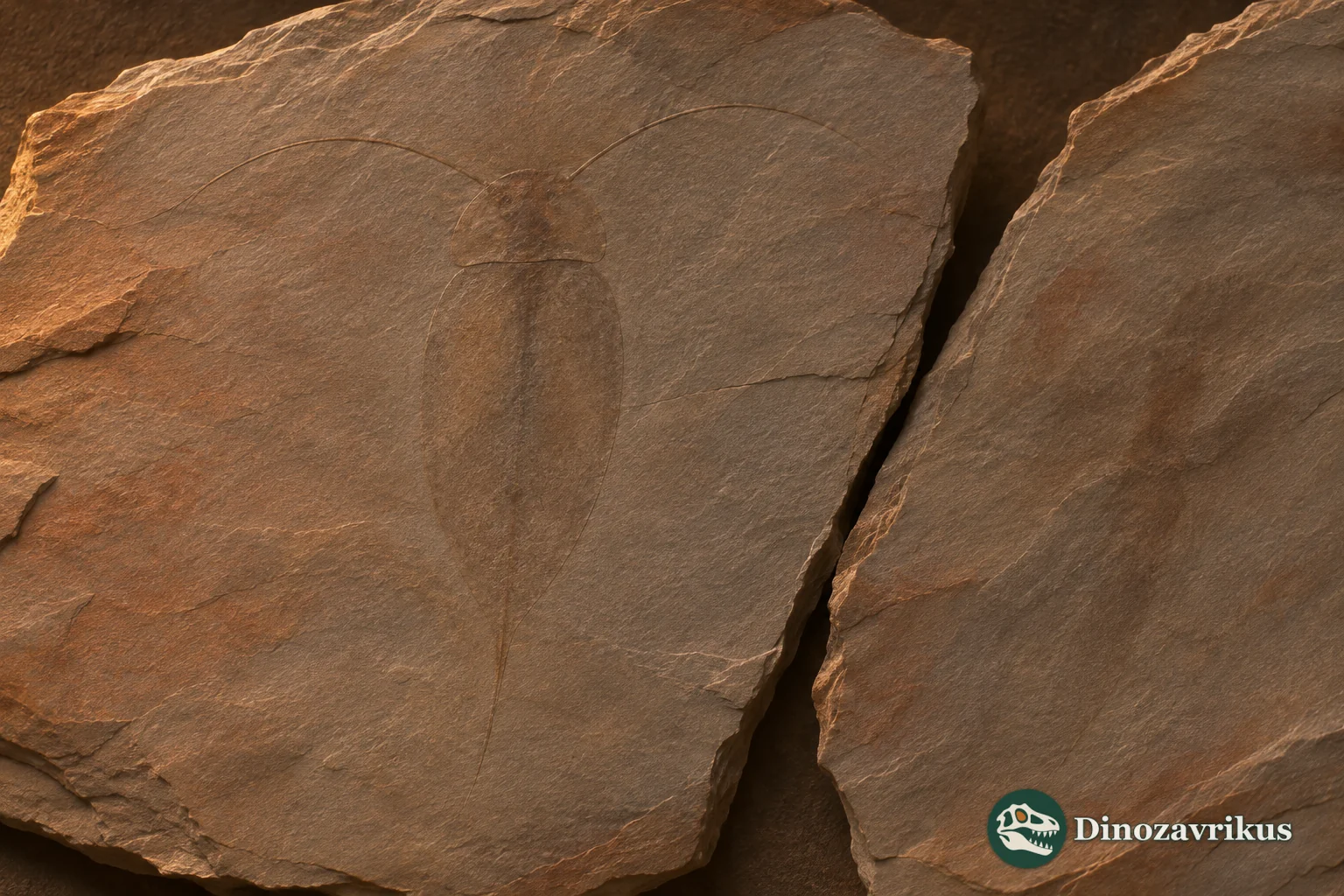
Misszhouia was a Cambrian arthropod in the family Naraoiidae. It carried two smooth dorsal shields, with the posterior one markedly longer. Fossils from China and Canada retain details of the limbs and gut. The Canadian species, in particular, forced a reassessment of some characters used to recognise the group.
Quick facts
| Group | Nektaspids, family Naraoiidae |
|---|---|
| Age | Early and Middle Cambrian |
| Region | Asia (China) and North America (Canada) |
| Diet | Possible predation or scavenging |
| Type species | Misszhouia longicaudata |
| Canadian holotype | ROMIP 64408 |
What can the fossils tell us?
A 2021 revision used the proportions of the two shields and the whole animal to characterise the subgenus.
The front of the gut shows a more elaborate branching pattern than the Chinese type species. Such a pattern does not identify an individual food source.
Chengjiang preserves the Chinese form. The named Canadian species comes from Marble Canyon in British Columbia.
From Chengjiang to the Canadian Rockies
Zhang and Hou described the Chinese species in 1985 as Naraoia longicaudata. Jun-Yuan Chen, Gregory Edgecombe and Lars Ramsköld established Misszhouia in 1997 and named it for the fossil preparator Guiqing Zhou. Chengjiang material from Yunnan preserves details of the two-branched limbs beneath the shields.
Fossils collected at Marble Canyon in British Columbia were reported in 2014. The formal description of M. canadensis appeared in 2019. Its holotype, ROMIP 64408, preserves appendages and a digestive tract with branching caeca near the front.
Why proportions matter
The 1997 diagnosis considered several features, including the direction of the antennae and the small branches of the front of the gut in the Chinese form. The Canadian fossils revealed digestive branches more like those of Naraoia. This weakened the value of gut anatomy as a distinction at generic rank.
In 2021 Adam Bond and Gregory Edgecombe treated Misszhouia as a subgenus of Naraoia. In their revised diagnosis the posterior shield is at least twice the length of the anterior shield, and the trunk accounts for more than 65 per cent of the overall length. The proportions remain measurable in many fossils that do not preserve soft tissues.
What the fossils imply about feeding
Limb bases and digestive anatomy suggested hunting or scavenging in the Chinese species. In the Canadian species, the development of the anterior digestive branches led researchers to propose opportunistic scavenging. Neither anatomical argument establishes a particular prey item or a single feeding strategy for all species.
Frequently asked questions
Was Misszhouia a trilobite?
It was a nektaspid in the naraoiid family. Its paired dorsal shields lacked the exposed row of thoracic segments typical of trilobites.
Where has Misszhouia been found?
Named species come from Chengjiang in Yunnan, China, and Marble Canyon in British Columbia, Canada.
Is Misszhouia a separate genus?
It was named as a genus in 1997. A 2021 revision treated it as a subgenus within Naraoia.
What did Misszhouia eat?
Hunting and scavenging have both been proposed. The fossil anatomy cannot establish particular foods.