

Mixotoxodon was a large plant-eating notoungulate in the toxodontid family. The best documented name, M. larensis, was established on Venezuelan jaw material and later recognised across a broad part of the Americas. Its record extends into Central America and Mexico, making it unusually far ranging for a lineage rooted in South America. Most evidence is dental, so a familiar rhino-like silhouette remains partly reconstruction.
The South American Toxodon is a relative, but the configuration of lower molar enamel folds helps distinguish the two genera.
Quick facts
| Group | Notoungulata, Toxodontidae |
|---|---|
| Recognised species | Mixotoxodon larensis |
| Named | Richard Van Frank, 1957 |
| Holotype | AMNH 48854, anterior lower jaw |
| Type locality | San Miguel, Lara State, Venezuela |
| Recorded region | South and Central America and Mexico |
What can the fossils tell us?
AMNH 48854 contains the front of a lower jaw, including incisors and premolars. Other type-series jaws preserve molars; the type is not a complete skeleton or a measured whole-body mass.
Enamel isotopes in Honduran toxodonts fit mixed C3 vegetation. They do not identify every food plant or demonstrate a permanent aquatic habitat.
Mene de Inciarte was radiocarbon dated through collagen from associated xenarthran osteoderms, near 25.5–28 thousand years. Neither the Venezuelan type jaw nor each later Mixotoxodon tooth was dated directly by that measurement.
Simpson's collection and Van Frank's name
George Gaylord Simpson collected fossil mammals near San Miguel, Lara State, in 1938 and 1939. Richard Van Frank studied the toxodontids and named Mixotoxodon larensis in a 1957 American Museum Novitates paper. San Miguel lies southwest of Barquisimeto. The generic name refers to a mixture of dental characters formerly used to separate toxodontid groups, while the species name refers to Lara.
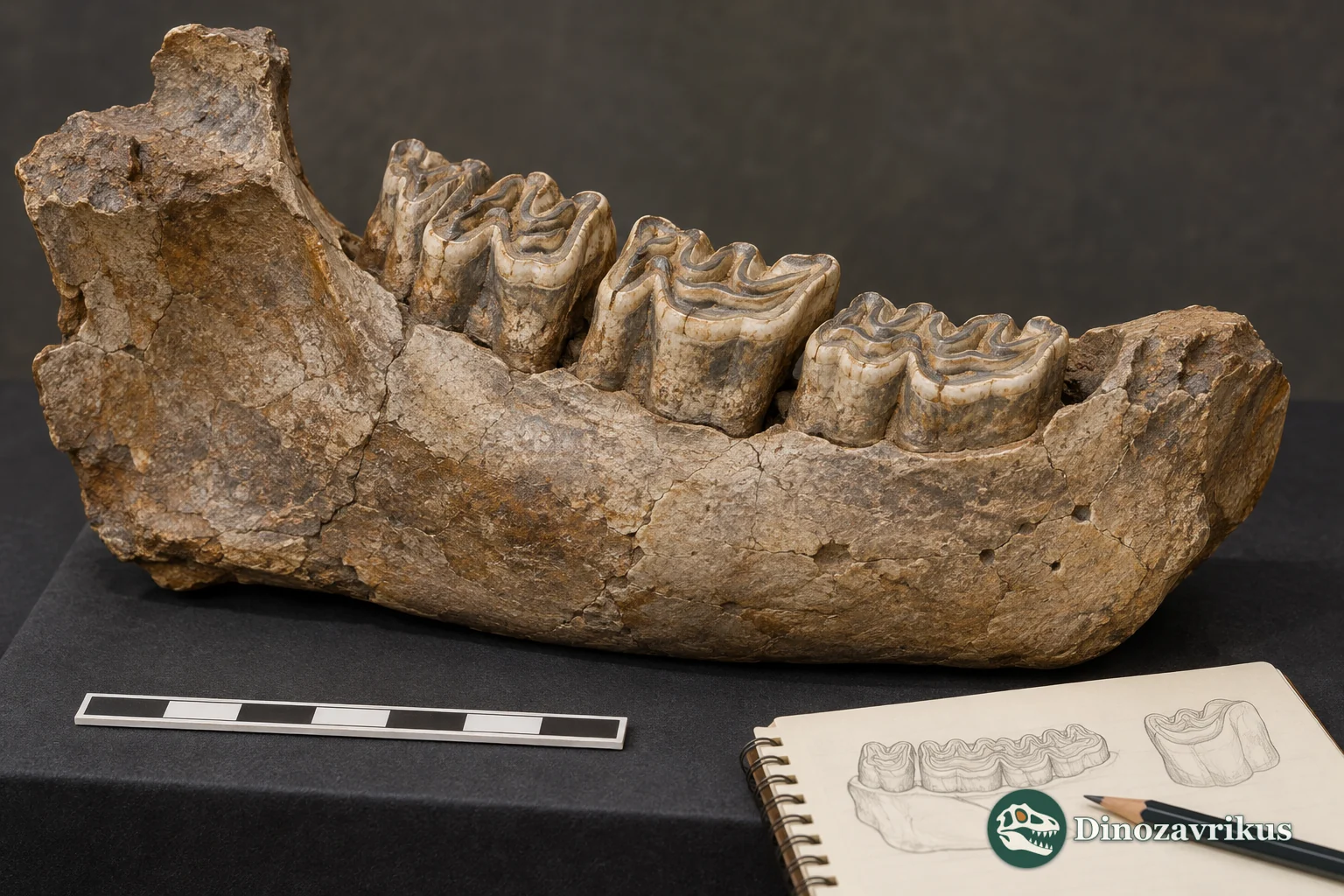
AMNH 48854, the holotype in the American Museum of Natural History, is an anterior mandibular symphysis retaining incisors and premolars. Paratypes AMNH 48851 and 48852 preserve separate portions of the lower jaw and molars. These are distinct fossils, not one articulated skeleton. A later comparison detailed the type series and showed why molars from several individuals are important for identification.
The diagnostic folds and their variation
Toxodontid cheek teeth were high crowned and continuously growing. In Mixotoxodon, the arrangement of lower molar enamel folds changes from m1 to m2 and m3 in a pattern used to separate it from Toxodon. Abrasion can obscure the same pattern, especially in isolated or heavily worn crowns. A single unfamiliar tooth therefore does not always yield a secure species name.
Late Pleistocene fossils from Tamaulipas confirmed the taxon in northern Mexico. A study of molar measurements and lingual folds proposed that some differences previously emphasised taxonomically may reflect sexual dimorphism or size variation. That is a population-level interpretation, not a way to assign sex to every isolated fossil.
A dated Venezuelan tar pit and a flexible diet
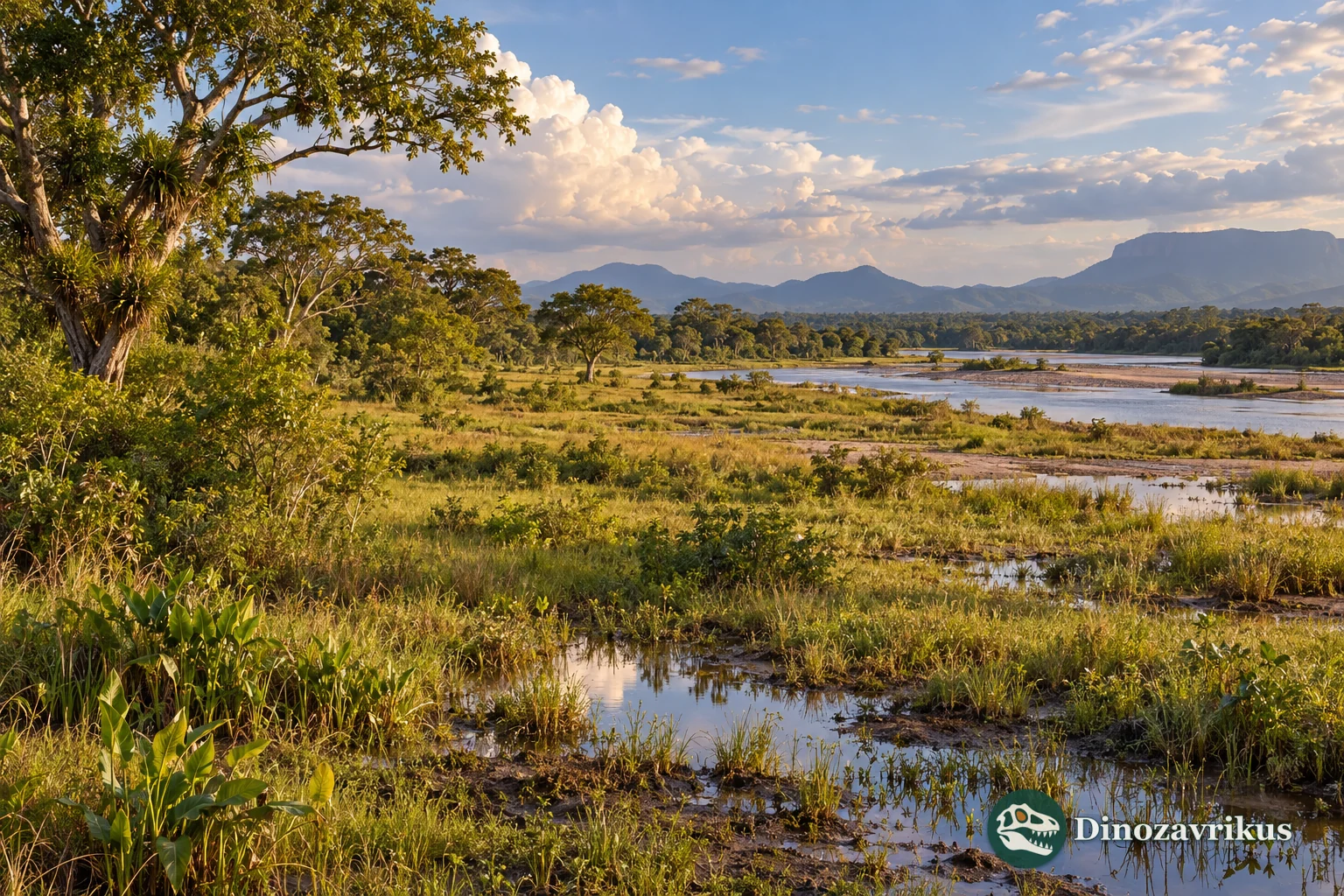
Further jaw and tooth remains came from Mene de Inciarte in Zulia, Venezuela. Radiocarbon measurements on collagen from associated xenarthran armour plates place parts of the assemblage around 25.5–28 thousand years ago. The dated material is not the San Miguel holotype. Faunal and sedimentary observations indicate an open savanna with isolated trees in lower levels and denser vegetation in a middle level, illustrating local environmental change rather than a genus-wide habitat preference.
Bruce MacFadden analysed isotope signatures from 47 toxodont teeth across several South and Central American regions. Honduran specimens yielded a signal compatible with mixed C3 vegetation rather than an exclusive grass diet. High crowned teeth alone do not fix the menu; enamel chemistry also averages intake over time and cannot name a plant species eaten by a particular individual. No complete type skeleton establishes one directly measured mass for all Mixotoxodon. The cover's body proportions and fur are comparative art, and a hippo-like life in water is not established by the jaw or isotopes.
Frequently asked questions
Is Mixotoxodon another name for Toxodon?
No. Both are toxodontids, but their lower molar enamel folds support separate generic diagnoses.
What is the holotype of M. larensis?
AMNH 48854 from San Miguel in Lara State is the front part of a lower jaw with incisors and premolars.
Does the fossil evidence show an aquatic animal?
No. Local sediments and tooth isotopes provide environmental and dietary clues, but they do not demonstrate a permanently semi-aquatic lifestyle.
How old are the Mene de Inciarte remains?
Associated levels have radiocarbon estimates around 25.5–28 thousand years based on other mammals' osteoderms, not a direct measurement of each Mixotoxodon fossil.