

Moeritherium was an early proboscidean known from late Eocene deposits of North Africa. Fossils from Egypt’s Fayum Depression have made it important for studying early proboscidean diversity, but it was not a direct ancestor of living elephants: it represents a side branch of the order’s early history.
The genus belongs in the ancient mammal catalogue. It is often compared with later proboscideans such as elephant evolution, a wider overview of branching history that does not imply direct ancestry.
Quick facts
| Scientific name | Moeritherium Andrews, 1901; type species M. lyonsi |
|---|---|
| Group | Proboscidea; family Moeritheriidae |
| Age | Late Eocene; some records approach the Eocene–Oligocene boundary |
| Range | Fayum, Egypt, and separate Libyan localities |
| Type material | Nearly complete lower jaw of M. lyonsi, CGM C.10000 |
| Ecological evidence | Dental microwear and stable isotopes from tooth enamel |
| Key limitation | Evidence supports partial aquaticity but not a direct ancestry to living elephants |
What do Moeritherium’s teeth and isotopes show?
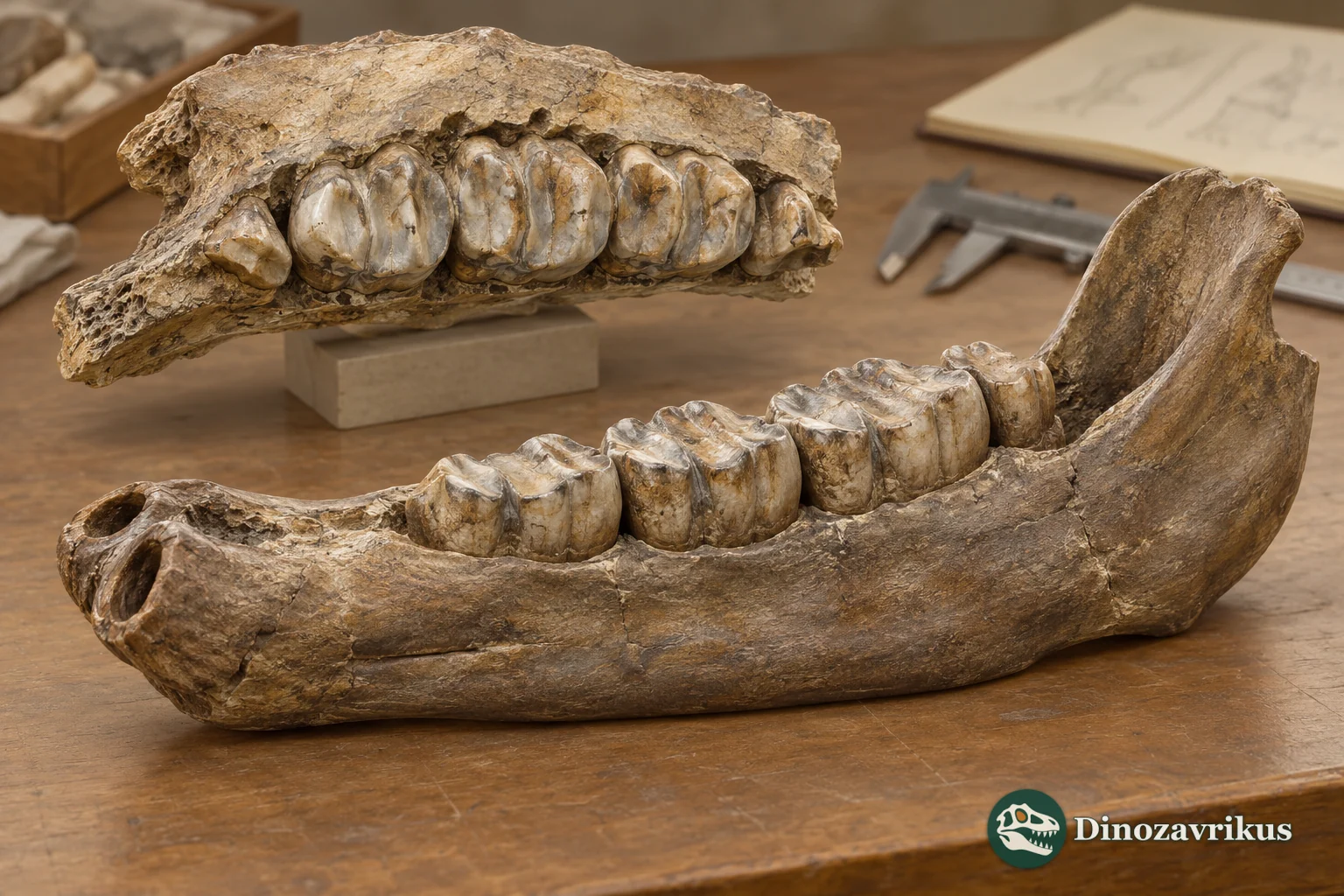
The type species Moeritherium lyonsi is based on the nearly complete lower jaw CGM C.10000 from the Fayum. It documents jaw and tooth anatomy but does not preserve a complete body or soft tissues.
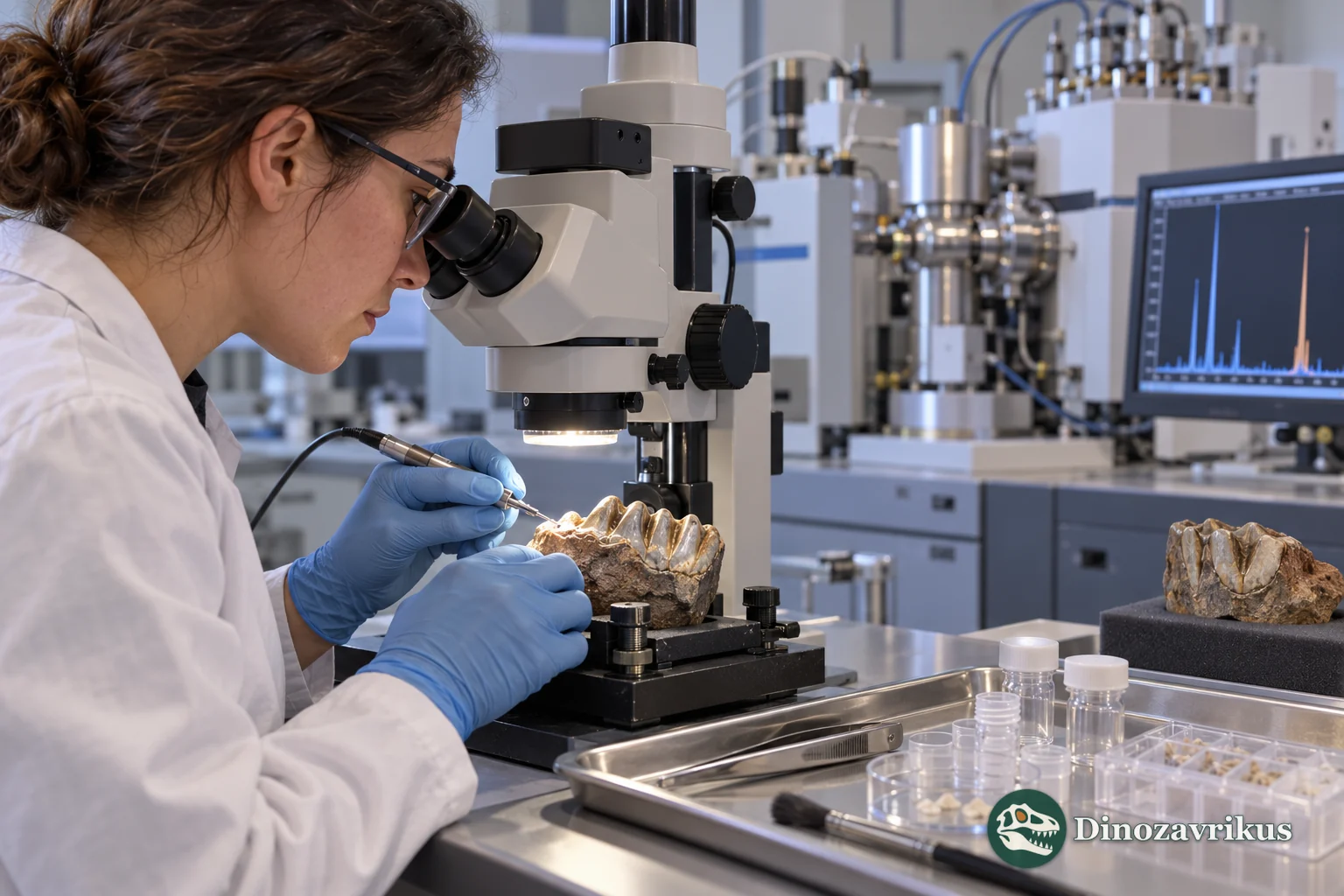
Oxygen isotope values in enamel were low and showed little variation, while carbon values were consistent with freshwater plants and possibly some terrestrial vegetation. The authors considered the combined evidence compatible with semiaquatic life; isotopes do not record how long an individual spent in water.
A 2026 study compared scratches and pits on M. lyonsi and M. trigodon teeth with those of living animals. The pattern better fits browsing on soft vegetation, perhaps near water, than the heavy grazing signal of hippopotamuses. Microwear cannot identify the exact plants eaten.
Recent treatments commonly distinguish M. lyonsi, M. trigodon and M. chehbeurameuri. The species are associated with different layers and localities; older names and boundaries have been reassessed.
Discovery and the type material
Charles William Andrews described Moeritherium lyonsi in 1901 from a nearly complete lower jaw collected in the Fayum. Catalogued as CGM C.10000, this specimen anchors the type species. It preserves a useful tooth row and jaw outline, but it cannot answer questions about the animal’s full body shape, trunk, colour or other soft tissues.
Several forms were named from North African localities during the early twentieth century. Later revisions compared teeth and cranial fragments and reconsidered their boundaries. Current studies commonly recognize M. lyonsi, M. trigodon and M. chehbeurameuri, while some older names have been synonymized or treated as insufficiently diagnosed. Finds therefore need to be tied to a species and horizon rather than generalized across the genus.
Teeth and feeding
Microscopic scratches and pits formed on Moeritherium molars during chewing. A 2026 study compared wear on M. lyonsi and M. trigodon teeth with patterns in living herbivores. The results support browsing on soft vegetation and differ from the intense scratching associated with grazing hippopotamuses. The authors considered frequent feeding in or near water possible.
These data do not reveal a precise menu. Microwear reflects food properties and particles entering the mouth, and comparisons with living animals are analogies rather than preserved gut contents. The 2026 paper describes the wear pattern as a narrower browsing signal than in living elephants; it does not identify particular plant species.
Isotopes and the connection with water
In 2008, Alexander Liu, Erik Seiffert and Elwyn Simons measured oxygen and carbon isotope ratios in tooth enamel of late Eocene proboscideans, including Moeritherium. Low oxygen values with little variation were compared with patterns in modern aquatic and semiaquatic mammals. Carbon values were consistent with freshwater plants, although some terrestrial vegetation could not be excluded.
The authors considered the combination of isotopes, dental functional morphology and depositional setting best explained by at least partly aquatic life in freshwater swamps or riverine habitats. This is an inference from several evidence lines, not direct observation of behaviour. Isotope values depend on local water and geology, and an animal could move between wet and dry areas.
Habitat and body form
The late Eocene Fayum included coastal, riverine and marsh environments. The placement of fossils in formations such as Birket Qarun and Qasr el-Sagha helps reconstruct regional change, but not every species came from the same layer. M. chehbeurameuri is associated with older late Eocene deposits, while M. lyonsi is known from the Qasr el-Sagha Formation. M. trigodon has been reported from younger horizons, including strata near the Eocene–Oligocene transition.
Jaws and teeth preserve the chewing apparatus, and scattered bones provide evidence for parts of the skeleton. Reconstructions often show a low-bodied animal with short limbs and enlarged incisors, but proportions remain generalized without a complete articulated skeleton. The upper and lower incisors were enlarged; that does not make them elephant-like tusks in the later sense. The position of the nasal openings does not prove a long trunk, whose precise form is unknown.
Classification and limits of reconstruction
Moeritherium is a proboscidean usually placed in Moeritheriidae. Its combination of traits helps document early diversity within the order, but resemblance to later forms does not establish direct ancestry to elephants. Relationships among early proboscideans are assessed from anatomical characters and may change as new fossils and analyses become available.
Fossils most securely document tooth and jaw structure. Microwear and isotope measurements provide research-based inferences about food and habitat. The available evidence does not establish an exact body mass, running speed, coat, colour or the shape of a soft trunk. The image on this page is one artistic reconstruction, not a preserved outline.
Frequently asked questions
When did Moeritherium live?
The genus is known mainly from late Eocene deposits in Egypt and Libya. Some M. trigodon records come from horizons near the Eocene–Oligocene boundary, so age depends on the species and locality.
Was Moeritherium an ancestor of modern elephants?
There is no basis for treating it as a direct ancestor. Moeritherium was an early proboscidean important to the order’s history, but it represented a separate branch.
What did it eat?
Enamel microwear and isotope data are consistent with plant feeding and possible consumption of soft aquatic vegetation. These methods cannot identify exact plants or reconstruct an individual’s menu.
Do fossils prove it lived in water?
Isotopes, dental wear and depositional context support a partly aquatic ecology. They do not show that Moeritherium stayed underwater continuously or spent a known fraction of each day there.