

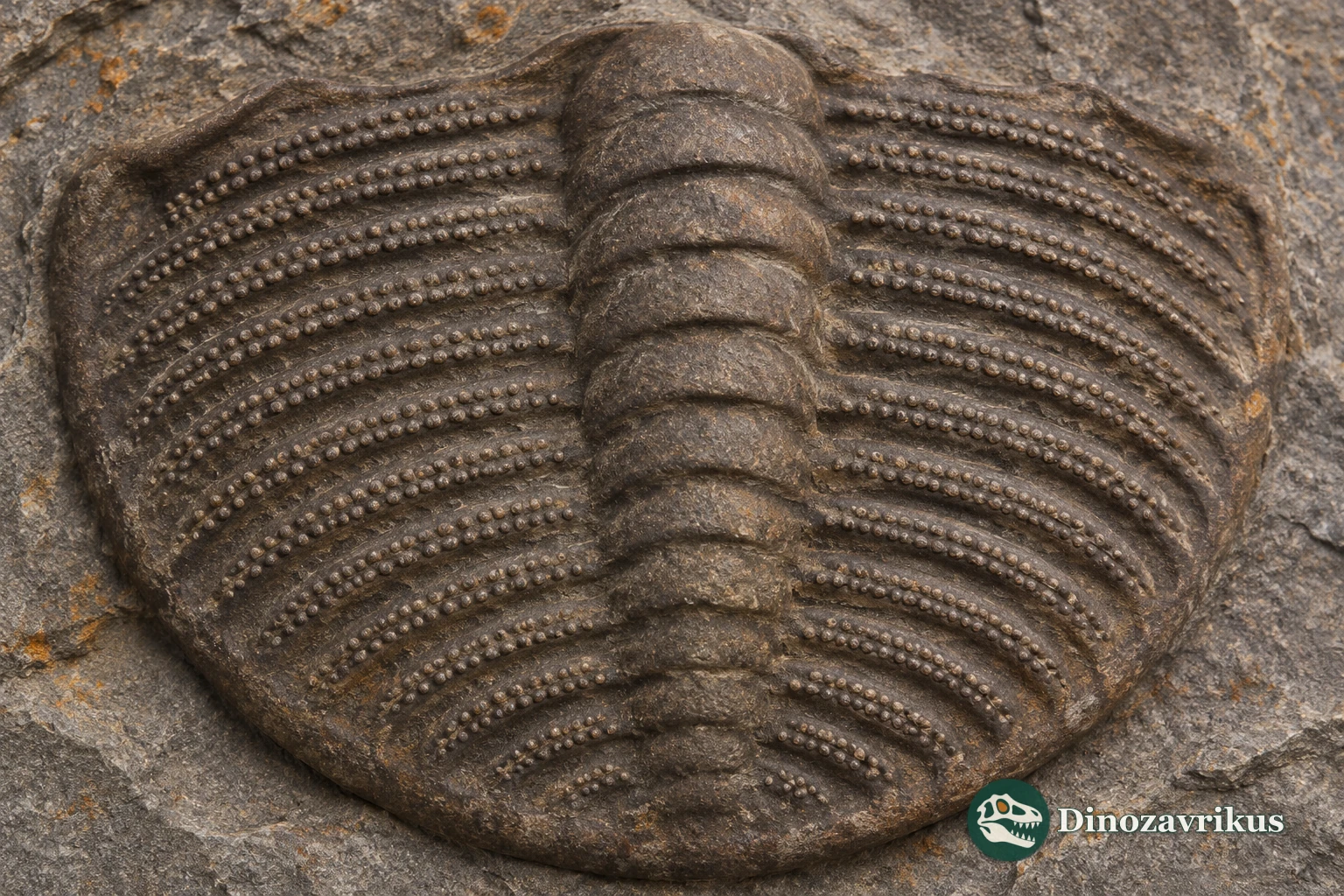
In Monodechenella, a pair of deep grooves cuts into the rear of the broad glabella at the centre of the head. The tail ribs carry rows of tiny tubercles. New York and Michigan fossils preserve enough of these features to compare shells from both regions.
Quick facts
| Group | Proetida |
|---|---|
| Type species | Monodechenella macrocephala |
| Type species age | Middle Devonian |
| Named by | Erwin Stumm, 1953 |
| Type species range | Eastern United States |
| Measured shell | About 6 cm, New York |
What can the fossils tell us?
The front grooves are usually subdued or absent. A damaged head shield can conceal the relevant features.
They record shell structure. They do not establish what the animal ate.
The comparison used head and tail morphology together. The overall outline was only part of the evidence.
The name of the genus
James Hall named the type species Proetus macrocephalus in 1861. In 1953 Erwin Stumm selected it as the type species of his new subgenus Dechenella (Monodechenella). He cited New York State Museum syntypes 13994/1–5.
Bruce Lieberman later treated Monodechenella as a genus in his revision of North American proetids and named M. legrandsmithi. In Dechenella proper, three pairs of glabellar furrows are usually distinct. The rear pair is by far the most evident in Monodechenella.
Head and tail sculpture
The glabella is broad, convex and tapers only slightly at the front. Deep grooves near its rear isolate two roughly triangular lateral lobes. The thorax has a broad, elevated axis and deep grooves on its flanks.
The tail has strongly convex ribs and an arched axis. Small raised tubercles ornament the shell, forming paired rows on the tail segments. An illustrated specimen from the Centerfield Limestone in New York measures about 6 cm. That length pertains to one shell.
From the Appalachian Basin to Michigan
Stumm compared head and tail shields from the Four Mile Dam Limestone in Alpena County, Michigan, with M. macrocephala from the Hamilton Group of New York. The tail shields closely match specimens from the Ludlowville shale. Smithsonian records document additional specimens from Huntingdon County, Pennsylvania.
A 2015 revision of Australian trilobites transferred the Carboniferous M. breviceps from Conophillipsia to Monodechenella. That broader genus concept includes fossils beyond the North American Devonian. The records of the American type species remain Middle Devonian.
Frequently asked questions
Which feature helps distinguish Monodechenella from Dechenella?
The broad glabella of Monodechenella has a conspicuous rear pair of grooves. The front grooves are much weaker or absent.
Why does the type species appear under different genus names?
Hall first described it under Proetus. Stumm moved it to a new subgenus of Dechenella, which later revisions used at genus rank.
Where is the type species known from?
Middle Devonian rocks of eastern North America, including New York, Michigan and Pennsylvania, preserve the species.
How large was Monodechenella?
One illustrated specimen from the Centerfield Limestone is about 6 cm long. Measurements of detached shields apply to those pieces alone.