

Muiscasaurus catheti is an Early Cretaceous ichthyosaur from Colombia’s Paja Formation. Researchers distinguished it by a slender snout, a narrow region behind the eyes, gracile teeth and an unusual external narial opening. It was first known from an incomplete skull; a better-preserved, though still incomplete, skeleton was later referred to the species.
Quick facts
| Type species | Muiscasaurus catheti |
|---|---|
| Holotype | CIP-FCG-CBP-74, partial skull and anterior skeleton |
| Additional specimen | FCG-CBP-16, skull and nearly complete axial skeleton |
| Age | Barremian–Aptian; exact horizon of holotype unresolved |
| Localities | Sáchica and Villa de Leyva area, Boyacá, Colombia |
| Total length | No secure estimate from a complete skeleton |
Evidence guide
The type is a partial, deformed skull with anterior postcranial material. Deformation and incomplete preparation limit some anatomical comparisons.
This subadult has a nearly complete skull and much of the axial skeleton. It improves anatomical comparisons but does not preserve a complete body with known soft tissues.
The narial configuration is a diagnostic feature. It does not establish a special ability to dive, smell or feed.
The position within Ophthalmosauridae is inferred from comparative character matrices, not observed as a direct ancestry.
Two specimens, with different limits
Erin Maxwell, Daniel Dick, Santiago Padilla and Mary Luz Parra described Muiscasaurus catheti in 2016. The holotype, CIP-FCG-CBP-74, came from the Sáchica area of Boyacá. It consists chiefly of an incomplete skull associated with the front part of the axial skeleton. Some skull bones are deformed, making a few original observations difficult to assess.
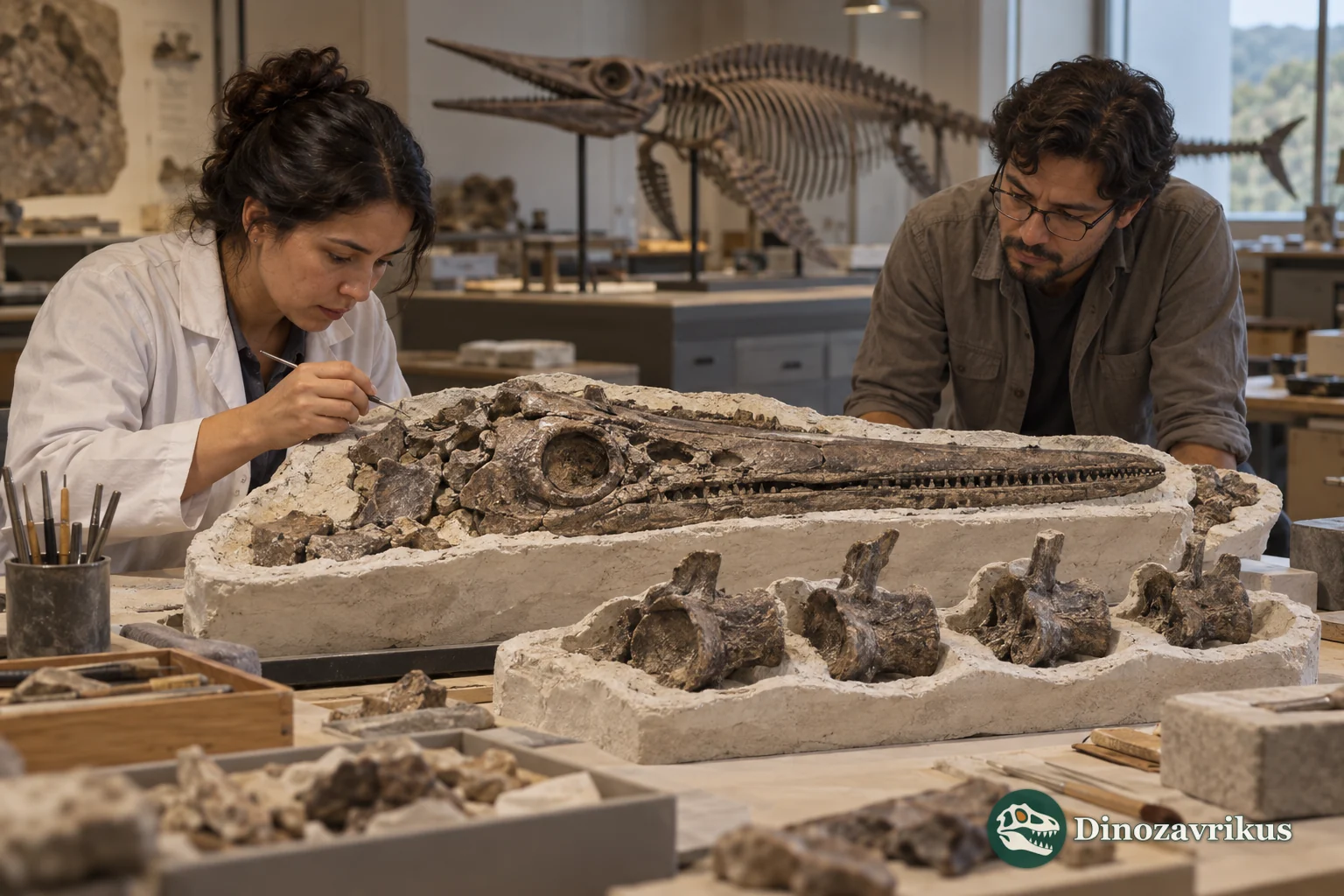
In 2021, María Eurídice Páramo-Fonseca and colleagues described FCG-CBP-16 from Loma La Catalina, about eight kilometres southwest of Villa de Leyva. Members of the Fundación Colombiana de Geobiología collected it in 2006. The fossil was recovered from a large concretion in separate blocks and prepared at the Centro de Investigaciones Paleontológicas. It preserves a nearly complete skull and much of the axial skeleton, including dozens of vertebrae and ribs. The authors proposed it as a benchmark specimen for future comparisons.
The two specimens come from the Paja Formation, but not from one precisely dated bed. The holotype is broadly dated to the Barremian–Aptian interval, whereas FCG-CBP-16 comes from upper Aptian strata. A shared formation does not make every fossil in it the same age.
An unusual narial region
Muiscasaurus has a slender upper jaw, a narrow postorbital region and relatively gracile teeth. Its most conspicuous feature is the external narial opening: a descending process of the nasal nearly meets a small projection of the lacrimal, almost splitting the opening in two. The specific epithet catheti refers to the reported perpendicular arrangement of its two portions.
These details help distinguish the species and compare it with other ophthalmosaurids, including Platypterygius. Partly divided narial openings occur in other ichthyosaurs as well, so the feature alone does not demonstrate direct relationship. Slender teeth may constrain possible prey, but no gut contents or other direct record of diet is known for this species.
Where it fits among ichthyosaurs
The first analysis placed the species among ophthalmosaurids, but its more precise position has varied between phylogenetic studies. The 2021 description recovered FCG-CBP-16 within Ophthalmosaurinae, closer to Ophthalmosaurus, unlike the earlier placement in another branch of the family. Such differences can arise from the taxa included and how individual bones are coded. Ophthalmosaurus is a useful point of comparison, not a demonstrated ancestor.
The better-preserved specimen enabled researchers to revisit features that were obscured or differently interpreted in the holotype. It substantially expands the evidence, but both specimens remain incomplete and the family-level position is still an analytical result rather than a directly observed family tree.
Size, habitat and what remains unknown
The fossils come from marine rocks of the Lower Cretaceous Paja Formation in central Colombia. FCG-CBP-16 is upper Aptian, while the holotype's horizon is not resolved beyond the broad age range of its member. The rocks and associated marine fauna describe the geological setting, not the precise depth at which an individual swam.
A partial skull or axial skeleton cannot establish total body length without a tested model of body proportions. Rounded popular estimates should not be mistaken for a measurement of either type specimen. The fossils also do not establish colour, exact diet, swimming speed, reproduction or social behaviour. The cover is an artistic reconstruction; its colour and soft tissues are not preserved. A much older Triassic ichthyosaur, Hudsonelpidia, illustrates the broad span of time represented among marine reptiles.
Related profiles: Platypterygius · Ophthalmosaurus · Hudsonelpidia.
Frequently asked questions
Where was Muiscasaurus found?
The holotype came from the Sáchica area of Boyacá. The better-preserved FCG-CBP-16 came from Loma La Catalina near Villa de Leyva, Colombia.
What is preserved in the holotype?
CIP-FCG-CBP-74 includes an incomplete, deformed skull and anterior postcranial material. FCG-CBP-16 adds a better-preserved skull and much of the axial skeleton.
What is unusual about its nostril?
Bony processes nearly divide the external narial opening into two parts. This is an anatomical feature, not direct evidence about physiology.
How long was Muiscasaurus?
No secure total length has been established from a complete skeleton. The known skull and axial remains do not directly measure the whole body.