

Mylodon darwinii was a large ground sloth of Pleistocene South America. Its fame rests on more than a spectacular skeleton: Cueva del Milodón in southern Chile preserves bones, pieces of skin and hair, and fossil dung containing plant remains. Together, these finds connect anatomy with diet and chronology.
Mylodon was a plant-eater with a heavy body, powerful limbs and long claws. Artistic images often show ground sloths upright, but that posture is a reconstruction, not a fossil snapshot of everyday behaviour. The genus belongs in the ancient mammal catalogue and must be distinguished from North American Paramylodon, a related but separate genus.
Quick facts
| Scientific name | Mylodon darwinii Owen |
|---|---|
| Type species | M. darwinii |
| Group | Xenarthra, Folivora, family Mylodontidae |
| Age | Pleistocene; reliable Cueva del Milodón dates cluster around 14,000–9,800 radiocarbon years BP |
| Range | Southern South America, especially Argentina and Chile |
| Type material | Paired lower jaws with teeth collected by Charles Darwin at Punta Alta in 1832 |
| Cueva del Milodón material | Bones, skin, hair, coprolites and plant remains |
| Body mass | Often estimated at roughly 1–2 tonnes; model-dependent |
What can the fossils tell us?
The name is anchored to paired lower jaws with teeth collected during the Beagle voyage in 1832. They establish a dental reference for the species, but do not preserve the animal’s fur or complete body.
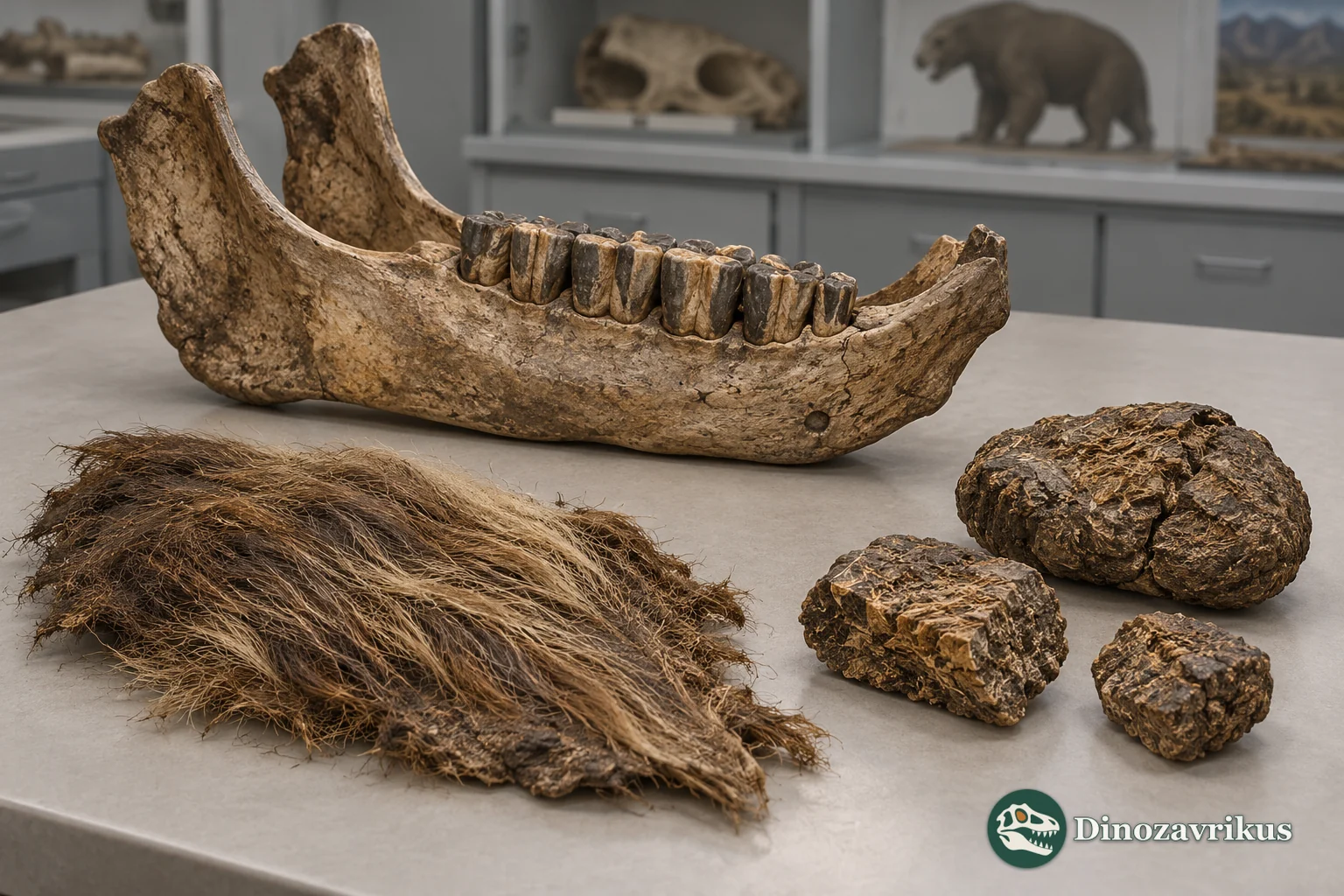
Cueva del Milodón has yielded bones, skin, hair and plant-bearing dung. These are separate lines of evidence and accumulated at different times; a cave assemblage is not automatically one individual or one event.
Pollen and plant fragments in dung can identify foods eaten by particular animals. Cave results cannot be transferred to every region; other evidence permits regional differences between grazing and browsing.
A modern synthesis accepts only a subset of published dates after excluding duplicates, transcription problems and uncertain identifications. Reliable cave dates span approximately 14,000 to 9,800 radiocarbon years BP.
Darwin’s jaw and the name
Charles Darwin collected the lower jaw of Mylodon at Punta Alta, in Argentina’s Buenos Aires Province, in 1832 during the voyage of HMS Beagle. He sent South American fossil mammals to Richard Owen, who described the collection in publications of 1839–1840. Owen introduced the name Mylodon for a large extinct sloth and named the species darwinii in recognition of its collector.
The type of M. darwinii consists of paired lower jaws with nearly complete tooth rows. The Natural History Museum in London records the specimen as NHMUK PV M 16563a, formerly RCS 3490. The jaws anchor the name and allow comparisons of tooth shape and arrangement; they are not a complete skeleton. Early reconstructions of the whole animal therefore depended on comparison with other sloths.
The genus has a complicated taxonomic history. Nineteenth-century authors sometimes grouped South American forms and North American material differently. The North American species once called Mylodon harlani is now usually assigned to the separate genus Paramylodon. Names such as M. robustus and M. listai have also received differing treatments in successive revisions. A historical label reading “Mylodon” may therefore refer to a broader, older concept than the genus used today.
Cueva del Milodón
Cueva del Milodón lies in the Última Esperanza region of southern Chile. Late nineteenth-century collecting brought to light unusually preserved remains, including bones, hide and hair. Cave deposits are heterogeneous and accumulated over time; fossils from the same cave need not belong to one animal or one moment.
Coprolites, or fossilized dung, provide an independent line of evidence. Pollen and plant fragments can reveal what an animal consumed shortly before it died. Hide and hair confirm a dense coat, but a surviving patch cannot reveal the animal’s complete colour pattern or seasonal changes. Museum displays are also not the original cave context: specimens have been collected, prepared and curated.
The radiocarbon record shows why dates must be checked specimen by specimen. Dozens of measurements have been published for bones, skin, hair and dung, but a recent review excluded some as duplicated, incorrectly transcribed or uncertain in their identification. The accepted reliable dates from the cave span roughly 14,000–9,800 radiocarbon years before present. This describes a particular cave record, not exact first and last appearance dates for the whole genus.
Body, coat and size
Mylodon belonged to Mylodontidae, a ground-sloth family with a robust body plan and distinctive teeth. Better skeletal material provides evidence from the skull, vertebral column, pelvis and limbs. Comparisons across localities require care because not every set of bones is an articulated skeleton from one individual.
Length estimates near three metres and body-mass estimates around one to two tonnes are often quoted for large adults. Mass is calculated from bone dimensions or comparative equations; no living animal was weighed, and the result depends on which bones and model are used. A range communicates the uncertainty better than a single dramatic number.
Fossil skin, hair and skeletal remains support a large, heavy, four-limbed animal with a substantial coat. Strong forelimbs and large claws were suited to grasping and pulling vegetation. Some ground sloths may have reared while braced by the hindlimbs and tail, but for Mylodon this is a functional reconstruction from skeletal mechanics, not a habitual movement directly recorded by trackways. The presence of hair is evidenced; its exact colour is unknown.
Diet and habitat
Plant-eating is supported by both the tooth system and coprolites. Cave samples contain plant fragments and pollen, and some studies infer a substantial grass component. Evidence from other regions allows selective browsing on leaves and shrubs. These results need not conflict: South America included different habitats, and diet could vary with place, season and available plants.
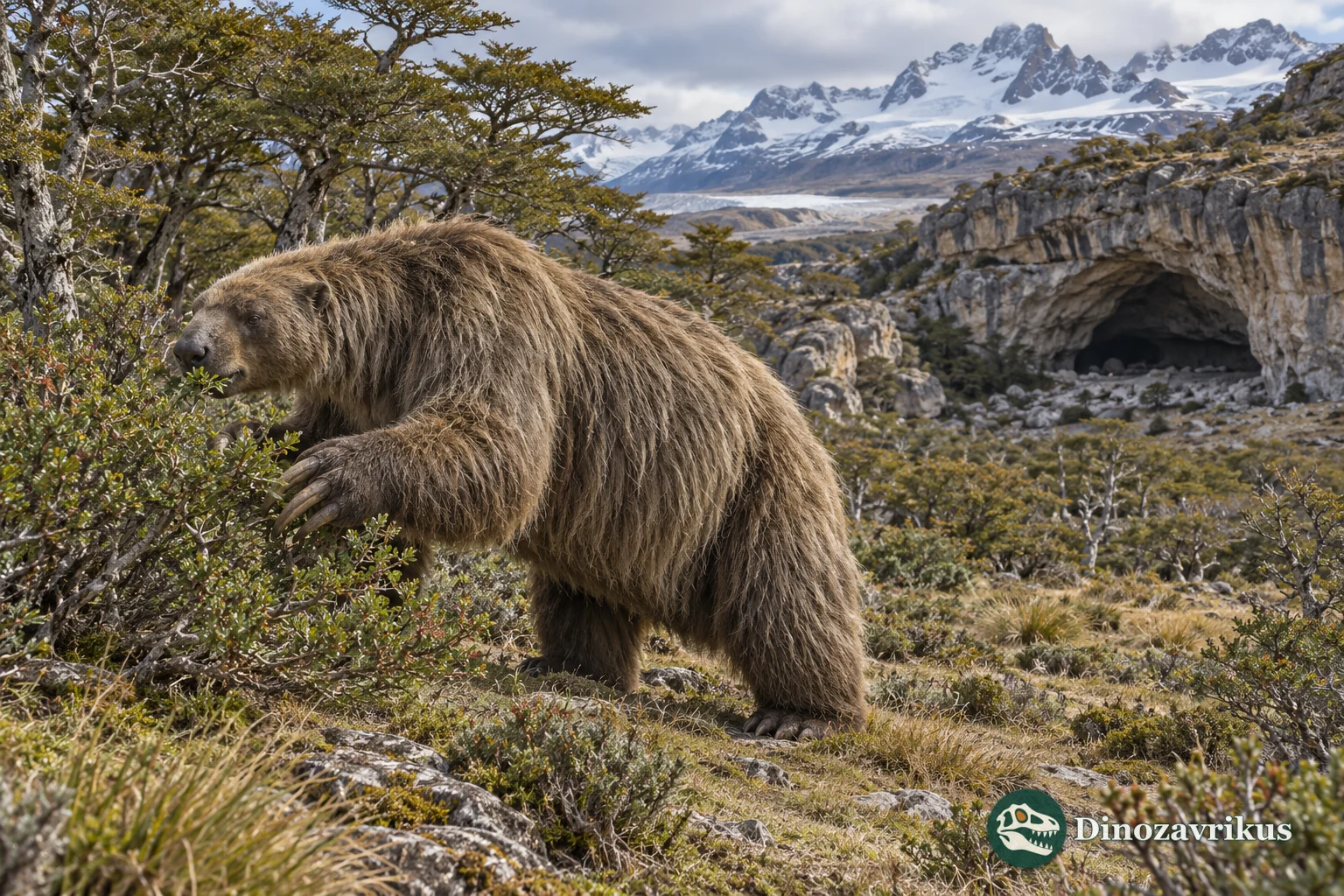
Mylodon lived in southern South America alongside other Pleistocene mammals. Its remains inside a cave do not prove that it lived there permanently: bones and dung may have accumulated at different times and through different processes. Human remains or artefacts from the broader region likewise do not, by themselves, establish hunting or direct interaction. Such claims require cut marks, secure contemporaneous dating and archaeological context.
Relationships and extinction
Mylodon darwinii was one South American mylodontid, not a direct ancestor of living sloths. Ground sloths and modern tree sloths belong to the broader group Folivora, but their lineages had diverged long before the late Pleistocene. The giant Megatherium was a more distant ground-sloth relative with a different skull and tooth structure.
Its disappearance cannot be reduced to one cause. Cave dates show that Mylodon remains persisted into late-glacial time, with some measurements close to the beginning of the Holocene. Climate and vegetation change may have altered food resources; humans introduced another possible pressure. The direct contribution of each factor remains difficult to establish. As with other Ice Age animals, temporal overlap is not proof of a single causal explanation.
Frequently asked questions
Were Mylodon and Paramylodon the same animal?
No. Mylodon is a South American genus whose type species is M. darwinii. The North American animal once called Mylodon harlani is now usually placed in Paramylodon.
Was Mylodon hair found in the cave?
Yes. Cueva del Milodón preserves pieces of hide and hair. They confirm a substantial coat but do not establish the animal’s complete colour.
What do the coprolites show?
Plant fragments and pollen in fossil dung help identify foods eaten by animals represented in particular deposits. One locality does not automatically describe diets throughout the genus’s range.
Did humans hunt Mylodon?
Human and late Mylodon remains overlap in parts of South America, but geographic and temporal proximity does not prove hunting. Direct butchery evidence or a secure archaeological association is needed.