

Mythunga camara was named for part of a toothed pterosaur skull from marine rocks in Queensland. The fossil consists of jaw pieces rather than a complete head or winged skeleton. A reinterpretation of its broken front end changed the supposed snout length, and a 2025 study argued that the remaining traits do not distinguish a separate genus. The specimen remains significant even if its name is treated as doubtful.
Quick facts
| Original name | Mythunga camara, Molnar and Thulborn, 2007 |
|---|---|
| Holotype | QM F18896, parts of upper and lower jaws |
| Locality | Dunluce Station near Hughenden, Queensland |
| Rock unit | Toolebuc Formation, late Albian |
| Body material | No associated wings or trunk |
| Current debate | An indeterminate tropeognathine in a 2025 analysis |
What can the fossils tell us?
QM F18896 preserves toothed upper and lower jaw material. Its front tip and postcranial skeleton are absent.
The teeth and jaw margins can be studied, but no stomach contents or prey remains demonstrate a particular diet.
Later work placed the specimen among anhanguerians. A 2025 analysis found the proposed distinguishing features too widespread among relatives.
The wing is unknown, so full size must be inferred from other pterosaurs and cannot be stated as a direct measurement.
A Queensland fossil in a limestone nodule
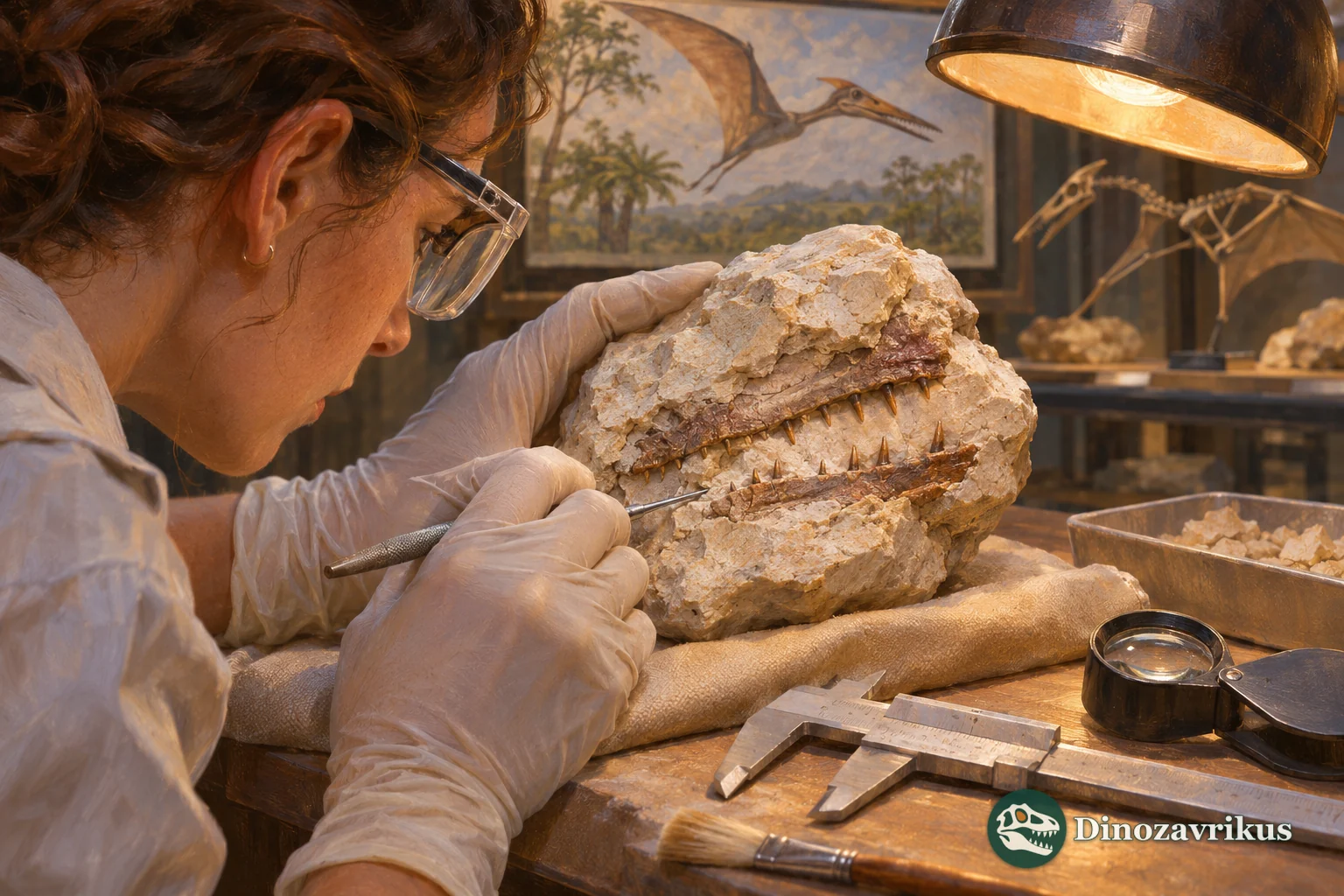
Phillip Gilmore found the fossil in April 1991 at Dunluce Station near Hughenden and donated it to the Queensland Museum, where it became QM F18896. Laurie Beirne recognised it as a pterosaur, and Angela Hatch prepared it. Ralph Molnar and Richard Thulborn named Mythunga camara in 2007. The species epithet refers to the chambered interior of its hollow snout.
The specimen came from a calcareous nodule in the marine Toolebuc Formation. Ammonites, other molluscs and scattered ichthyosaur bones were noted in the area. These establish a marine depositional setting, not where the flying animal fed or died. No wing, trunk, leg or complete skull belongs to the holotype.
Why the supposedly short snout changed
The original interpretation treated the preserved portion as most of the anterior skull, implying a relatively short snout. Subsequent workers recognised that its anterior end was missing: the fossil is a middle segment of a longer rostrum. An old short-beaked restoration should therefore not be treated as an observation from the rock.
The jaws bear sizeable conical teeth and locally wavy edges. Early diagnoses used the spacing and relative height of teeth to distinguish the animal. Later comparisons questioned whether these features are unique. Thapunngaka is another Queensland pterosaur known from different jaw material; its fossil cannot simply be attached to the missing front of QM F18896.
From a new genus to a doubtful name
Revisions compared Mythunga with toothed anhanguerians, including tropeognathines. This placement rests on jaw anatomy; no complete skeleton tests it. In 2025, a phylogenetic study argued that the traits proposed as unique to Mythunga are also present in related forms. Its authors called the name a nomen dubium and treated the holotype as an indeterminate tropeognathine. This is a published taxonomic judgement, not a claim that the fossil itself has vanished.
Ferrodraco illustrates how associated postcranial bones can inform the classification of an Australian pterosaur. None is associated with Mythunga. A new specimen would have to be securely linked to the type before it could settle the name's standing.
What living-animal artwork can show
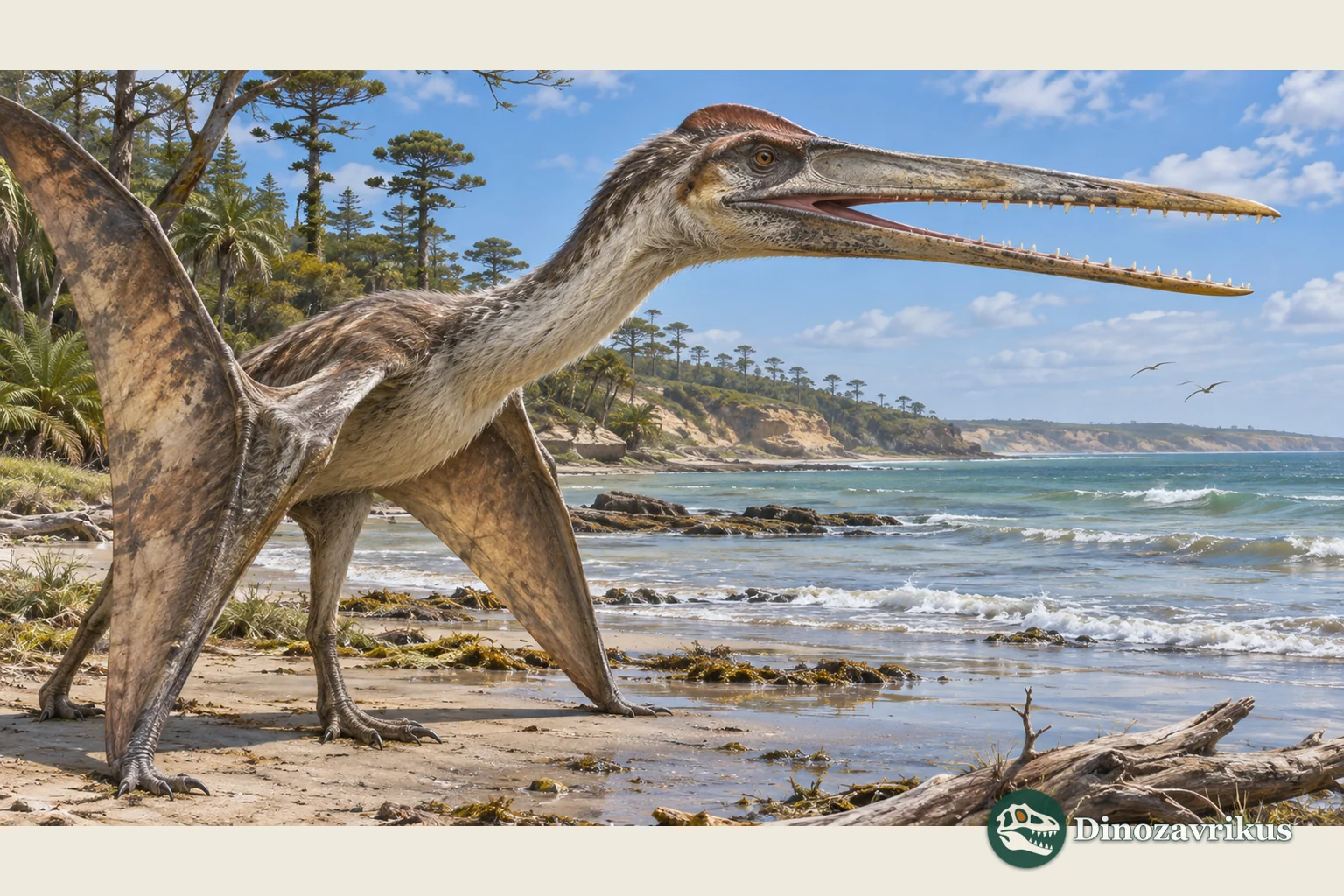
Neither wingspan nor body mass can be measured from the surviving jaw pieces. Their teeth permit discussion of grasping animal prey, but no prey remains identify fish or any other particular food. A coastal setting is consistent with the marine rock, while a specific hunting route is unknowable.
The cover and shoreline scene are artistic reconstructions of an anhanguerian-like pterosaur. Wing outline, full beak, crest, skin and colour remain unverified for QM F18896. Even the continued use of the name Mythunga depends on how future comparisons assess its diagnostic features.
Frequently asked questions
What fossil defines Mythunga?
QM F18896 comprises incomplete upper and lower toothed jaws. No complete skull or associated wing skeleton is known.
Why did early artwork give it a short snout?
The front of the fossil was missing. Later researchers interpreted the preserved piece as part of a longer rostrum.
Is Mythunga still a valid genus?
It was named in 2007, but a 2025 study judged its proposed diagnostic traits insufficient and treated the fossil as an indeterminate tropeognathine.
Can its wingspan be measured?
No. The type specimen lacks wings, so any full-span figure would rely on comparison with relatives rather than direct measurement.