

Nanchangosaurus suni was a small marine reptile from the hupehsuchian lineage of South China. Hupehsuchians are early ichthyosauromorphs, but Nanchangosaurus was neither a dinosaur nor an ichthyosaur in the narrow sense. Two small specimens preserve parts of the skull, vertebral column, ribs, armour and forelimbs.
Quick facts
| Type species | Nanchangosaurus suni Wang, 1959 |
|---|---|
| Age | Upper Spathian, Olenekian, Early Triassic |
| Locality | Nanzhang County, Hubei Province, South China |
| Holotype | GMC V636; referred specimen WGSC 26006 |
| Group | Hupehsuchia, an early ichthyosauromorph lineage |
| Estimated length | Slightly over 40 cm, inferred from incomplete remains |
Evidence guide
GMC V636 preserves a partial skull, vertebrae, ribs, armour and parts of the forelimbs; WGSC 26006 adds anatomical information. They are not a complete skeleton or a large growth series.
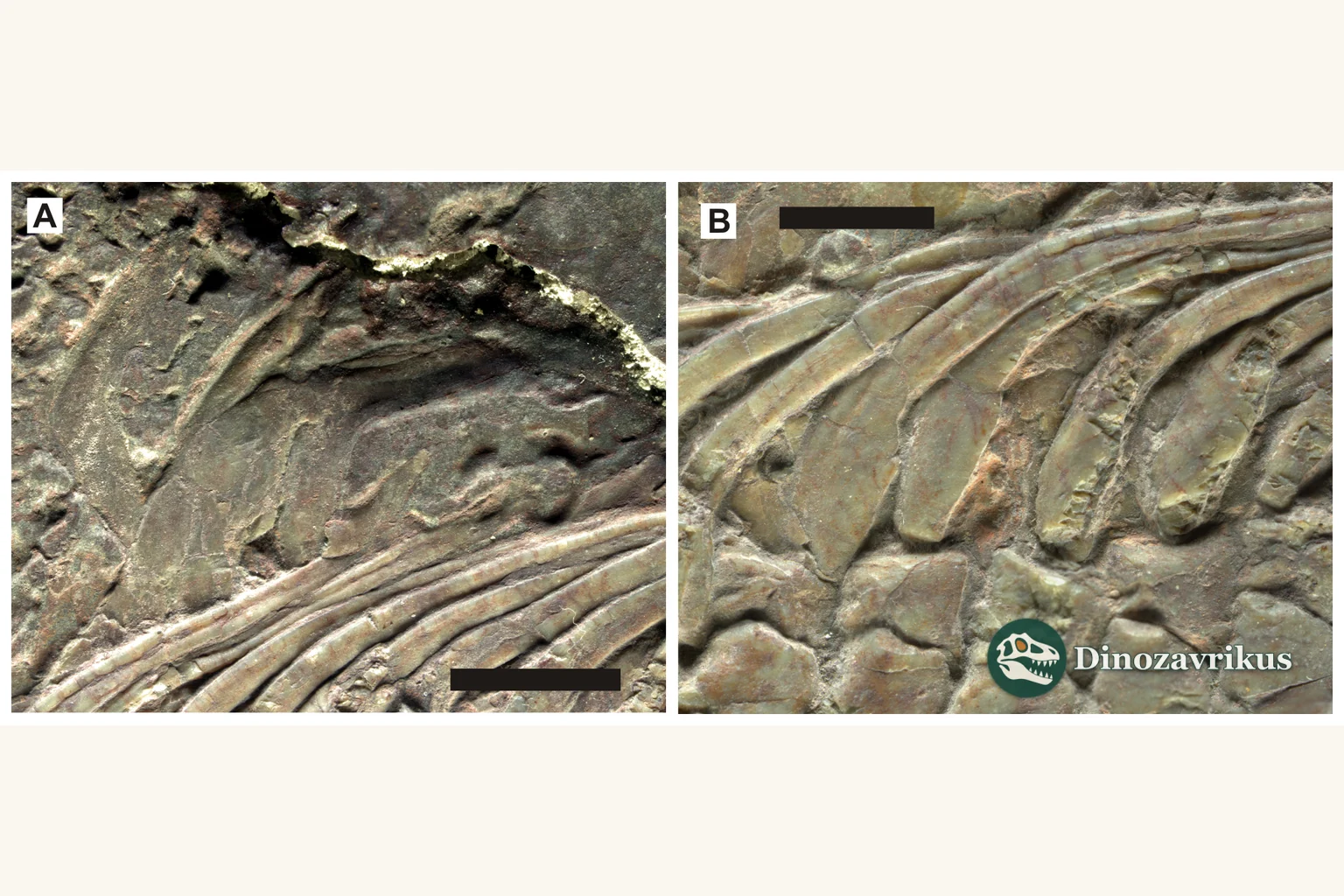
Proximal posterior flanges and flattened, grooved shafts are described in the ribs. Some flanges are damaged, so individual details are not equally clear on every bone.
The described Nanchangosaurus specimens preserve a single layer of dorsal armour. A 2026 study contrasted this with the three layers in a juvenile Hupehsuchus of similar size.
Chen and colleagues retained Nanchangosaurus as a distinct hupehsuchian in 2014. A 2026 juvenile Hupehsuchus of comparable size preserves diagnostic differences, supporting their independence; quantitative tests remain preliminary because the sample is small.
Discoveries from Hubei
Wang named Nanchangosaurus in 1959 from holotype GMC V636. A redescription reports that the type fossil was discovered during house construction near the type locality in Nanzhang County, Hubei Province. Specimen WGSC 26006 later provided additional information on the skeleton.
The material is assigned to the upper part of the Jialingjiang Formation, in the upper Spathian of the Olenekian, Early Triassic. An older report had placed the fossil in the Daye Formation, which led to the idea that it predated Hupehsuchus. The revised local geological context places the forms in a comparable interval.
The holotype preserves 28.4 cm of the skeleton, about 19.6 cm of it precaudal. The referred specimen preserves 18.2 cm, also precaudal. Both lack a similar portion of the snout. Using Hupehsuchus proportions, Chen and colleagues estimated a total length slightly above 40 cm; that figure is inferred, not directly measured from a complete animal.
Ribs, vertebrae and armour
The skull is incomplete and its snout is fragmentary. A partial impression suggests an elongated, broad snout. No teeth are securely identified, so the authors considered the animal likely edentulous by comparison with Hupehsuchus, while noting that preservation limits confirmation.
The holotype has ten cervical and twenty-six dorsal vertebrae; WGSC 26006 has ten and twenty-seven. The dorsal neural spines are bipartite, with faint sutures in some places, and are lower than in some other hupehsuchians. The ribs carry a posterior flange near their base and become flatter distally, where longitudinal striations and a groove are reported. Hupehsuchus has rounder, smoother rib shafts. Lateral gastralia overlap to form part of the body wall.
Dorsal osteoderms are preserved above the vertebral column. The described material shows one armour layer, unlike the three-layer arrangement identified in Hupehsuchus. These features help compare taxa, but the small number and preservation of specimens must be kept in view.
Short forelimbs and incomplete evidence
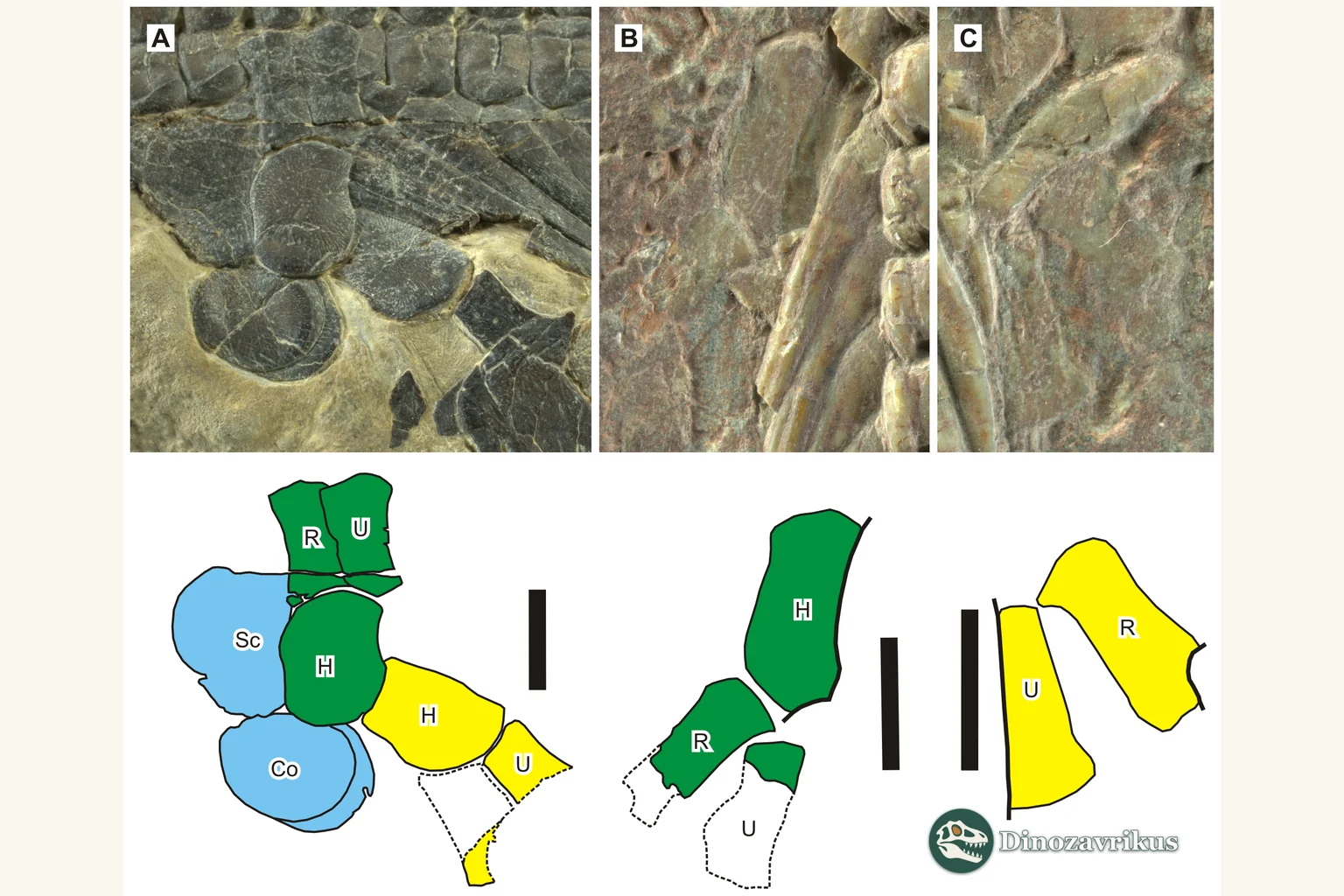
Only the proximal forelimb bones are known: humerus, radius and ulna. They are short and robust relative to those of Hupehsuchus and Parahupehsuchus. The humerus has an anterior flange with a slightly concave margin. Chen and colleagues considered immaturity or paedomorphic anatomy as possible explanations for the limb proportions; the few fossils do not decide between those alternatives.
The figure below shows photographed bones and the authors’ anatomical labels. It is not a complete arm or a life reconstruction.
The comparison with Hupehsuchus
Some researchers have asked whether Nanchangosaurus might represent a juvenile Hupehsuchus because the two genera share many features and early material was limited. A 2014 redescription identified differences in neural spines, ribs and forelimbs and retained Nanchangosaurus as a separate genus. Its broader phylogenetic analysis also showed that inferred aquatic adaptations can strongly affect results, so functional similarity alone does not demonstrate close relationship.
In October 2026, Wang and colleagues described YGM17-1, a juvenile Hupehsuchus nanchangensis from the uppermost Spathian of Yuan’an. Although it is comparable in size to Nanchangosaurus, it has Hupehsuchus traits not found in Nanchangosaurus: the frontal is excluded from the orbital margin and the armour has three layers rather than one. Other features of YGM17-1 show immaturity, including unossified carpals. The comparison supports separate species, while the authors describe their quantitative tests as preliminary because the sample remains small.
What remains uncertain
An elongated snout, lack of confirmed teeth and short forelimbs do not identify exact prey or feeding mechanics. Armour is directly preserved, but its effect on behaviour is not. The body was small, yet size alone cannot establish whether each specimen was juvenile; the comparison with a similarly sized juvenile Hupehsuchus is a reminder to consider multiple anatomical markers.
Hupehsuchians were one of several distinct marine reptile groups in the Early Triassic. The unrelated Triassic form Omphalosaurus offers a useful comparison of how varied marine reptile anatomy could be. The ichthyosaur Mixosaurus belongs to a different lineage, despite sharing the broader marine setting.
Frequently asked questions
Was Nanchangosaurus a dinosaur or an ichthyosaur?
No. It was a hupehsuchian, part of an early ichthyosauromorph lineage. It was neither a dinosaur nor an ichthyosaur in the narrow taxonomic sense.
Where and when did it live?
Its fossils come from Nanzhang County, Hubei Province, South China, in the upper Jialingjiang Formation, upper Spathian of the Early Triassic.
How long was it?
The preserved skeleton is incomplete. A total length slightly above 40 cm was inferred from comparison with Hupehsuchus; it is not a direct measurement of a complete skeleton.
Is Nanchangosaurus a juvenile Hupehsuchus?
Evidence described in 2014 and 2026 supports separate forms, including differences in rib anatomy and armour layers. The 2026 study notes that quantitative tests remain preliminary because the sample is small.