

Nannopterygius was a marine ichthyosaur in the ophthalmosaurid family. Its English type skeleton came from Kimmeridge Clay, while further material assigned to the genus occurs in Russia and the Arctic. A 2021 revision recognized four species, including one from the earliest Cretaceous.
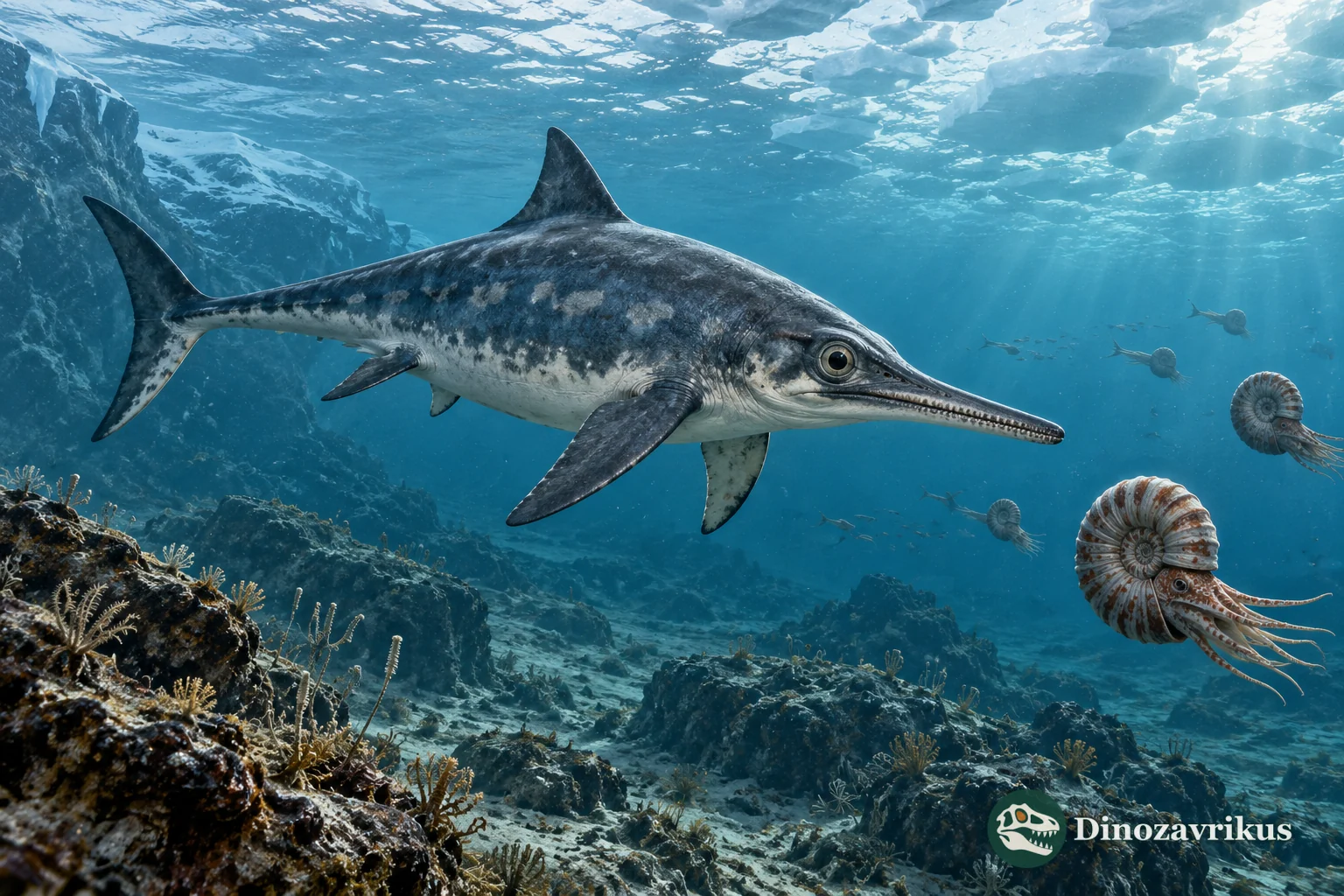
The animals' skin color and behavior are artistic reconstructions. Fossils instead preserve skeletal anatomy that can test how the specimens relate and how far the genus extends through time.
Quick facts
| Type species | Nannopterygius enthekiodon (Hulke, 1871) |
|---|---|
| Genus named | Friedrich von Huene, 1922 |
| Type specimen | NHMUK PV 46497, Natural History Museum, London |
| Group | Ophthalmosauridae |
| Genus range | Kimmeridgian to Berriasian |
| Known regions | England, European Russia and the Arctic |
| 2021 revision | Four recognized species |
What can the fossils tell us?
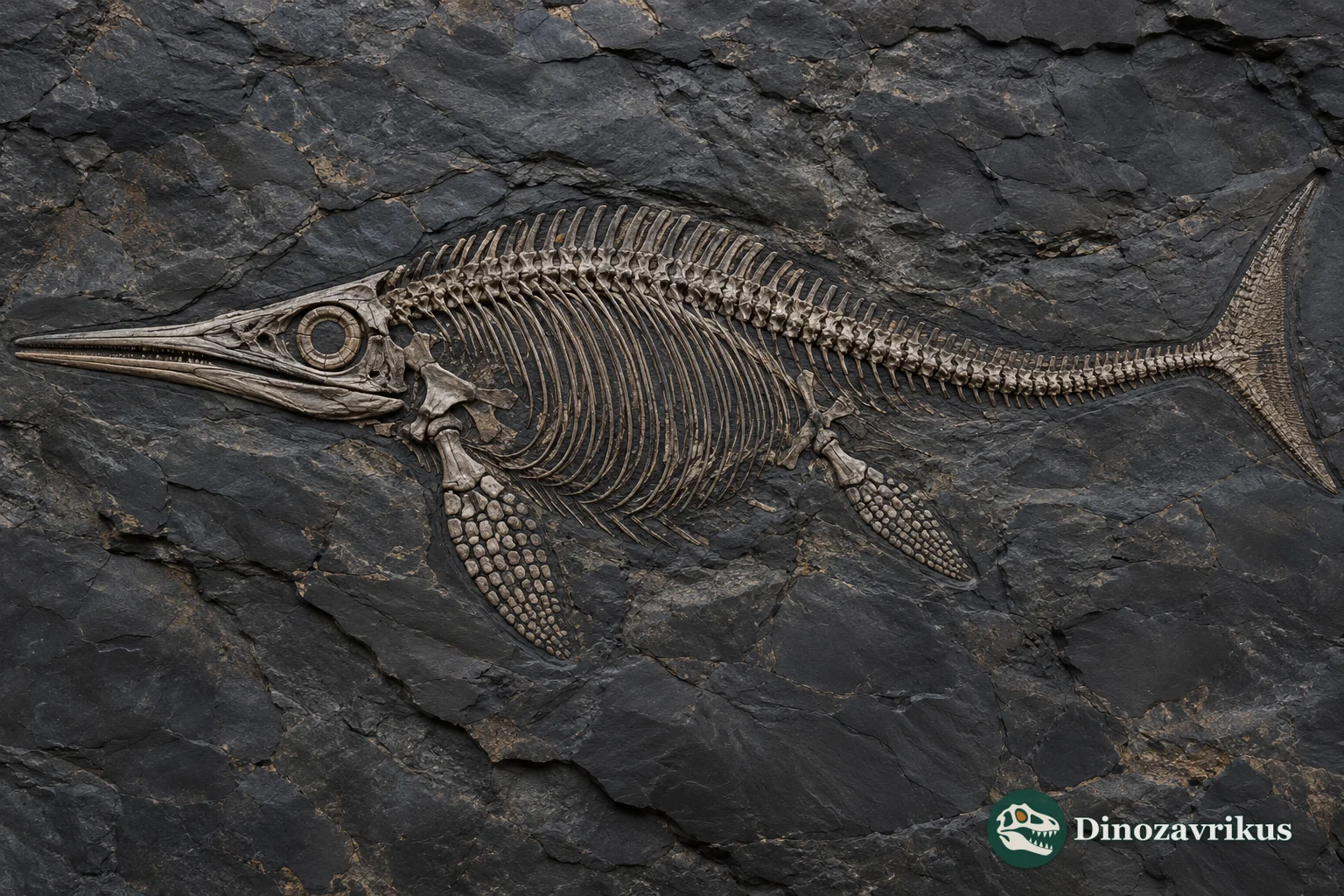
NHMUK PV 46497 preserves much of a skeleton in Kimmeridge Clay. Its exact source horizon is not recorded, so later stratigraphically secure specimens must inform the timing of the type species.
Early descriptions emphasized a small girdle relative to the deep ribcage. Ratios of humerus and coracoid to skull length are comparable with other ophthalmosaurids.
The 2021 revision recognized N. borealis from Arctic Early Cretaceous material. That range belongs to the genus, not to the English type specimen.
The English skeleton and its name
John Hulke described the type species as Ichthyosaurus enthekiodon in 1871. Friedrich von Huene established the genus Nannopterygius in 1922. The holotype NHMUK PV 46497 is a substantial skeleton held in London's Natural History Museum. It came from English Kimmeridge Clay, although the exact bed of the old find was never recorded.
The name evokes small fins, reflecting an early impression of girdle bones against a deep ribcage. The 2021 revision found that humerus and coracoid lengths scaled to skull length were much like those of other ophthalmosaurids. A drawing with exceptionally tiny paddles would overstate the evidence.
Four species and a longer timeline
Nikolay Zverkov and Megan Jacobs compared British museum fossils with Russian specimens formerly assigned to Paraophthalmosaurus and Yasykovia. Their 2021 revision recognized N. enthekiodon, N. saveljeviensis, N. yasykovi and N. borealis. Shared combinations of skull, vertebral and limb features support the grouping; individual species retain diagnostic differences.
Securely dated records of the type species fall in Lower Volgian, or Tithonian, beds. The Arctic N. borealis is Berriasian, extending the genus into the Early Cretaceous. That does not make the English type skeleton Cretaceous. Comparing the genus with Ophthalmosaurus and Arthropterygius helps distinguish related forms; shared aquatic outlines alone cannot establish species identity.
What the fossils cannot show
Bone proportions help reconstruct anatomy, but do not directly yield a measured swimming speed, the color of living tissue or a diet for every species. A broad genus range also does not identify every isolated Arctic bone. The history of ichthyosaurs depends on secure specimen assignments and their own dated layers, not an assumed continuous presence of one species across millions of years.
Frequently asked questions
Where is the type specimen kept?
NHMUK PV 46497, the type skeleton of N. enthekiodon, is held by the Natural History Museum in London.
Did Nannopterygius have exceptionally small fins?
Early descriptions suggested this, but skull-scaled humerus and coracoid measurements resemble those of other ophthalmosaurids.
How many species were recognized in 2021?
The revision recognized four: N. enthekiodon, N. saveljeviensis, N. yasykovi and N. borealis.
Did the genus survive into the Cretaceous?
Yes. Arctic N. borealis is Berriasian, while the English type is Jurassic.