

Nanotyrannus was a predatory theropod from the latest Cretaceous of western North America. Its identity was debated for decades because the original fossil preserves a skull with very little else. New studies approached the question through fine-scale bone structure and direct comparisons with other fossils.
Quick facts
| Group | Theropods, tyrannosauroids (Tyrannosauroidea) |
|---|---|
| Age | Late Cretaceous (late Maastrichtian) |
| Region | North America (Montana, United States) |
| Diet | Carnivorous |
| Type species | Nanotyrannus lancensis |
| Holotype | CMNH 7541, skull and hyoid elements |
| Formation | Hell Creek Formation |
What can the fossils tell us?
The Montana skull carries the name. It also preserves an element of the hyoid apparatus, which provided a sample for microscopic examination.
The authors studied the hyoid of the type specimen and compared it with other reptiles. Work on more complete specimens examined growth in their limb bones.
One revision assigned these fossils to two species of Nanotyrannus. Another proposed placing each skeleton in a different genus.
The Cleveland skull
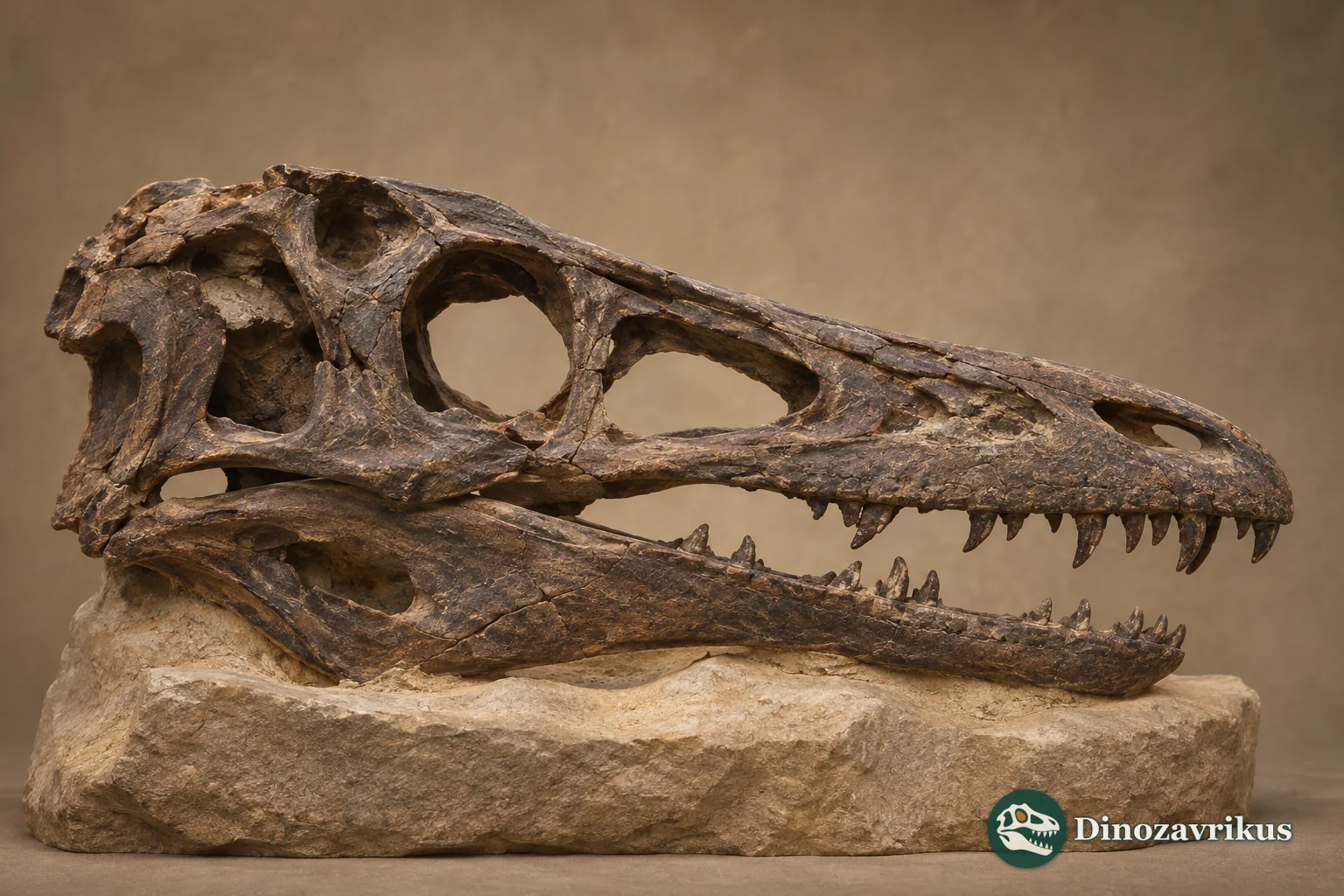
In 1946 Charles Gilmore described CMNH 7541 as a species of Gorgosaurus. Robert Bakker and colleagues erected Nanotyrannus for it in 1988. The skull comes from the Hell Creek Formation of Montana and is kept at the Cleveland Museum of Natural History.
The skull is about 57 cm long. The narrow snout and the teeth can be compared against both young and adult Tyrannosaurus. Its cutting teeth indicate carnivory. That evidence narrows down the feeding mode and leaves the identity of its prey open.
Reading growth in different bones
The Cleveland specimen lacks the long bones commonly sampled to study dinosaur growth. Christopher Griffin and colleagues examined a ceratobranchial from its hyoid apparatus and compared its microscopic structure with that of other dinosaurs and modern reptiles, including birds. The bone record indicated slowing growth. They inferred that the animal was at or near skeletal maturity. The use of hyoid bone as a proxy for the growth of the whole skeleton continues to be debated.
Earlier sections through the leg bones of Jane and another small specimen showed that those individuals had been growing. An expanded 2026 study found that the two growth trajectories were statistically incompatible with the shared model for the other Tyrannosaurus in its sample. The maturity of one fossil and the species identification of other, growing individuals are separate questions.
Why some skeletons still have competing names
In 2025 Lindsay Zanno and James Napoli assigned the nearly mature skeleton NCSM 40000 to the type species based on similarities with the Cleveland skull. They named a second species, N. lethaeus, for the specimen Jane, BMRP 2002.4.1. Their analysis recovered Nanotyrannus outside the family Tyrannosauridae.
In 2026 Franco Sancarlo and Gregory Paul proposed separate genera for NCSM 40000 and Jane. The body proportions of these unusually informative fossils can therefore be described with their specimen numbers. The Cleveland skull remains the name-bearing specimen of N. lancensis under either arrangement.

Frequently asked questions
Where was the Nanotyrannus type found?
It comes from the Hell Creek Formation of Montana. The Cleveland Museum of Natural History holds the skull.
Which bone helped establish its maturity?
An element of its hyoid apparatus. Microscopic structures in the bone indicate that the animal’s growth had slowed markedly.
Was Nanotyrannus a young Tyrannosaurus?
Recent studies support the distinct identity of the type species. The assignment of other small tyrannosaur skeletons remains debated.
Why does Jane have more than one name?
It was made the type of *Nanotyrannus lethaeus* in 2025. A subsequent revision proposed the genus *Gilmoretyrannus* for the same species.