

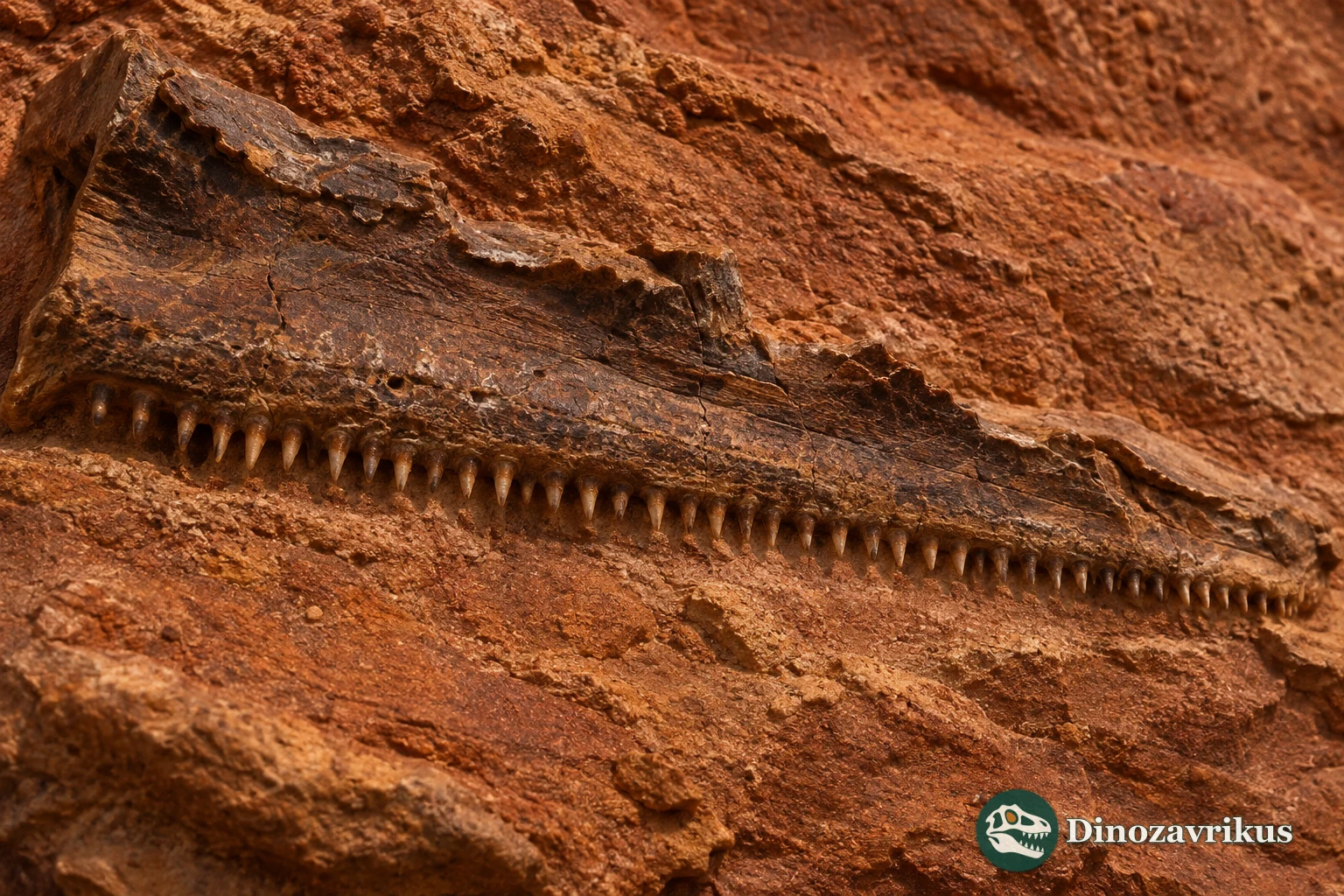
Neldasaurus was a temnospondyl amphibian from the Early Permian of Texas. The front of its flattened skull extended into a long snout, with the two small nostrils close together near the tip. Each side of the upper jaw carried more than a hundred marginal teeth.
Quick facts
| Group | Temnospondyls, trimerorhachids (Trimerorhachidae) |
|---|---|
| Age | Early Permian |
| Region | North America, Texas (United States) |
| Type species | Neldasaurus wrightae |
| Scientific name | Neldasaurus |
| Diet | Exact prey is unknown |
What can the fossils tell us?
Specimen MCZ 2200 preserves most of the skull. Its bones show the outline of the snout and the position of the nostrils.
Comparisons within the trimerorhachid family use the outline of the skull, teeth on the palate and the proportions of the bones in the vertebrae.
The tooth rows show how the jaws were built. Their form alone cannot identify the prey species.
The Texas skull
John Newland Chase described Neldasaurus wrightae in 1965. Its type specimen, MCZ 2200, came from the Terrapin School locality in Archer County and is housed at Harvard’s Museum of Comparative Zoology. Material from the Archer City Formation also preserves elements of the skeleton behind the skull.
A distinctive snout
The stretch of skull in front of the eyes is longer than in Trimerorhachis. In Neldasaurus the lacrimal bone stops short of the nostril, and the two nostrils lie close together near the tip of the snout. These details offer points of comparison even when a skull survives in pieces.
Teeth along the edge and on the palate
Neldasaurus bore teeth on the palate as well as on the margins of the jaws. A pair of large teeth on the ectopterygoid was followed by about twenty smaller ones. An opening in the lower jaw received a large tooth from a bone in the palate called the vomer. Its position shows where that tooth fitted when the mouth closed.
Frequently asked questions
Where was Neldasaurus found?
The holotype comes from the Terrapin School locality in Archer County, north-central Texas.
When did Neldasaurus live?
The fossils are generally assigned to the Early Permian.
How many teeth lined its upper jaw?
The described material had more than a hundred marginal teeth on each side. There were separate sets of teeth on the palate.
Which family did Neldasaurus belong to?
It belongs to Trimerorhachidae, a family of temnospondyl amphibians that also includes Trimerorhachis.