

Notochampsa istedana was a small crocodile relative from the Early Jurassic of South Africa. Its only known skeleton lies in a block of fine sandstone. More than a century after it was named, researchers placed the fossil in a measured geological section and used CT to see part of the jaw inside the rock.
Quick facts
| Species | Notochampsa istedana |
|---|---|
| Family | Notochampsidae in the 2021 analysis |
| Age | Early Jurassic, Pliensbachian |
| Locality | Funnystone farm near Rhodes, Eastern Cape, South Africa |
| Holotype | SAM-PK-4013, partial skeleton and skull |
| Rock unit | Fine sandstone of the Clarens Formation |
What can the fossils tell us?
Field measurements place the source exposure about 65 metres above the Elliot–Clarens boundary. They constrain its stratigraphic position without directly dating the bone.
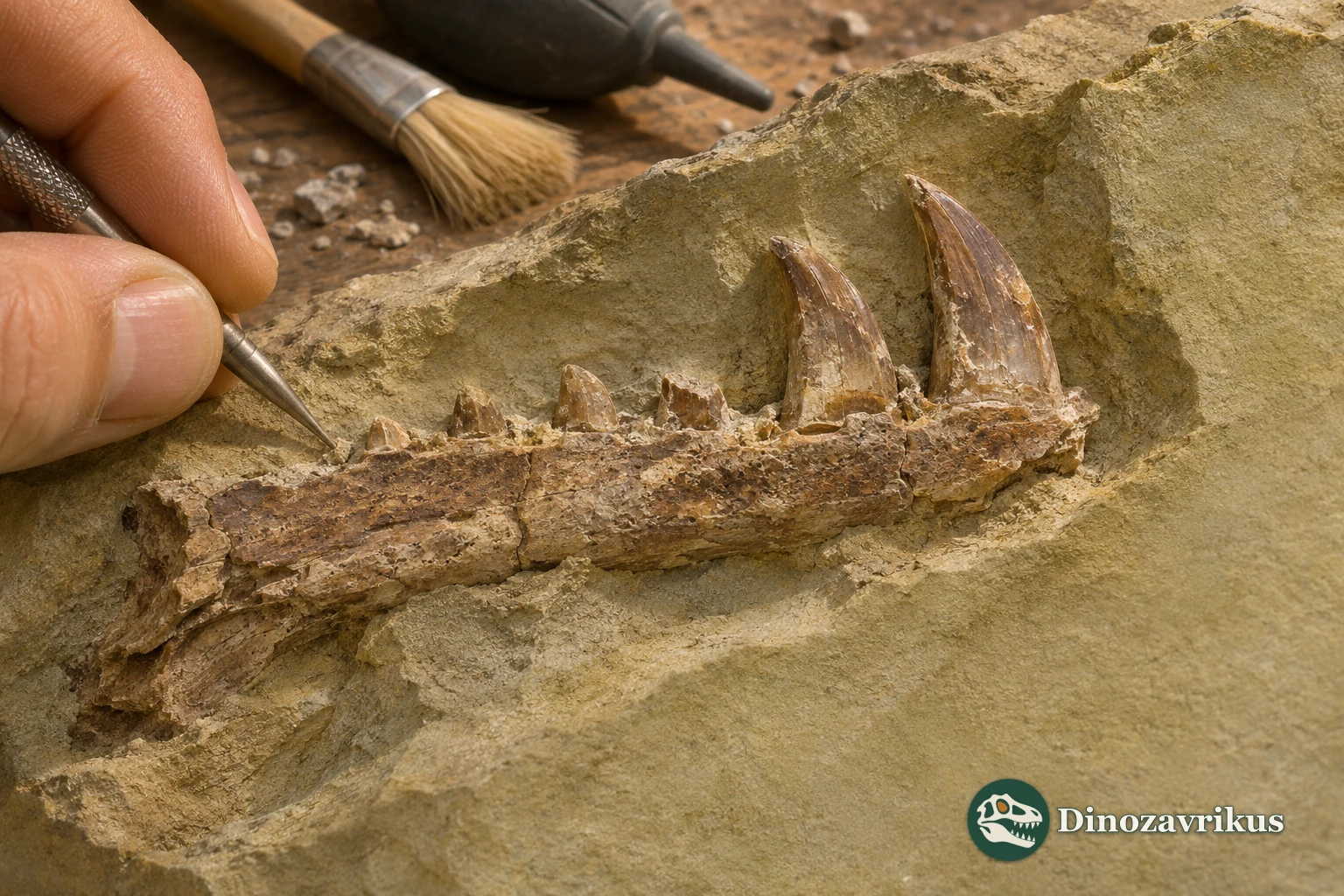
The scans resolved the joined part of the lower jaw and some teeth. Other bones were too similar in density to the sandstone to be separated confidently.
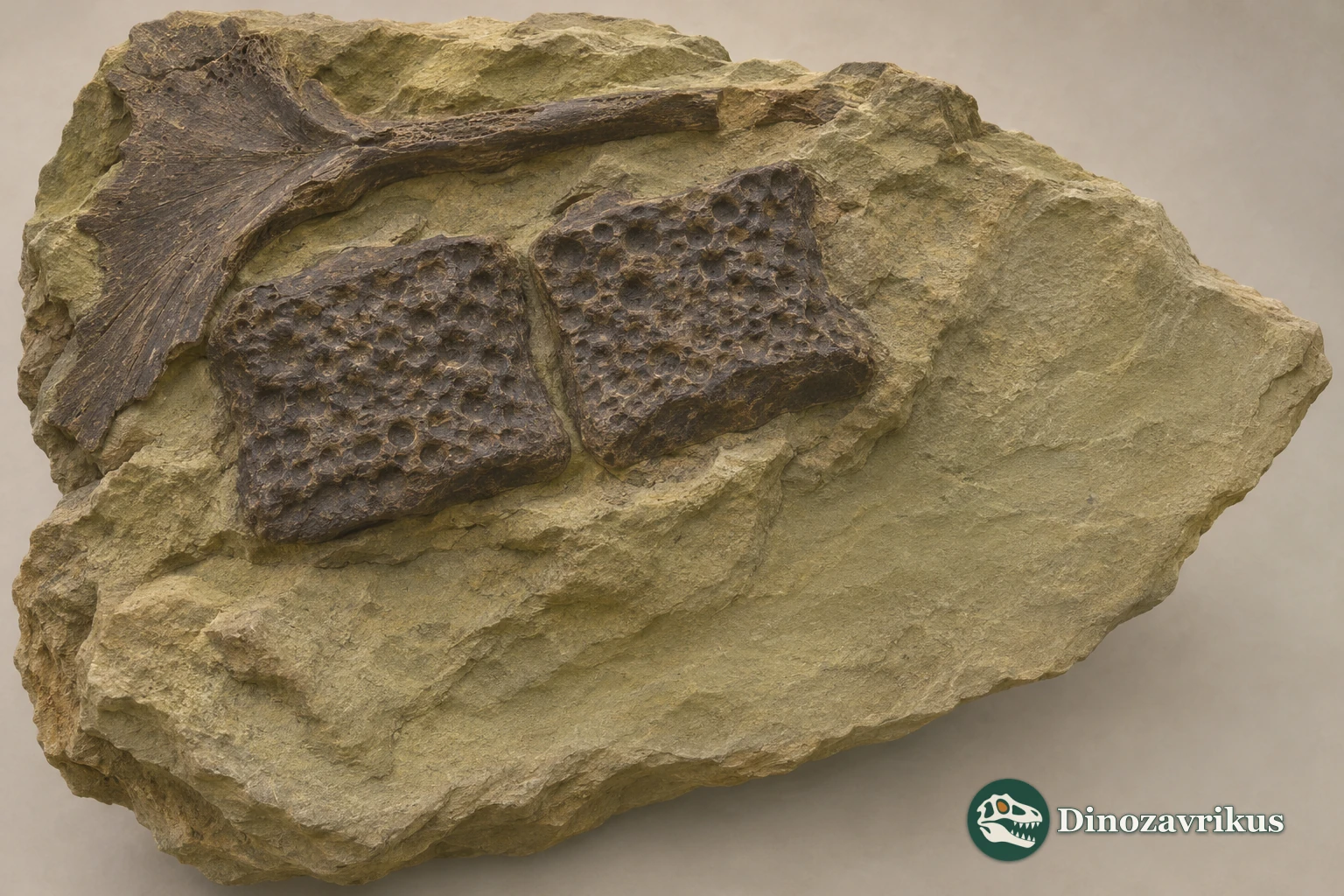
These expansions and the rectangular scutes provide comparisons with Orthosuchus. The fossils cannot establish the exact motion of the trunk.
The skeleton from Funnystone farm
Art Isted found the specimen at Funnystone near Rhodes, and Robert Broom described it in 1904. SAM-PK-4013 preserves part of the skull, the right lower jaw, parts of the shoulder girdle and limbs, ribs and dorsal scutes. The tip of the snout and the region around the eyes are missing.
Kathleen Dollman and colleagues revisited its geology in 2021. They placed the farm exposure in the Clarens Formation, about 65 metres above its contact with the Elliot. They assigned the fossil to the Pliensbachian stage. The formation records windblown dunes and lakes between them, a broader setting than the patch of landscape occupied by any one animal.
The front of the jaw in CT
The researchers could separate the joined front of the lower jaw and a rib in the scans. The third and fourth lower sockets held large teeth compressed from side to side. The teeth behind them were less than half as tall.
The two branches of the lower jaw joined as far back as the fifth or sixth socket, resembling Protosuchus in this respect. Orthosuchus had a shorter join and more rounded large teeth. The differences help identify these animals even where the skulls are incomplete.
Scutes, broad ribs and family relationships
Pairs of rectangular bony scutes lined the back. Several anterior ribs expanded along their front and rear margins. The 2021 analysis linked Notochampsa with Orthosuchus in Notochampsidae, drawing on those rib expansions and a long projection of the squamosal bone in the skull.
Broom also named Notochampsa longipes, later transferred to Erythrochampsa. A 2026 re-examination documented differences from the Notochampsa skeleton and found that the exact placement of the longipes specimen remained unresolved.
Frequently asked questions
Who discovered Notochampsa?
Art Isted found the type at Funnystone farm near Rhodes, South Africa.
How old is it?
The 2021 revision assigned it to the Pliensbachian part of the Early Jurassic.
Why did CT reveal only some of the buried bones?
In parts of the block, the density of the fossil bone and the sandstone was too similar for the boundaries to be traced clearly.
How did it differ from Orthosuchus?
It had a longer join between the lower jaw branches and more strongly compressed enlarged lower teeth.