

Notochoerus was an extinct African pig-family mammal recognized chiefly from very large cheek teeth and pieces of jaw. Several named forms occur in Pliocene and early Pleistocene deposits. The cover reconstructs a possible living animal; its coat and full-body proportions were not fossilized.
Its relationship to Nyanzachoerus helps researchers discuss change in African suid dentitions. A resemblance between two teeth is not a complete family tree. Crown shape, wear, the sedimentary layer and associated specimens all matter.
Quick facts
| Family | Suidae |
|---|---|
| Common placement | Tetraconodontinae |
| Type species | Notochoerus capensis Broom, 1925 |
| Age | Pliocene to early Pleistocene for the main studied forms |
| Regions | Eastern and southern Africa |
| Fossils | Mostly molars and jaw fragments |
What can the fossils tell us?
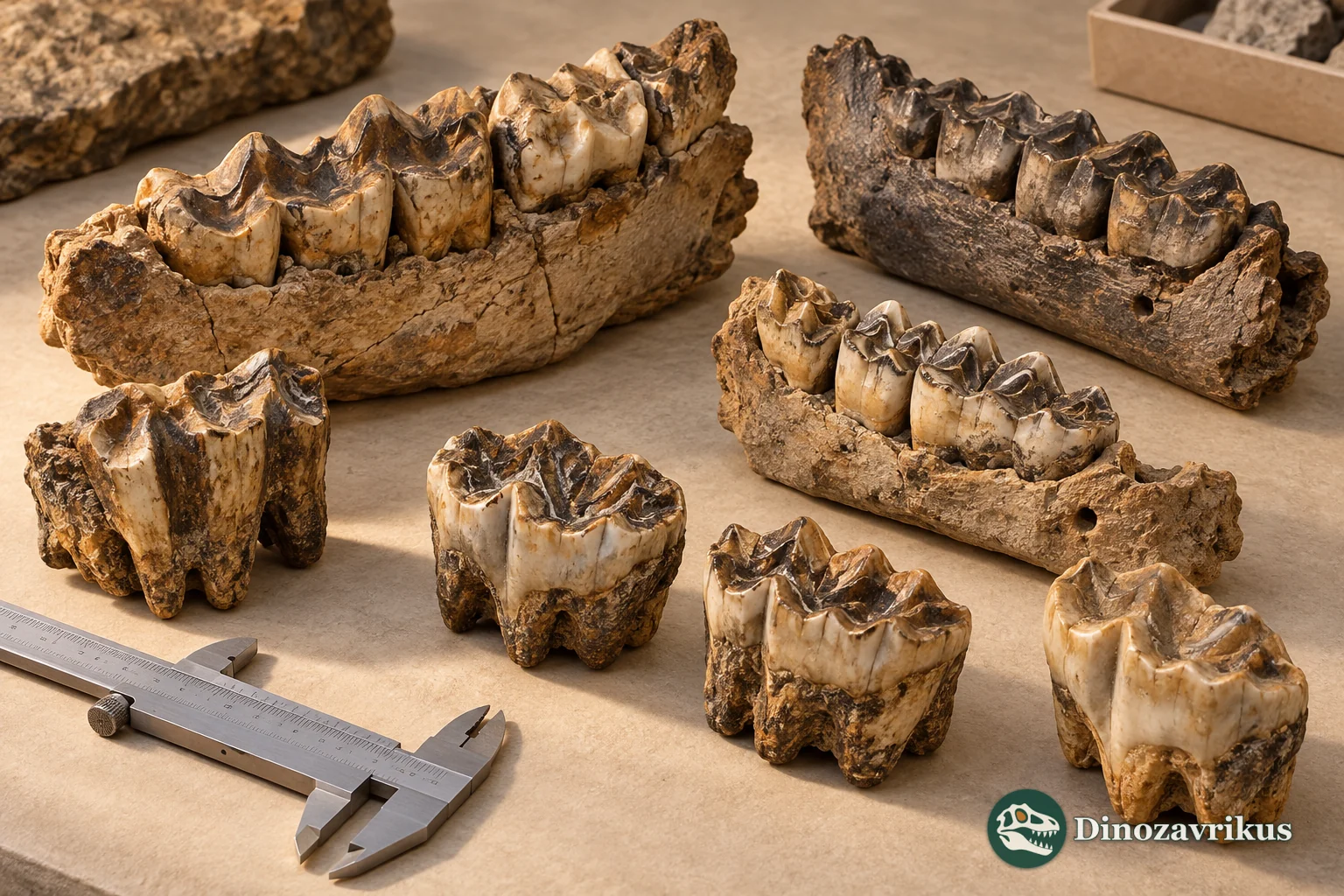
Third molars differ in crown proportions, cusps and wear. A lone large tooth cannot define an entire animal or settle every disputed species name.
Kanapoi and other eastern African assemblages constrain when related suid forms appeared. Dental similarity suggests a lineage, but a continuous ancestor series has not been recovered.
Isotope measurements of Chiwondo teeth help estimate C3 and C4 plant contributions. They do not specify every food item or all populations of the genus.
A type founded on part of a tooth
Robert Broom described the type species N. capensis in 1925 from an incomplete upper third molar in the Vaal River gravels of South Africa. This limited type material made later identification difficult. Subsequent workers named or reassigned many comparably large African suid molars, and tooth size alone cannot settle which names are synonyms.
The boundary with Gerontochoerus is one example. The form often called N. scotti has also been placed in Gerontochoerus. The genus assigned to jaegeri has likewise changed in different revisions. These alternatives are scientific classifications of fossil samples, not evidence that the animal itself changed identity.
A sequence in eastern and southern Africa
The Kanapoi suid assemblage in Kenya includes Nyanzachoerus kanamensis and a form assigned to Notochoerus jaegeri. Based on teeth, researchers proposed that the later N. euilus might descend from the latter. They also emphasized that the precise transition remains unresolved; two species in one fauna do not make an uninterrupted ancestor series.
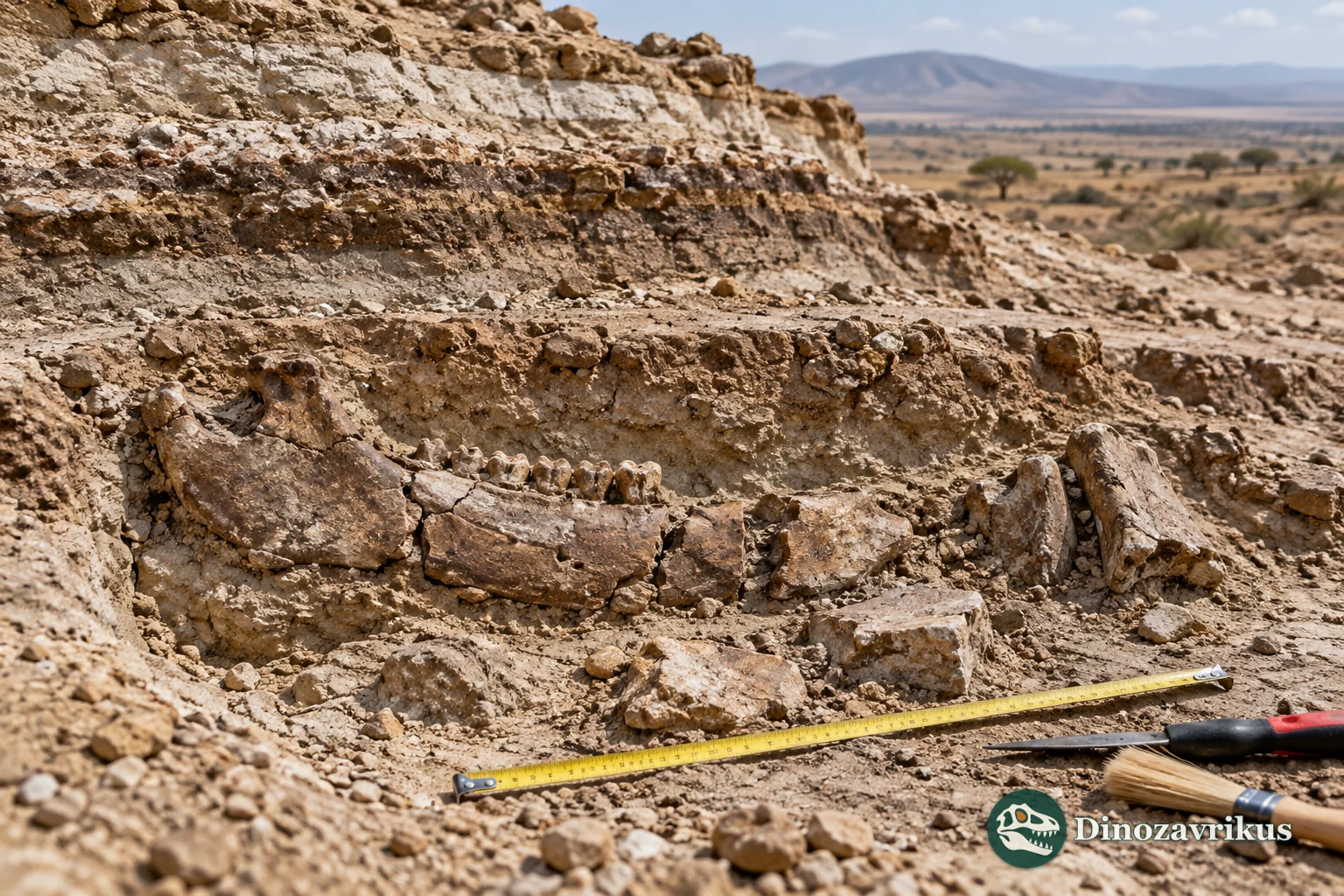
N. euilus is well represented in Pliocene eastern African deposits. The large form N. scotti occurs later and reaches the early Pleistocene. Suids from the Chiwondo Beds in Malawi help distinguish successive assemblages. Each occurrence has its own stratigraphic context, so a single date cannot be assigned to all populations. The illustrated field exposure below is a generic example, not a documented Kanapoi or Chiwondo excavation.
Dietary clues and the limits of reconstruction
Cheek-tooth structure indicates extensive chewing of plant food. Researchers also measured carbon isotopes in enamel from Chiwondo teeth assigned to N. jaegeri, N. euilus and N. scotti. Those values help distinguish contributions from different plant photosynthetic pathways in that local ecosystem; they cannot list the plants eaten by every individual.
A very large molar suggests an unusually substantial chewing apparatus, yet a reliable body-mass estimate needs measured skull or skeletal material and an explicit method. Metridiochoerus and Kolpochoerus show that African suids diversified and turned over near the Pliocene–Pleistocene transition. The fossils do not establish a single simple cause for the disappearance of Notochoerus.
Frequently asked questions
Did Notochoerus live only in the Pleistocene?
No. Much of its documented sequence belongs to the Pliocene, while some forms reach the early Pleistocene.
What was the type species based on?
N. capensis was described from an incomplete upper third molar found in the Vaal River gravels.
Are all huge African fossil pig molars one species?
No. Tooth size overlaps and names have changed. Researchers compare tooth form, series of specimens and geological context.
Can enamel identify its exact diet?
Carbon isotopes can estimate plant-source contributions for sampled animals, but they cannot list every food or describe every population.