

Notostylops was a South American notoungulate, an extinct mammal lineage often described as native ungulates. Its type species, N. murinus, is known from Patagonia. Teeth formed the basis of early classifications, but a partial skeleton later supplied limb bones that could be examined for movement.
Florentino Ameghino named the genus in 1897. Well-studied N. murinus material comes from Middle Eocene levels of the Sarmiento Formation. The genus is listed in the ancient mammal catalogue; the Palaeogene overview provides a broader geological frame, while each fossil still requires its own formation and bed data.
Quick facts
| Scientific name | Notostylops Ameghino, 1897 |
|---|---|
| Type species | Notostylops murinus Ameghino, 1897 |
| Group | Notoungulata, family Notostylopidae |
| Region and age | Patagonia, Argentina; best-known material is Middle Eocene |
| Formation | Sarmiento Formation |
| Fossil evidence | Teeth, cranial material and partial skeleton MLP 82-V-1-8 |
| Estimated mass | About 8.5–20 kg in one functional study; model-based |
| Movement | Limb anatomy supports a range of possible movements, not direct behaviour |
What can the fossils tell us?
Early descriptions split dental differences into several species and genera. Later comparisons of type specimens showed that some names represented variation, wear or distortion. Teeth remain diagnostic, but each historical name must be checked against its type.
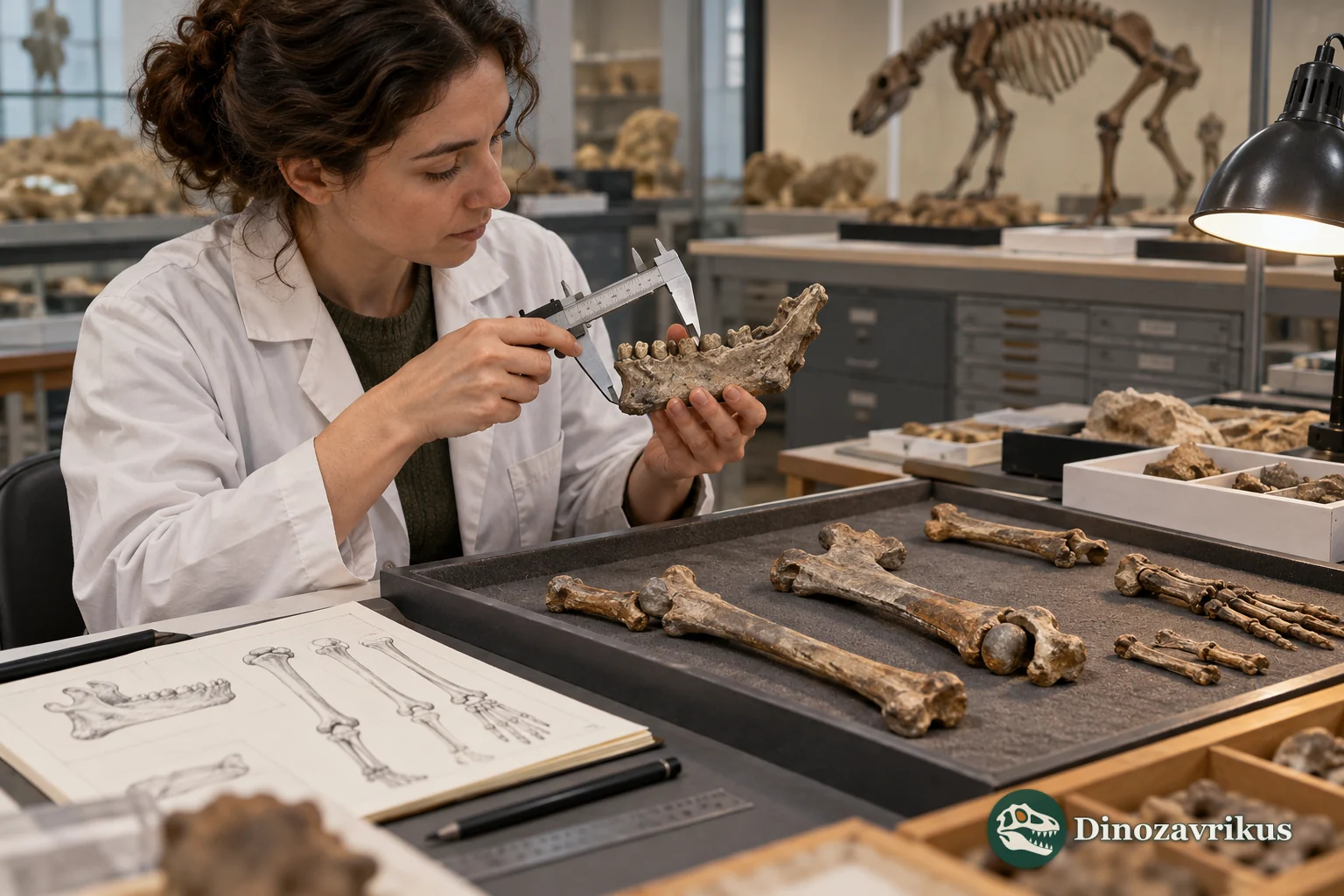
Specimen MLP 82-V-1-8 includes teeth, vertebrae, a rib, limb bones, pelvis and calcaneus. It is a valuable association, not a complete articulated skeleton, and does not justify assigning every isolated bone to the genus.
A 2019 study described generalized limb anatomy and a broad range of possible movements. A 2022 functional analysis inferred dynamic digitigrade posture and possible secondary climbing. Neither study directly observes gait or speed.
The published range is calculated from anatomy and functional comparisons, not measured from a whole animal. Its width reflects model dependence and should be reported as an estimate.
Discovery, type material and historical names
Florentino Ameghino established Notostylops in 1897 from the rich mammal record of Patagonia. His early descriptions divided dental differences into many names. In a 1948 review, George Gaylord Simpson selected lower-jaw material MACN-A 10498 as the lectotype of N. murinus; skull material MACN-A 10500 belongs to the original syntype series.
Comparing types allowed later workers to unite some names that had been founded on individual differences, tooth wear or crushed specimens. An old genus or species name may therefore be a synonym rather than a separate animal. The type material, not just a spelling in a catalogue, determines how the name is applied.
The historical term “Notostylops beds” referred to fossil-bearing strata in Patagonia where this mammal was common. It is not the modern name of a separate formation. The best-known N. murinus material comes from the Sarmiento Formation.
Teeth and species boundaries
The early record is rich in teeth and jaws. Crown outlines, enamel folds and the sequence of incisors, premolars and molars helped Ameghino distinguish species. Later revisions compared type specimens directly and showed why a small morphological difference cannot always be treated as a separate species.
Crushing can shift teeth within the jaw, while wear removes enamel features and young animals may not yet have a full adult tooth row. These effects are especially relevant to old specimens from the Casamayoran fauna. Isolated teeth may be useful, but they carry less information than a well-preserved jaw with known position and collection history.
The partial skeleton MLP 82-V-1-8
Malena Lorente, Javier Gelfo and Guillermo López described the first substantial postcranial sample assigned to Notostylops from Middle Eocene levels of the Sarmiento Formation in Patagonia. Adult specimen MLP 82-V-1-8 includes two teeth, an axis and other vertebral bodies, a rib, a left humerus, both radii, two metapodials, phalanges, a pelvis, a right femur, a right calcaneus and additional fragments.
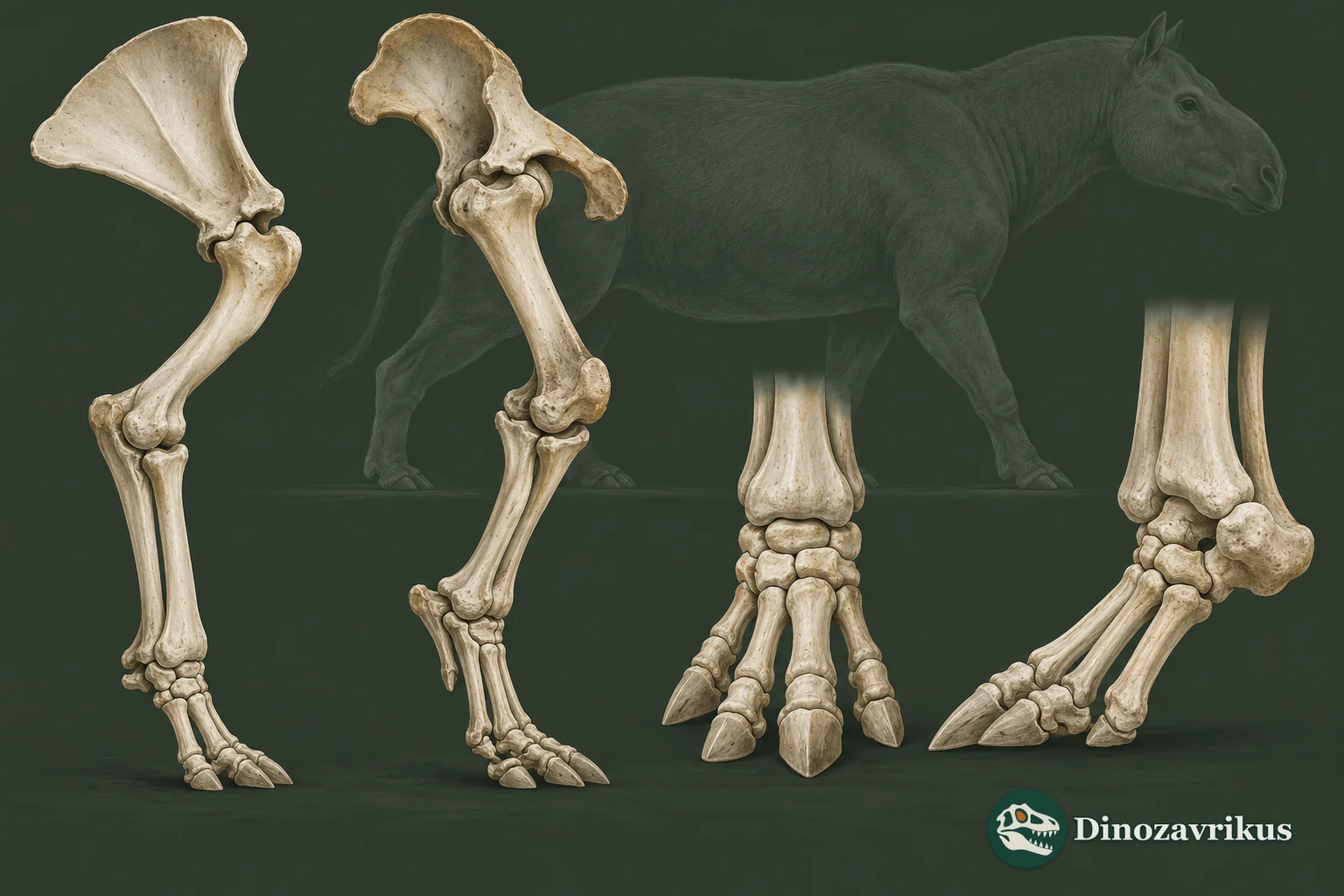
The radii were not fused to the ulnae and were shorter than the humerus. The authors described the appendicular skeleton as generalized, with some similarities to terrestrial rodents. It does not resemble the highly constrained limb design of a specialised cursor or jumper. The preserved bones instead leave room for a range of movements.
The 2019 study also questioned earlier assignments of some isolated postcranial fossils to Pleurostylodon. This is an important limit: once limb bones can be compared with an associated Notostylops skeleton, other isolated bones may need reassessment rather than automatic referral.
Locomotion and body-mass estimates
A 2022 functional study used the new skeletal information to test traditional descriptions of early notoungulates as unspecialized generalists. Its analysis suggested that Notostylops could adopt a dynamic digitigrade posture and may have had a secondary scansorial habit. The authors estimated a body mass of about 8.5–20 kg and a possible top speed up to 50 km/h.
These values come from comparative and biomechanical models. No fossil records a living animal running or climbing, and speed depends on assumptions about stride, muscle and soft tissue. The broad mass range is more honest than one exact value; the locomotor interpretation is a testable hypothesis about what the bones could do.
Age, Patagonia and the fossil landscape
The best-known sample of N. murinus comes from Middle Eocene strata of the Sarmiento Formation in Patagonia, Argentina. Ameghino's “Notostylops fauna” became an important reference for the Casamayoran South American Land Mammal Age. The old collecting record, however, varies in how precisely it identifies locality and bed.
Different species and historical referrals can widen a genus-level time range in databases. Such a range should not be copied onto the partial skeleton without checking its species, locality and stratigraphy. A fossil age belongs to the specimen's context first.
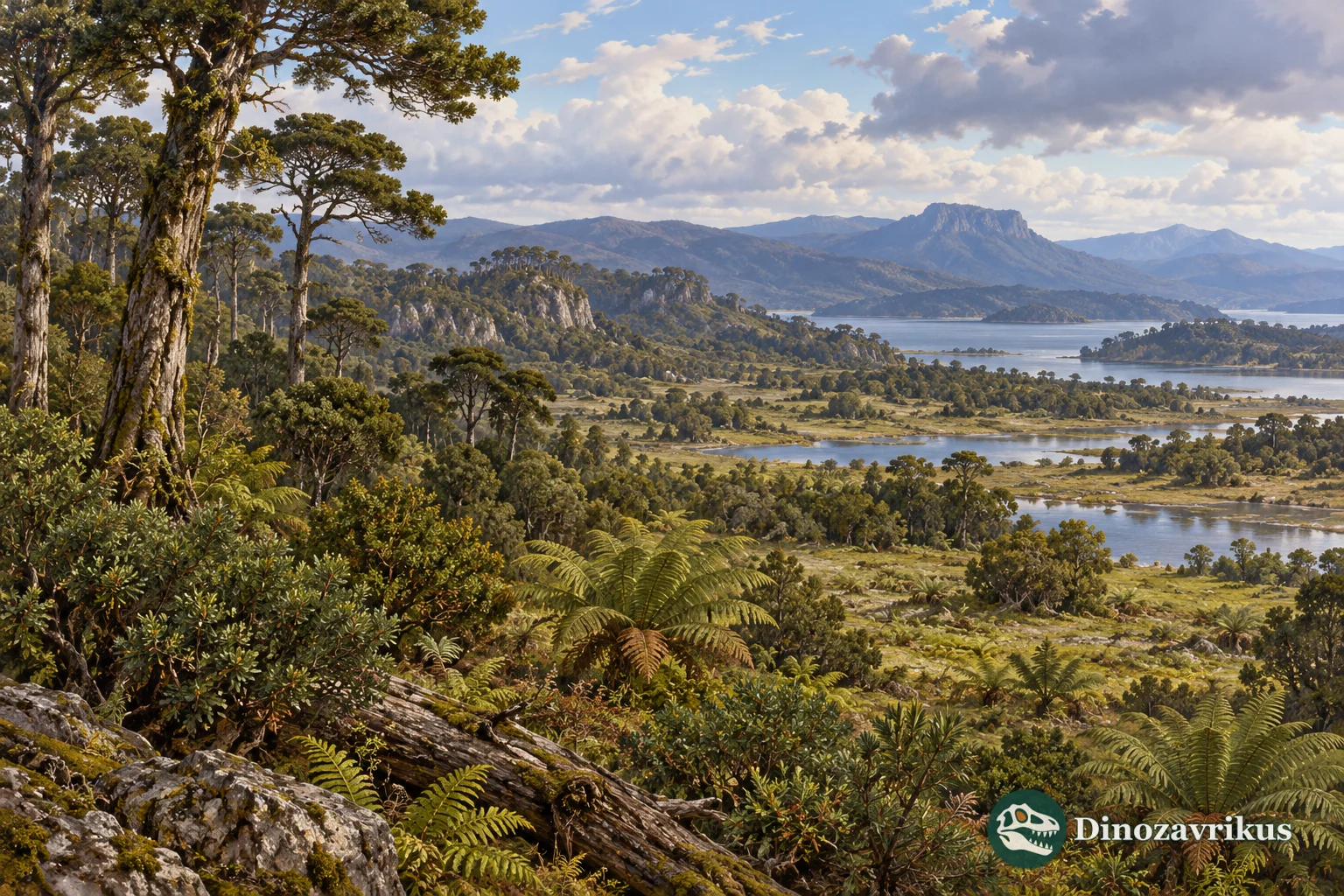
The formation preserves terrestrial deposits and a diverse vertebrate fauna. Regional sediment and plant evidence can inform habitat reconstructions, but neither a single bone nor the genus name proves the exact vegetation around one individual. A landscape image is therefore a contextual illustration rather than documentation of a named collecting site.
Diet, size and the reconstructed animal
Low-crowned cheek teeth are consistent with feeding on relatively soft vegetation, and plant-eating is commonly inferred for notoungulates. There is no stomach content or unique feeding trace for N. murinus that identifies particular leaves or fruits. The broad dietary interpretation is plausible but less direct than the dental anatomy.
The body-mass range does not determine an exact body length or height. Nor does the partial skeleton preserve the coat, ears, skin or colour. The cover shows a compact quadruped built around the known general limb plan; its soft-tissue outline remains artistic.
Frequently asked questions
When did Notostylops live?
The best-known species, Notostylops murinus, comes from Middle Eocene Patagonia. The genus-level range depends on which species and historical referrals are included.
Was a complete skeleton found?
No. MLP 82-V-1-8 is a partial skeleton with teeth, vertebrae and several limb and pelvic bones, but it is not complete or fully articulated.
How much did Notostylops weigh?
A functional study estimated about 8.5–20 kg. The range is model-based and should not be treated as a direct measurement.
Could it climb?
A 2022 biomechanical analysis considered secondary climbing possible from limb anatomy. This is an inference, not direct evidence of behaviour.