

Numidocapra was an extinct African bovid known chiefly from skulls, horn cores and teeth. Its name evokes goats, but a comparative revision placed it among alcelaphines, the branch that includes several living African antelopes. The cover offers an artistic body and coat; fossils do not preserve those details.
Algerian finds established the type species, while three Ethiopian crania make it possible to compare more than an isolated horn. South African horn cores have been tentatively assigned to another species of the genus, but that does not make every African occurrence the same animal.
Quick facts
| Group | Bovidae, tribe Alcelaphini |
|---|---|
| Type species | Numidocapra crassicornis Arambourg, 1949 |
| Type area | Ain Hanech, northeastern Algeria |
| Ain Hanech age | About 1.78 million years under later stratigraphic correlation |
| Bouri fossils | Three partial horned crania BOU-1/21, BOU-1/31 and BOU-6/1 |
| Taxonomy | Early goat-like placement revised toward alcelaphines |
| Evidence limit | Bones do not preserve coat color or behavior |
What can the fossils tell us?
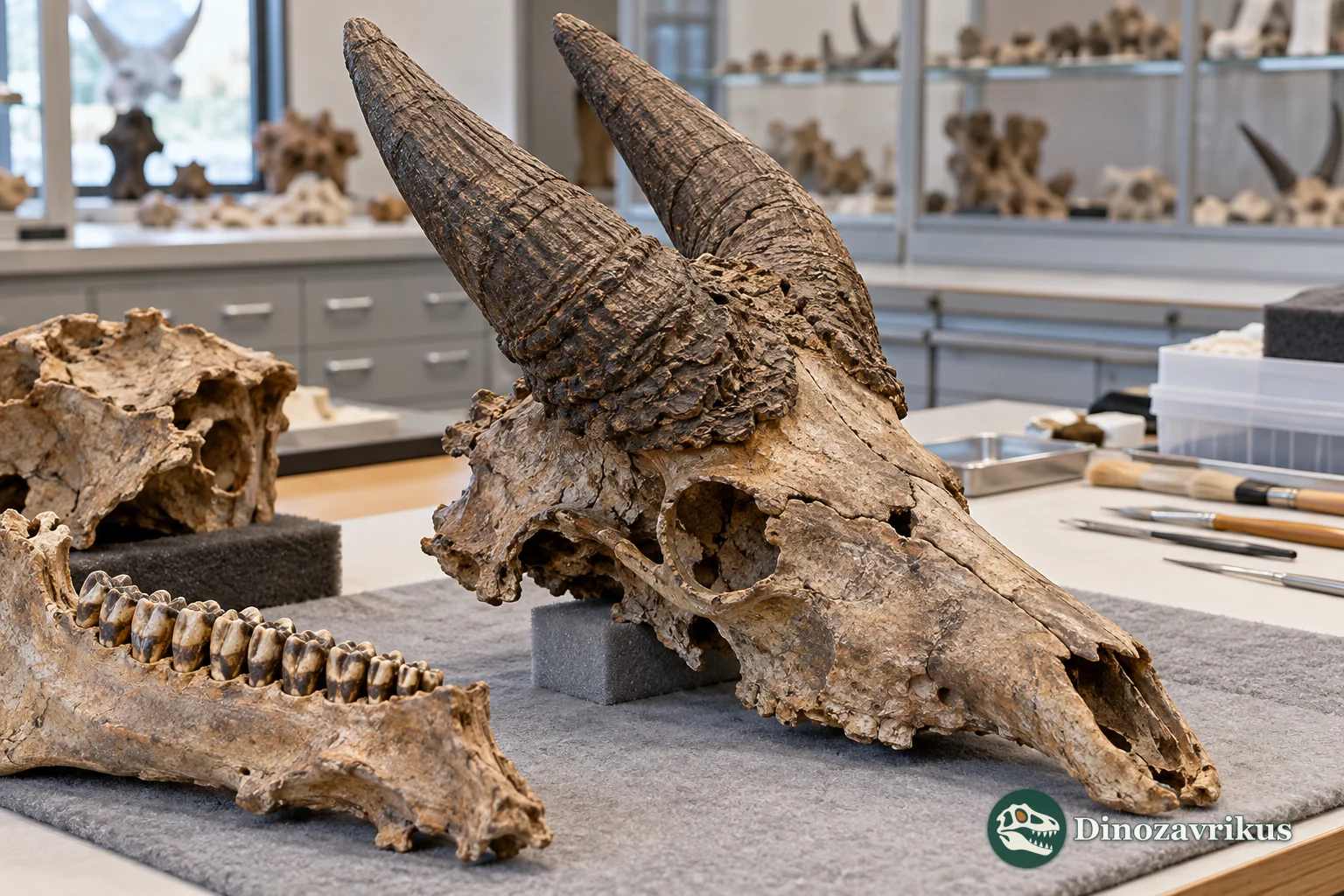
The cores are massive, close-set and point forward and upward, with compressed oval bases. A single curve is less informative than the combined cranial characters.
Ethiopian fossils BOU-1/21, BOU-1/31 and the younger individual BOU-6/1 come from deposits estimated near one million years old. Individual age and preservation affect their comparison.
Older faunal estimates suggested about 1–1.2 million years. Later magnetic and faunal correlation assigns the relevant levels around 1.78 million years.
An Algerian name and a revised family placement
Camille Arambourg named N. crassicornis in 1949 from Ain Hanech material in northeastern Algeria. Early comparisons emphasized goat-like horn traits. Elizabeth Vrba's revision compared skull shape, horn-core bases and teeth and treated Numidocapra as an alcelaphine. The older caprine placement documents a historical hypothesis, not established kinship with a modern ibex.
The type species has large, close-set horn cores projecting forward and upward. Their basal cross-sections are oval and often compressed, and the frontals between them are raised. These are observations of bone, while the shape of the missing horn sheath remains uncertain.
Three Ethiopian crania and individual variation
Bouri localities 1 and 6 yielded partial crania BOU-1/21, BOU-1/31 and BOU-6/1 attributed to N. crassicornis. One combines rear skull with horn bases and an anterior part bearing upper teeth. Another preserves much of both horn cores. BOU-6/1 belongs to a younger individual. Their deposits were estimated near one million years old.
The young specimen shows slight ridging not simply interpretable as a species difference. Horn direction, compression and dental proportions must be assessed across the sample. Relatively large cheek teeth and a reduced premolar row are described, but they cannot determine an exact menu or herd size.
Changing dates and other African records
Older faunal comparisons placed Ain Hanech around 1–1.2 million years ago. A later study of the Ain Boucherit–Ain Hanech sequence combined magnetic polarity, faunal turnover and stratigraphic position and proposed roughly 1.78 million years for Ain Hanech and El Kherba. Those estimates arise from different methods and should not be averaged. The lower Ain Boucherit levels include Anancus; a fossil in one level cannot be assigned to every level of the sequence.
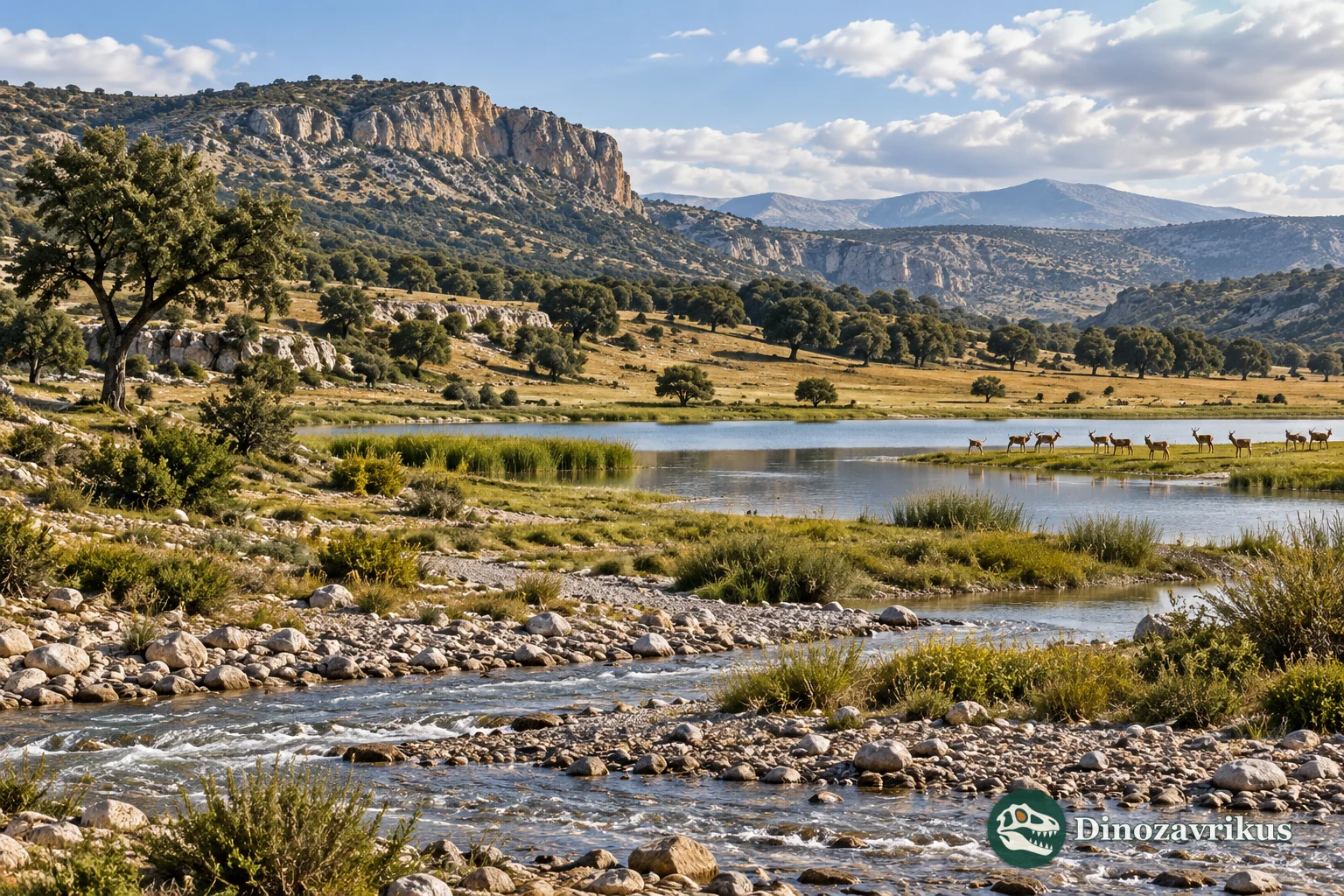
Horn cores from South Africa's Kromdraai Unit P were reported cautiously as Numidocapra cf. porrocornutus. The 'cf.' signals comparison rather than definitive species identification. Open habitats are inferred from associated fauna and sediments, not directly from the name. The landscape image is an interpretation of a possible depositional setting rather than a photograph of Ain Hanech.
What remains unknown
Neither horn cores nor teeth preserve coat pattern, seasonal movements or the behavior of living animals. Even when fossils occupy Early Pleistocene layers of the Quaternary, each locality needs its own dating evidence.
Frequently asked questions
Was Numidocapra a goat?
No under the comparative classification used here. Its skull and teeth place it with alcelaphines despite earlier goat-like comparisons.
What was found at Bouri?
Three partial horned crania were described, including the younger individual BOU-6/1 and a specimen with upper teeth.
Why do ages for Ain Hanech differ?
Older figures relied heavily on faunal correlation; later magnetic and stratigraphic analysis suggested roughly 1.78 million years for the relevant levels.
Does the Kromdraai find prove the type species lived there?
No. Those South African horn cores were compared tentatively with N. porrocornutus, not securely identified as the Algerian type species.