

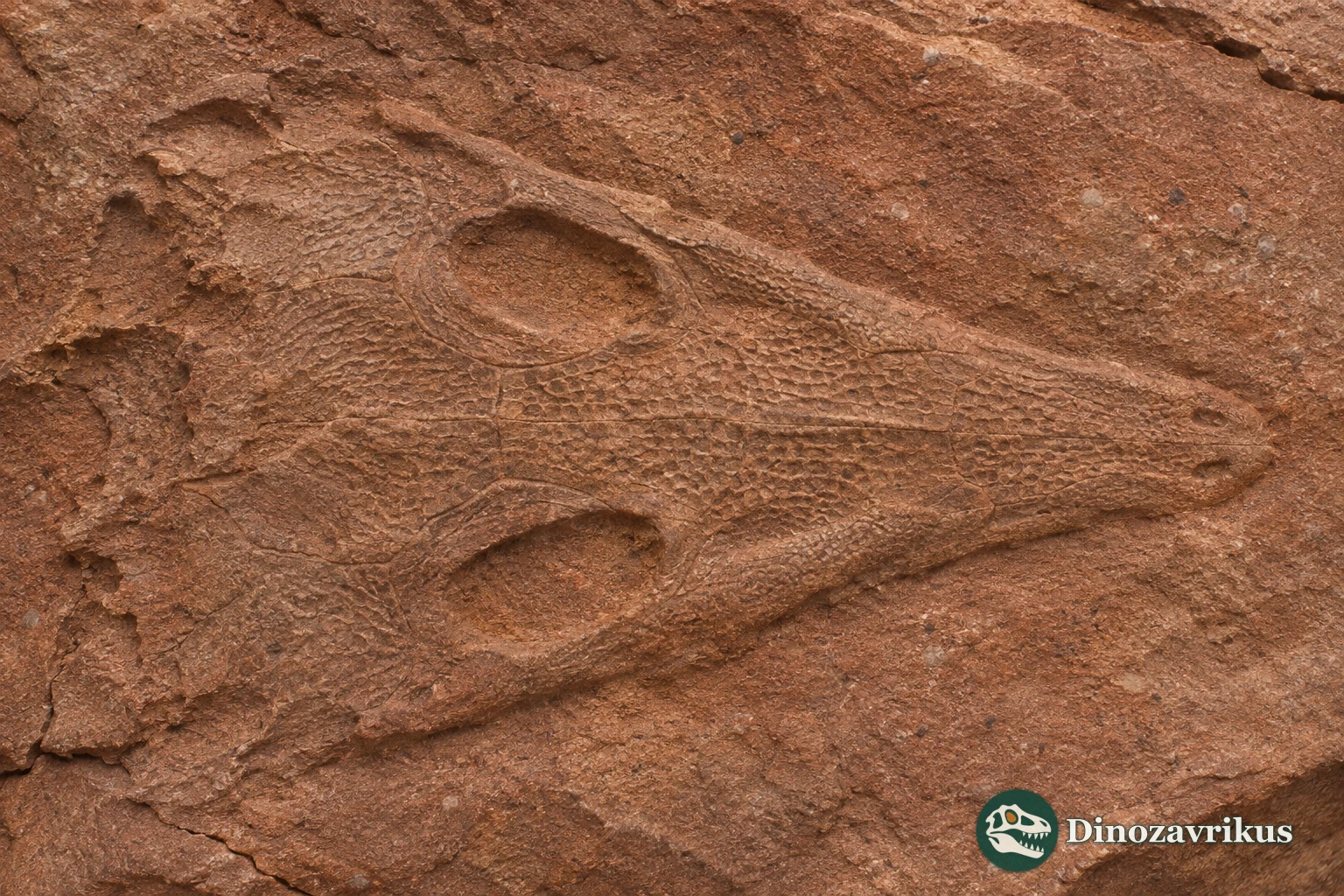
Odenwaldia is known from a skull preserved in coarse Early Triassic sandstone. The natural mould records the shape of the long snout and the position of the nostrils, along with part of the ornament on the skull roof. These features help place the amphibian among capitosaurs.
Quick facts
| Group | Temnospondyls, capitosaurs |
|---|---|
| Age | Early Triassic, late Olenekian |
| Region | Europe: Odenwald, Germany |
| Type species | Odenwaldia heidelbergensis |
| Scientific name | Odenwaldia |
| Diet | Exact prey is unknown |
What can the fossils tell us?
The type specimen, GPIH SMO 1, preserves the roof of the skull, marginal teeth and traces of internal structures in coarse sandstone.
Skull shape and openings link the genus to capitosaurs. Different anatomical analyses place it on different branches within that group.
The type skull cannot provide a direct measurement of total body length. No direct evidence identifies its prey.
A fossil from the Buntsandstein
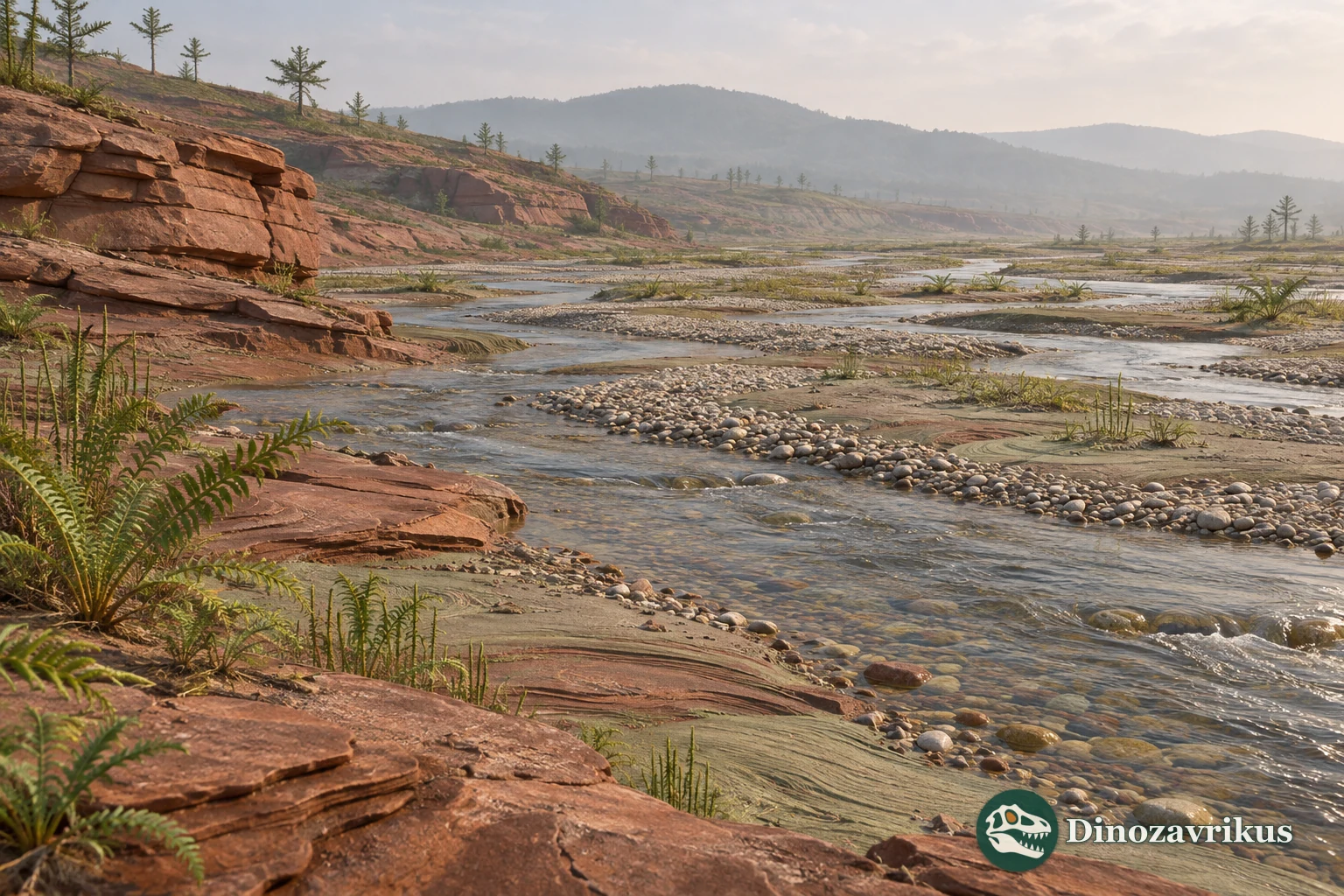
The skull came from Waldkatzenbach near Katzenbuckel in Germany’s Odenwald hills. It was found in the Upper Conglomerate of the Middle Buntsandstein, in the late Olenekian Solling Formation. Michael Morales and Donat Kamphausen established the genus and species in 1984.
Interpreting the mould
The skull roof is elongate and triangular. Its large oval nostrils lie close to the outer margins, leaving a substantial length of snout in front. The nostrils of Parotosuchus have a similar position. The relief of the skull surface is preserved, but sandstone grains interrupt some bone boundaries. In his redescription, Rainer Schoch compared the outer impression with the internal cast to follow the sutures.
Relationships within capitosaurs
The original description drew comparisons with Benthosuchus. Schoch later recovered Odenwaldia close to Cherinia. Another comparative study placed it closer to the base of the capitosaur tree. The studies agree on the broader relationship while differing on where within the group the genus belongs.
Frequently asked questions
Which parts of Odenwaldia are preserved?
The type preserves a mould and natural cast of the skull, with the skull roof, marginal teeth and traces of internal structures.
When did Odenwaldia live?
It lived in the late Olenekian, near the end of the Early Triassic.
Where was its type skull found?
Near Waldkatzenbach and Katzenbuckel in the Odenwald hills of southwestern Germany.
Why are some bone boundaries unclear?
Coarse grains and cracks interrupt the fine lines that mark contact between some skull bones.