

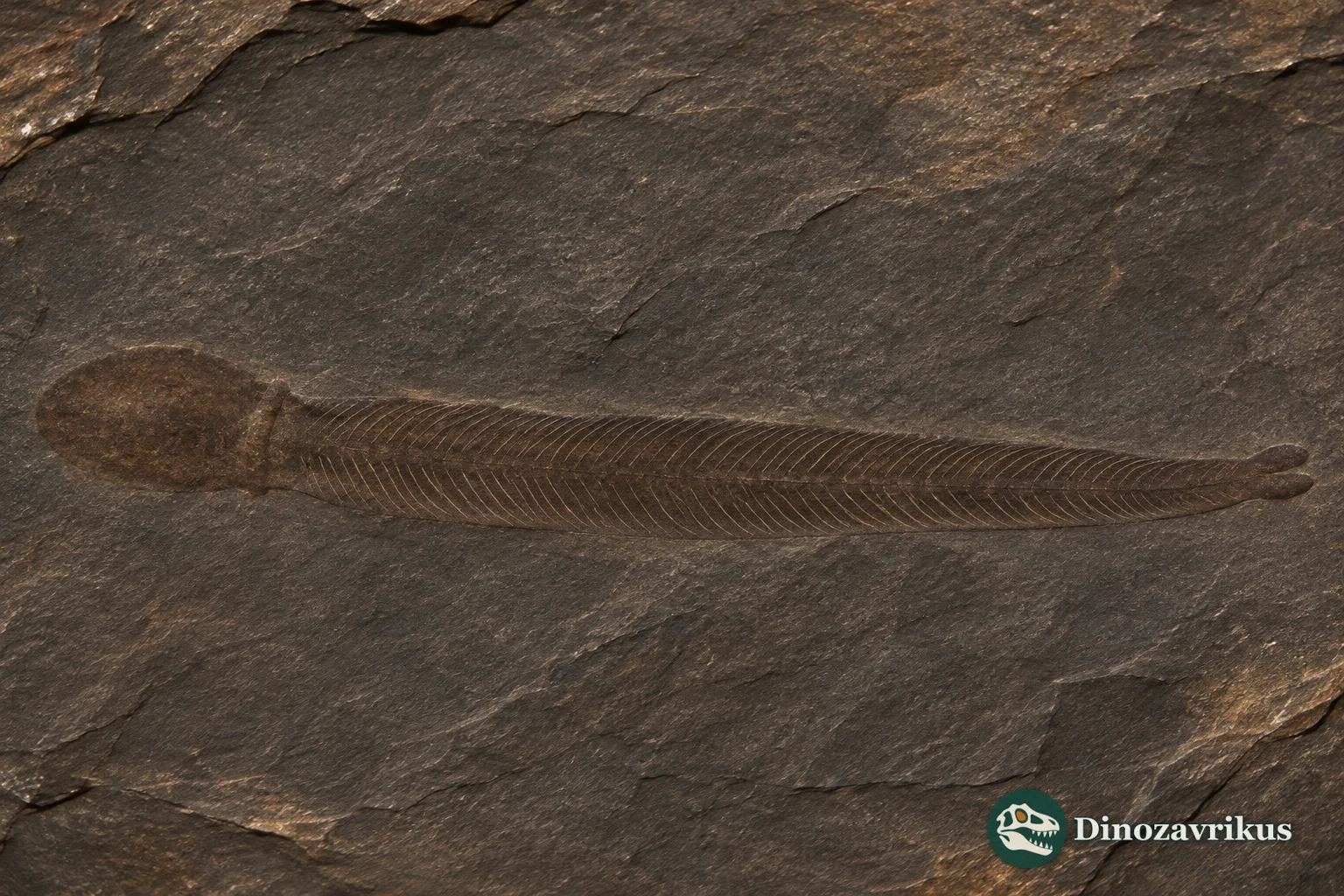
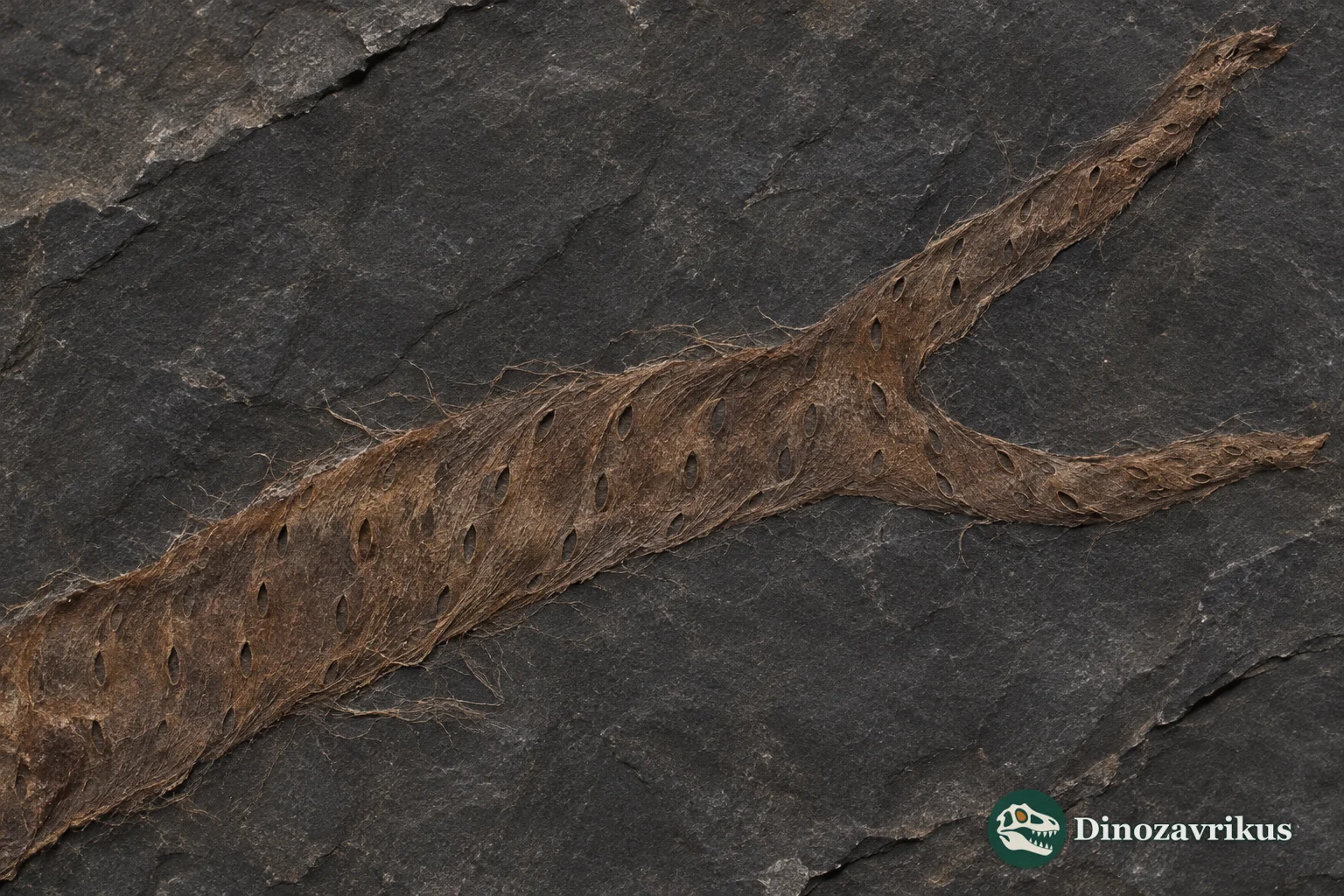
Oesia was a worm-shaped hemichordate of the Middle Cambrian. Burgess Shale fossils preserve its long body, short collar and a series of delicate gill bars in the throat. Dozens of specimens are found inside perforated tubes. Those tubes were long interpreted as fossil algae before the animals were recognised within them.
Quick facts
| Group | Hemichordates, acorn worms |
|---|---|
| Age | Middle Cambrian, Miaolingian |
| Region | North America: British Columbia, Canada |
| Diet | Suspension feeding |
| Type species | Oesia disjuncta |
| Body length | 2.4–120 mm in the measured sample |
| Material | Soft-body compressions and fibrous tubes |
What can the fossils tell us?
Forty-five associations were reported from Marble Canyon and six from the Raymond Quarry. In these fossils the animal lies inside the perforated tube.
A pharynx with numerous gill bars took up roughly four fifths of the trunk. Its extent supports suspension feeding, with water able to pass through the tube wall.
It may have helped the animal grip the inside of the tube and change position. The fossils preserve its shape and leave the movement open to interpretation.
What the Burgess Shale preserved
Charles Walcott described Oesia disjuncta in 1911. It was compared at different times with annelids, tunicates and arrow worms. The Marble Canyon material allowed researchers to examine the proboscis, short collar and trunk with an extensive pharynx. Together those features support its placement among early acorn worms. The same locality yielded Marrella.
In a 2016 study, measurements of 187 individuals yielded a mean length of 53 mm and a range from 2.4 to 120 mm. The body rarely exceeded 10 mm in width. Specimen ROM 63713 shows a distinct bilobed structure at the rear.
A tube once taken for a seaweed
The fibrous fossils with holes were originally described as Margaretia dorus. The discovery of Oesia within these structures at two Canadian sites showed that they were dwelling tubes. Some pieces preserve a fork. Openings form roughly helical rows on the walls, and some tubes could have exceeded half a metre in length.
The tube was typically at least twice as wide as the worm, leaving room for the animal to move. Each preserved association contained one individual. Since many tubes are incomplete, the possibility of more than one occupant in a longer tube remains open.
How Oesia obtained food
The pharynx occupied about 80 percent of the trunk. It carried many curved gill bars. The extent of this surface led researchers to infer that Oesia filtered particles suspended in the water. Numerous openings in the tube would have allowed water to pass through the wall.
Tubes of the same type occur in the Spence Shale of Utah. Those finds tell us about the distribution of the perforated dwellings. The Canadian fossils preserving the soft body provide direct evidence of the animal itself.
Frequently asked questions
What was Margaretia?
Margaretia dorus was the name given to perforated tubes. Fossils preserving worms inside made it possible to identify them as Oesia dwellings.
How large was Oesia?
The average body length in a sample of 187 individuals was about 53 mm. The longest measured specimen reached 120 mm.
How do researchers identify its feeding mode?
A long pharynx packed with gill bars provides the main evidence for extracting suspended particles from water.
Where have worms been found in their tubes?
The associations have been described from Marble Canyon and the Raymond Quarry in British Columbia.