

Ogygopsis was a Cambrian trilobite. The type species, O. klotzi, is particularly common in the shale of Mount Stephen in the Canadian Rockies. Its fossils preserve large tail shields, and a few specimens retain impressions of jointed antennae.
Quick facts
| Group | Trilobites, order Corynexochida |
|---|---|
| Age | Early and middle Cambrian |
| Region | North America: Canada, United States and Greenland. Asia: Mongolia and the Altai–Sayan region |
| Diet | Unknown |
| Type species | Ogygopsis klotzi |
| Exoskeleton length | Up to 13 cm in O. klotzi |
What can the fossils tell us?
Articulated O. klotzi specimens preserve eight trunk segments. Rare impressions show a pair of antennae.
In many fossils the free cheeks separated along the facial sutures, consistent with a route through which the animal could leave its old shell.
Some damaged segments show evidence of recovery. Their shape leaves the cause of the injury uncertain.
The shape of Ogygopsis
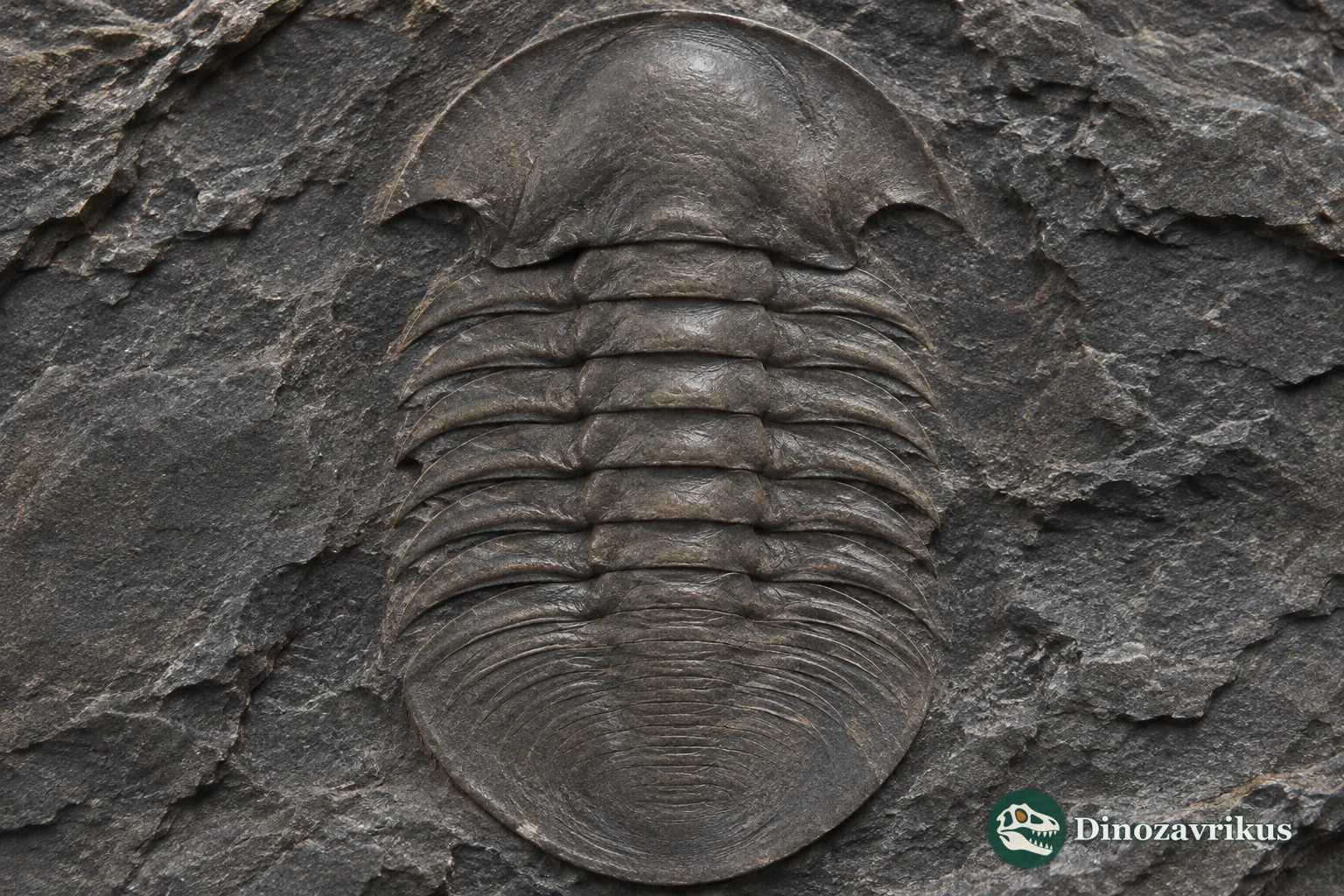
Adult O. klotzi exoskeletons reached 13 cm in length. The broad head shield carried an elongated, rounded glabella, the raised axial lobe. Narrow eyes lay to either side of it. The free cheeks ended in short straight spines pointing backwards.
Eight movable trunk segments made up the middle part of the exoskeleton. Their outer tips ended in short points. The tail shield in the type species was broad and almost semicircular, with curved ribs and a smooth outer rim. Some other species had short spines along that rim.
Why Mount Stephen is known for its trilobites
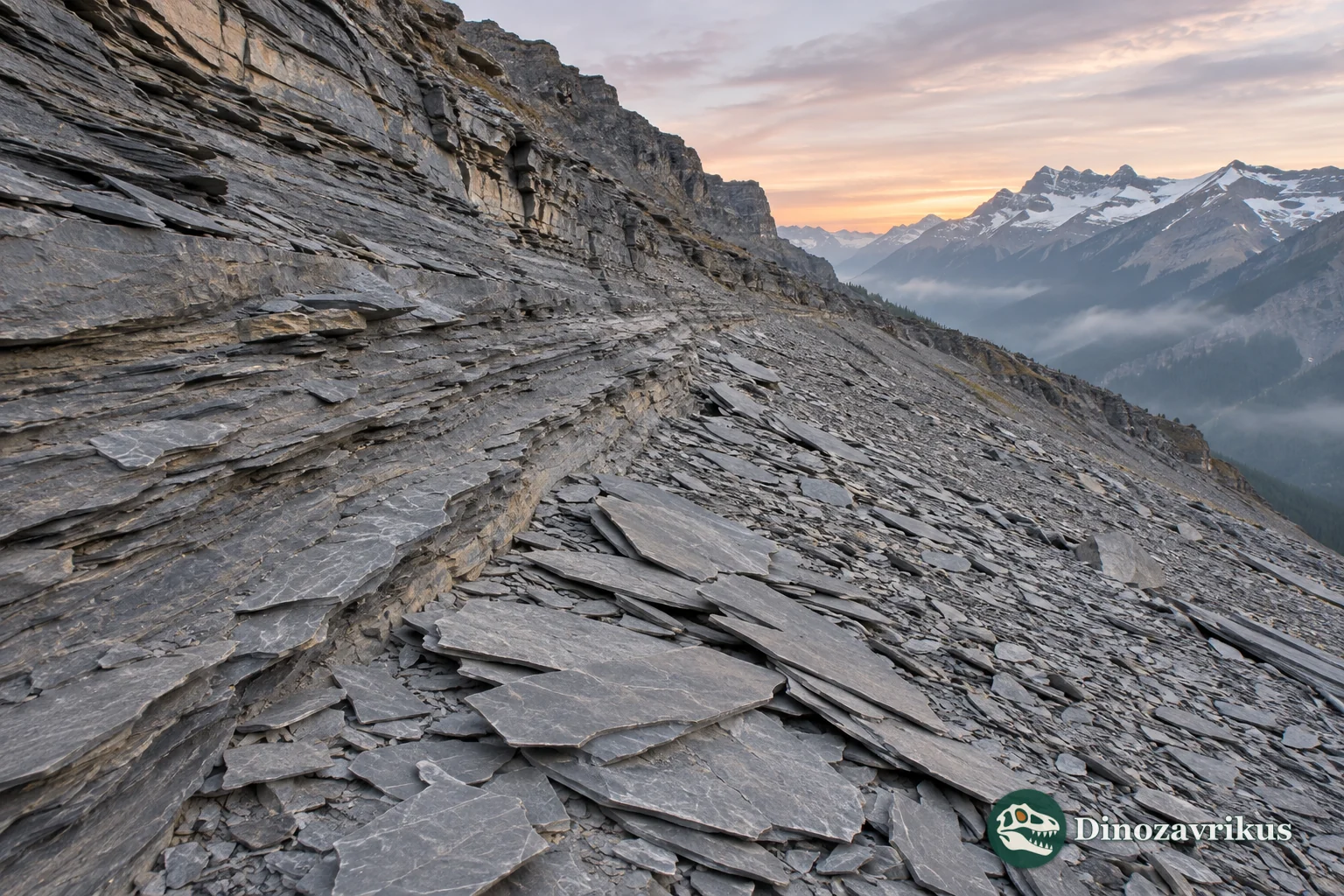
Carl Rominger described the species as Ogygia klotzi in 1887, honouring Otto Klotz, the surveyor who supplied the fossils. Charles Walcott erected Ogygopsis in 1889 and later used the name Ogygopsis shale for the beds where this form abounds. The horizon is now placed in the Campsite Cliff Shale Member of the Burgess Shale Formation.
Most nearly complete exoskeletons from Mount Stephen have lost their free cheeks. The cheeks could separate along the facial sutures and leave a gap for the trilobite to exit while moulting. This accounts for many of the articulated shields in the beds.
What an injured specimen reveals
The London Natural History Museum specimen NHMUK PI I 4749 has an indentation that truncates two lateral tips on the thorax by as much as 6.6 mm. One shows partial regrowth, supporting an injury during life. Similar damage is recorded in Olenoides from the same beds. The cause of the damage in this individual remains uncertain.
Adults probably moved along the seafloor, where they might have picked up small organic particles. The rare antenna impressions show that they had flexible sensory appendages. Their diet remains uncertain.
Other species outside Canada
Lower Cambrian rocks in Nevada yielded O. batis, with short paired spines near the front corners of the tail shield. O. virgata is known from North Greenland, the Altai–Sayan region and western Mongolia. The Mongolian tail shields have six pairs of broad lateral furrows and two pairs of marginal spines.
Frequently asked questions
How many trunk segments did Ogygopsis have?
The type species O. klotzi had eight movable segments between its head and tail shields.
How long was O. klotzi?
Adult exoskeletons can reach about 13 cm.
Why are the cheeks missing on many fossils?
The free cheeks could detach at the facial sutures when the animal moulted, leaving an opening to escape the old shell.
Is Ogygopsis known only from Mount Stephen?
Other species occur in the United States, Greenland and Asia. Mount Stephen is especially rich in the type species.