

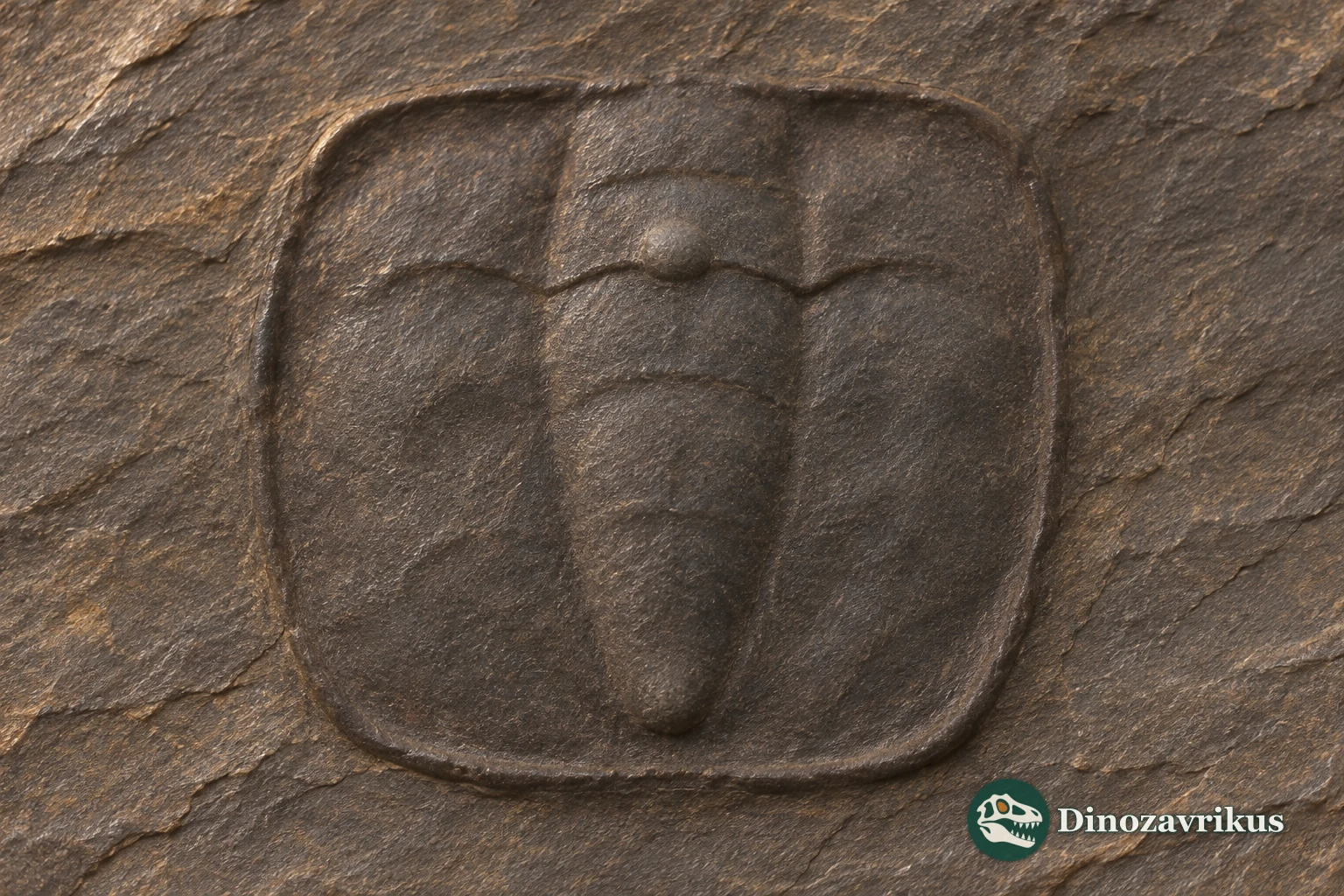
A raised node on the long tail axis of Onymagnostus bends the groove that runs across it. That shield identifies the Norwegian reference fossil. Complete carapaces from the Swedish Caledonides show how the tail and head were joined by two movable segments.
Quick facts
| Group | Agnostids |
|---|---|
| Age | Middle Cambrian |
| Named by | Armin Öpik, 1979 |
| Original type species | Onymagnostus angulatus |
| Lectotype of older species | PMO 28096, Krekling |
| Complete shells | Granberget, Sweden |
What can the fossils tell us?
It can be compared directly with other tails. Its head anatomy comes from separate finds.
The Granberget shells preserve diagnostic parts of both shields in the same individual.
The name is still used in descriptions of new finds. Which species it includes depends on the classification.
How two names became associated
Armin Öpik established Onymagnostus in 1979 and selected O. angulatus as its type species. Later studies compared this form from the Current Bush Limestone of Queensland with material that Waldemar Brøgger had named as a variety of Agnostus gibbus in 1878. Under the interpretation that they belong to one species, the older epithet hybridus takes priority.
PMO 28096, the lectotype of O. hybridus, is an isolated tail shield from the Alum Shale at Krekling, Norway, in the Ptychagnostus punctuosus Zone. Two complete specimens, PMU 37116 and PMU 37123, come from the atavus Zone of Granberget in Sweden. The species is known from both sides of the boundary between these fossil zones in Scandinavia. Occurrences of Ptychagnostus also help trace their succession.
Features on the two shields
In O. hybridus, the front glabellar lobe is round, with a minute point on the midline. The cheeks narrow considerably towards the front. Their surface can be smooth or show shallow pits. In the complete shells these features are preserved alongside those of the tail.
The long tail axis is about as wide as one of the flanking fields. A stout node on the second ring bends the transverse groove. The Swedish collections include complete exoskeletons and many isolated shields showing variation in the width of the border.
Why the genus is still debated
Some studies place the species of Onymagnostus in Ptychagnostus in a broad sense. Richard Robison also treated Onymagnostus as a synonym of Lejopyge in one classification. The Swedish study retained Onymagnostus. A reanalysis of character data published in 2025 failed to recover all the species assigned to the genus as one evolutionary branch.
The same 2025 study described shields from New Brunswick as comparable to O. hybridus. One difficulty is the incomplete knowledge of the type material of the similar O. seminula and the effect of growth on the length of the tail axis. Fossils of several sizes from measured sections help test the identification.
Frequently asked questions
Why are two names associated with the type species?
O. angulatus was designated when the genus was established. If it is the same species as Brøgger’s older Norwegian form, the epithet hybridus takes priority.
Where was the lectotype of the older species found?
PMO 28096 is a tail shield from the Alum Shale at Krekling in Norway.
What do the complete Swedish specimens preserve?
Both the head and tail shields are present, with two movable segments in between.
Why were the New Brunswick fossils identified with a qualification?
Small shields resemble those of other related species. Their anatomy and position in the local rock sequence need to be compared together.