

Orthambonites is a genus of marine brachiopods in the order Orthida. Its fossil record consists chiefly of mineralised shells, but its modern taxonomic scope is narrower than many historical lists suggest. A major revision by Gunnar Jaanusson and Michael G. Bassett in 1993 reassessed the type concept and separated species once grouped by superficial resemblance.
The genus is Ordovician, not Cambrian. The Treatise compilation gives a range from the Floian to the Darriwilian. That span summarises different species and localities; it does not mean one population persisted continuously throughout the interval. The early animal catalogue groups these marine fossils with other Cambrian and early Palaeozoic taxa while retaining their actual Ordovician ages.
Quick facts
| Scientific name | Orthambonites Pander, 1830 |
|---|---|
| Type species | Orthambonites rotunda, linked to Orthis calligramma |
| Group | Rhynchonellata, order Orthida, family Orthidae |
| Range | Floian to Darriwilian in the Treatise compilation |
| Material | Mineralised valves, hinge and internal structures |
| Key traits | Rounded, ventribiconvex shell and diagnostic internal supports |
| Revision | Jaanusson & Bassett, 1993 restricted the genus |
| Limit | Historical records do not all match the revised diagnosis |
What can the fossils tell us?
Jaanusson and Bassett treated Orthambonites transversa as a nomen dubium and proposed O. rotunda as the formal type. Its name is associated with the earlier Orthis calligramma. Older records need review against this revised concept.
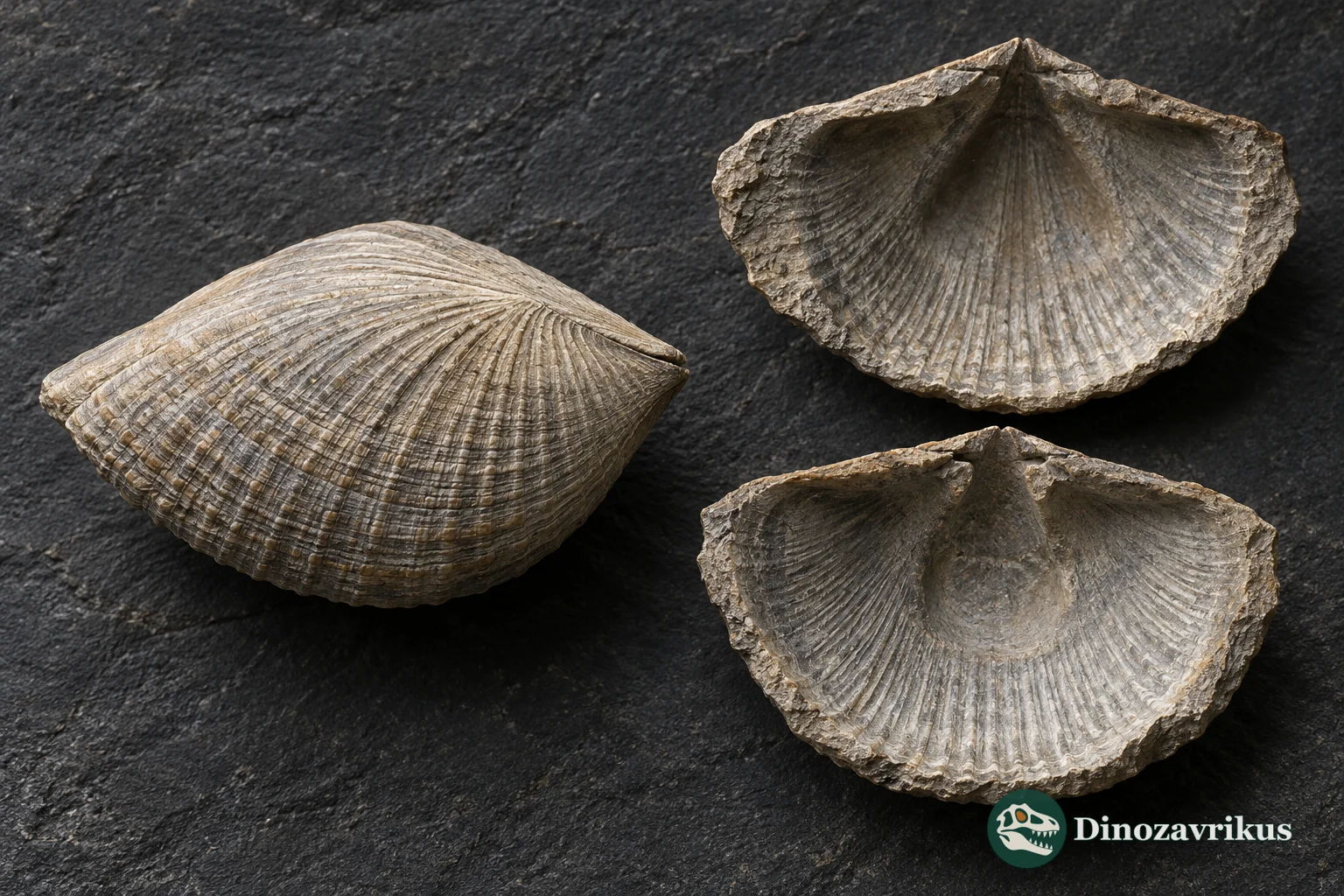
Descriptions compare valve outline and convexity, hinge features and internal supports. Divergence of the brachiophores and the lack of a ventral median ridge are among the diagnostic details; a buried or damaged interior cannot be scored reliably.
The Treatise account lists Floian through Llanvirn/Darriwilian. The 1993 revision focused on late Lower Ordovician to Llanvirn-equivalent Baltoscandian material. These are stratigraphic bounds for attributed species, not proof of an uninterrupted population.
The revision transferred some forms to Paralenorthis and recognised related genera including Sulevorthis, Sivorthis, Shoshonorthis and Krattorthis. Similar shells alone do not establish membership in Orthambonites.
The type name and the 1993 revision
Peter Simon Pallas used Orthambonites in 1776 as Anomites orthambonites; Christian Heinrich Pander formalised the genus in 1830 while describing Silurian strata around Saint Petersburg. Many species were later assigned to the genus. An old combination, however, is not by itself evidence that a specimen fits the diagnosis accepted today.
Jaanusson and Bassett considered the widely used name Orthambonites transversa a nomen dubium because its available characters did not securely establish its application. They proposed O. rotunda as the formal type species. In their treatment it is linked to the senior subjective synonym Orthis calligramma Conrad. A type species anchors the genus name; it does not automatically include every similar shell.
The revision moved some species to Paralenorthis and established or discussed related genera such as Sulevorthis, Sivorthis, Shoshonorthis and Krattorthis. Compare its separate diagnostic history with the orthide Hesperorthis.
Reading the shell
Brachiopods have dorsal and ventral valves, unlike the left and right valves of clams. Orthambonites is generally described as small and rounded, with both valves convex. Growth lines may cross the shell surface. Reliable identification uses more than the outline: researchers inspect the hinge and internal supports, including the brachiophores and the ventral interior.
Some diagnostic structures can be hidden by matrix, broken away or altered by compression. A shell that has been flattened after burial may look unlike its original living form. For this reason a surface photograph alone may support only a tentative identification.
Age and geographic context
The genus is important in Baltic Ordovician brachiopod studies. The 1993 revision focused on material from Baltoscandia and described the restricted group as late Lower Ordovician to Llanvirn-equivalent. In current international stage terminology, the Treatise range extends from the Floian into the Darriwilian. Historical collections can retain older identifications that later revisions transferred to other genera.
Use the age of an individual specimen from its documented bed and revised identification. A genus-level range is an aggregate, not a date that can simply be assigned to every museum label.
Feeding and limits of reconstruction
Like other brachiopods, Orthambonites probably filtered suspended particles from seawater with a lophophore. Many brachiopods attached to the substrate by a pedicle. These are inferences from brachiopod biology, not soft tissues directly preserved in the shell fossils discussed here.
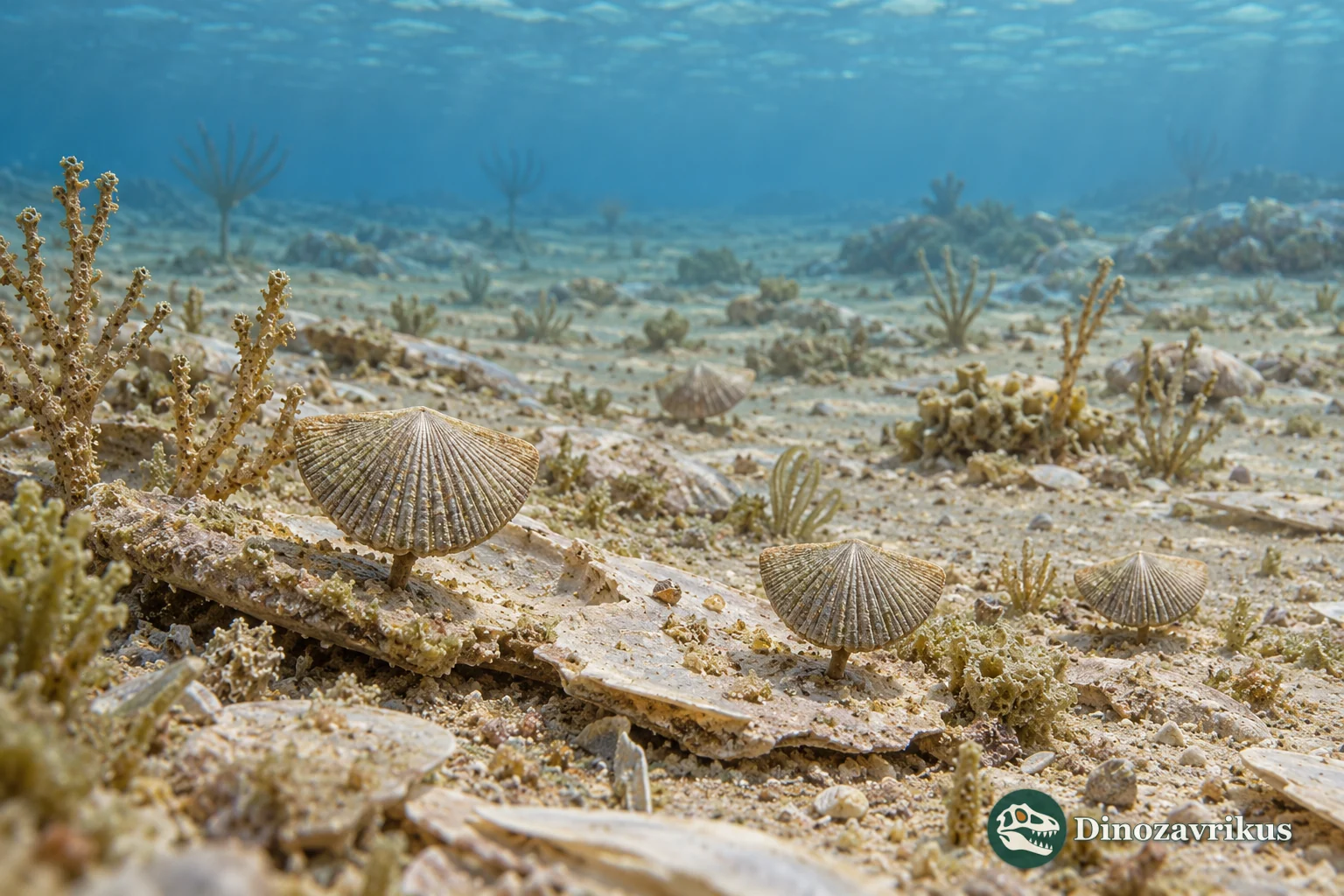
The shell records growth and mineralised anatomy, but not colour, the exact lophophore shape, seasonal reproduction or behaviour. Environmental scenes are interpretive illustrations rather than records of a specific fossil community.
Frequently asked questions
When did Orthambonites live?
In the Ordovician. The Treatise compilation gives a Floian to Darriwilian range, while each occurrence needs its own stratigraphic context.
Why is Orthambonites transversa a nomen dubium?
The 1993 revision judged the available characters insufficient to apply the name confidently and proposed O. rotunda as the formal type.
How are brachiopod valves different from clam valves?
Brachiopod valves are dorsal and ventral; clam valves are left and right.
Can the shell reveal colour or exact diet?
No. Suspension feeding is inferred from brachiopod biology; colour and soft anatomy are not preserved by these shells.