

Orthosuchus stormbergi was a small Early Jurassic crocodile relative from southern Africa. Its type skeleton from Lesotho preserves the skull, limbs and bony scutes. Synchrotron imaging revealed growth lines inside individual bones. It also allowed researchers to test ideas about how frequently an adult might have entered the water.
Quick facts
| Species | Orthosuchus stormbergi |
|---|---|
| Group | Early crocodyliform, Notochampsidae |
| Age | Early Jurassic |
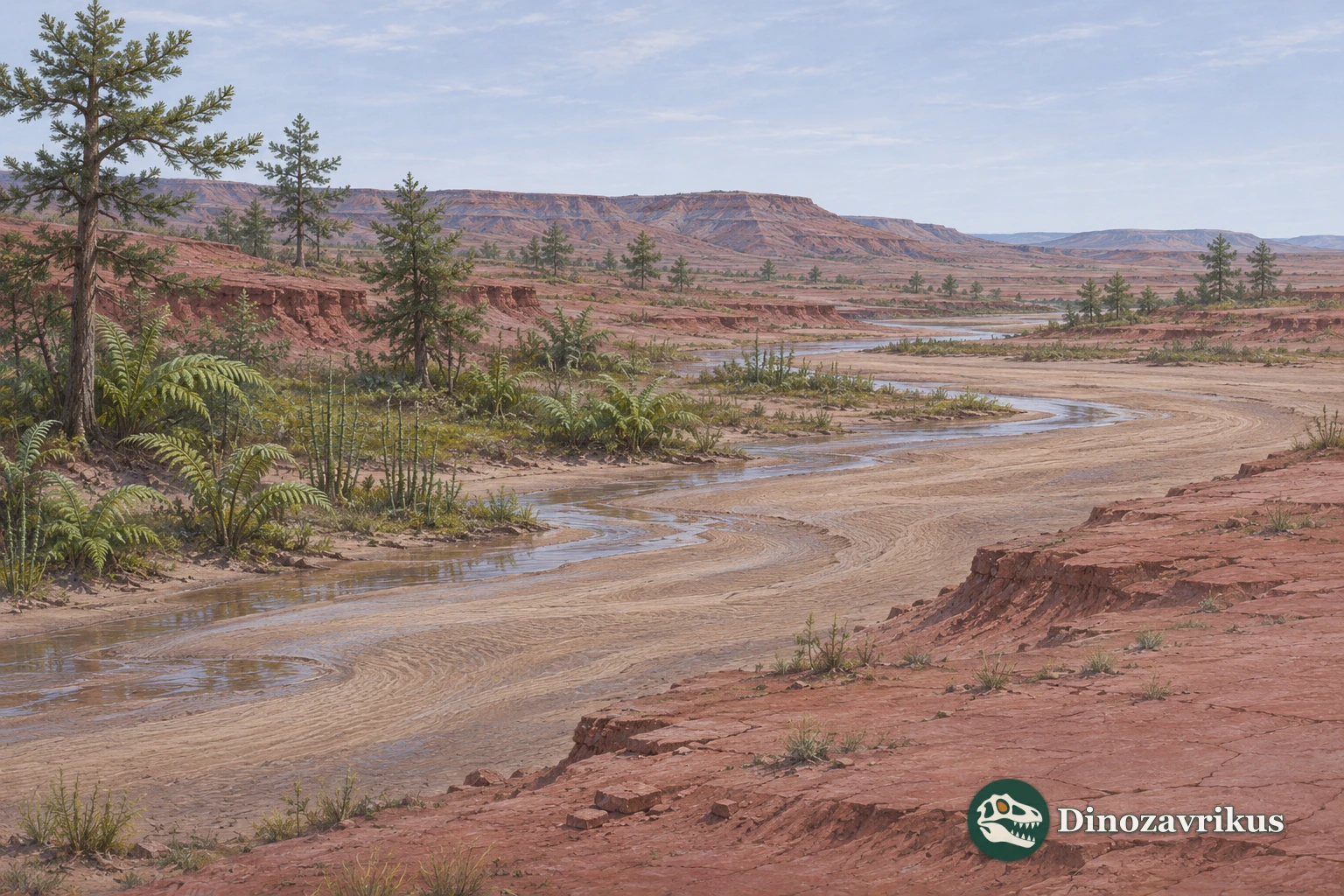
| Horizon | Upper Elliot Formation |
| Holotype | SAM-PK-K409, skull and most of the skeleton |
| Estimated adult mass | About 0.8–1.2 kg from limb bones |
What can the fossils tell us?
Much of the Lesotho skeleton is articulated, including limbs and dorsal scutes. The tail region is missing, which limits a direct measurement of total length.
The type fibula preserves nine lines of arrested growth, while its humerus preserves four. A count from one bone gives an incomplete growth record.
Their structure is compatible with regular submersion in adults. Similar structure can arise in animals with other habits.
Fossils from Lesotho and South Africa
The type was found in 1963 near Qacha’s Nek, Lesotho. Diane Nash named Orthosuchus in 1968, when the red beds were considered Late Triassic. The upper part of the Elliot Formation is now assigned to the Early Jurassic. SAM-PK-K409 is held at the Iziko South African Museum in Cape Town.
South African specimens include a nearly complete dentary, BP/1/7979, and articulated parts of the body and limbs, BP/1/4242. Together with the type, they provide points of comparison for the jaw, scutes and limb bones of different individuals.
The front of the palate and the shape of the jaw
Skull scans show a pair of oval internal nostrils near the front of the palate, separated by the paired vomer bones. The bony shelves of the palatines do not meet at the midline. This is one of several arrangements of the bony breathing passage known in early crocodyliforms.
At the front of the lower jaw the two branches meet back to the gap between the third and fourth sockets. Bony scutes lay along the back, and the margins of the trunk ribs are expanded. A 2021 analysis linked Orthosuchus with Notochampsa using features of the ribs and skull.
Growth, adult mass and a possible link to water
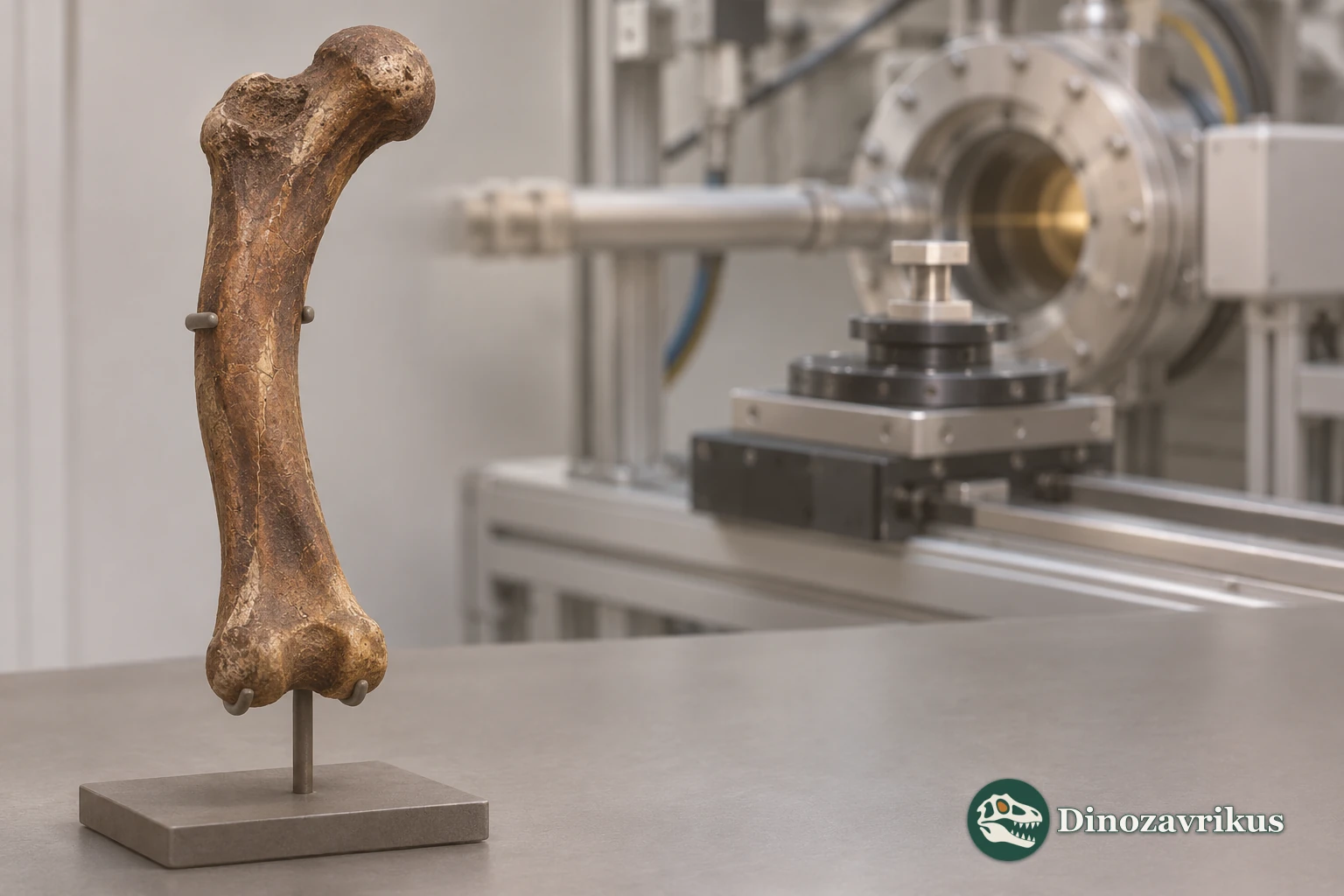
Weiss and colleagues examined the type and the femur of BP/1/4242 with synchrotron imaging. The outer layers contain mostly lamellar bone with sparse blood-vessel channels. Lines and close growth layers towards the bone surface record slowing growth. Models using limb-bone circumferences gave adult masses of about 0.8–1.2 kilograms.
The researchers compared its relatively regular growth with that of the dinosaur Lesothosaurus from the same regional deposits. The compact, thick walls of Orthosuchus bones are consistent with adults sometimes submerging regularly. Thick bones also occur in some land animals, so they do not establish how much time Orthosuchus spent in water.
Frequently asked questions
Where was the type found?
Near Qacha’s Nek in Lesotho, in the Early Jurassic upper Elliot Formation.
Why do older papers call it Triassic?
The red beds were originally thought to be Late Triassic. The upper Elliot Formation was later dated to the Early Jurassic.
How was adult mass estimated?
Comparative models used the circumferences of the femur, or the femur and humerus together. They gave about 0.8–1.2 kilograms.
Do the compact bones settle whether it lived in water?
They support the possibility of regular submersion, but similar bones occur in some terrestrial animals.