

Pachagnathus benitoi is an early pterosaur from the Late Triassic of San Juan Province, Argentina. Its name rests on one fragment of a fused lower jaw, not a complete skeleton. The fossil helps establish that pterosaurs had reached the Southern Hemisphere by the Late Triassic, yet it reveals neither the animal's wingspan nor its living outline.
Quick facts
| Named species | Pachagnathus benitoi, Martínez and colleagues, 2022 |
|---|---|
| Holotype | PVSJ 1080, partial fused lower jaw |
| Locality | Quebrada del Puma, San Juan Province, Argentina |
| Rock unit | Quebrada del Barro Formation |
| Age | Late Triassic, late Norian–Rhaetian |
| Preserved bone length | 61.5 mm; the front tip is missing |
| Known wingspan | Cannot be established from the jaw |
What can the fossils tell us?
PVSJ 1080 preserves 61.5 mm of the lower-jaw symphysis. The missing front means the complete snout length cannot be measured.
A damaged tooth, roots and sockets are preserved. The missing tip cannot be reconstructed as a measured tooth row.
The Quebrada del Barro Formation is assigned to the late Norian–Rhaetian interval; this is a geological age, not an individual death date.
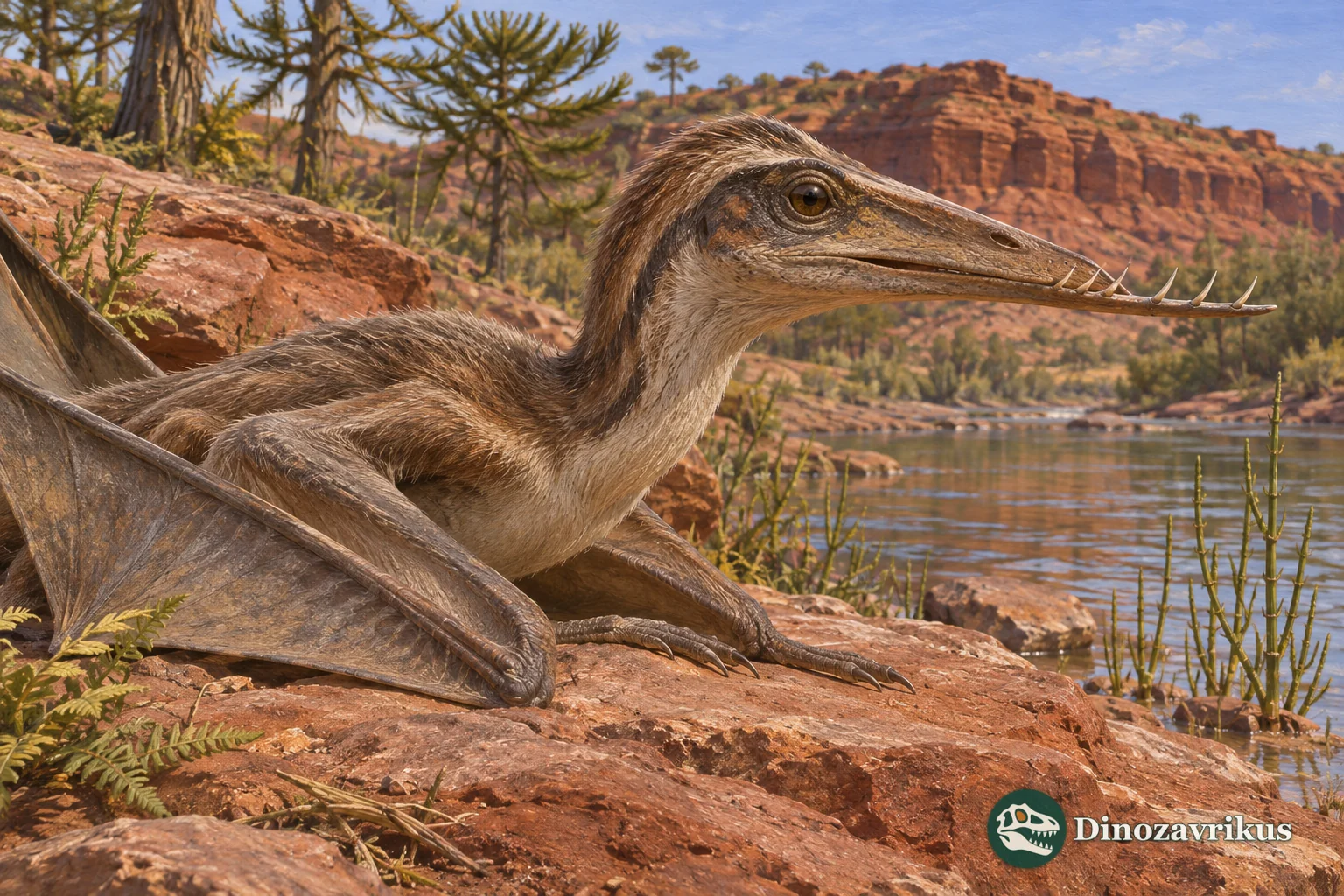
The fossil has neither wings nor soft tissues. Whole-animal illustrations depend on comparisons with other early pterosaurs.
Discovery in San Juan
Ricardo Martínez, Brian Andres, Cecilia Apaldetti and Ignacio Cerda named Pachagnathus in 2022 alongside another pterosaur from the same formation. The genus combines the Aymara word pacha, earth, with Greek gnathos, jaw. The species honours Benito Leyes, a local guide who assisted fossil searches. The name applies to jaw specimen PVSJ 1080 rather than to every pterosaur bone reported in the study.
The holotype came from Quebrada del Puma in the Marayes–El Carrizal Basin. The continental Quebrada del Barro Formation is placed in the later part of the Triassic, from the late Norian into the Rhaetian. This interval describes its geological context, not the precise year in which the animal lived.
What the jaw preserves
PVSJ 1080 is part of the symphysis, where the two sides of the lower jaw meet toward the front. Its preserved length is 61.5 mm, but the anterior tip is absent. The study described a tooth with a broken apex and empty sockets on one side, with roots and sockets on the other. At least five tooth positions are indicated on each side of the available fragment. None of these measurements gives the complete snout length.
Surface relief, the shape of the joined jaw and tooth positions distinguished the specimen from other early pterosaurs. The other Argentine pterosaur named in the same paper is represented by a different part of the head and a separate ulna. Those elements cannot be transferred to Pachagnathus to create an apparently complete skeleton.
An early evolutionary branch
In the authors' phylogenetic analysis, Pachagnathus grouped with the other Argentine genus and the European Raeticodactylus. That arrangement depends on the chosen characters and on fossils with little anatomical overlap. It is a research hypothesis, not a proven ancestor–descendant sequence.
The European Austriadactylus and Peteinosaurus provide comparisons with better known early forms. Similar age does not give the Argentine jaw their wing dimensions, ecology or exact appearance.
What remains unknown
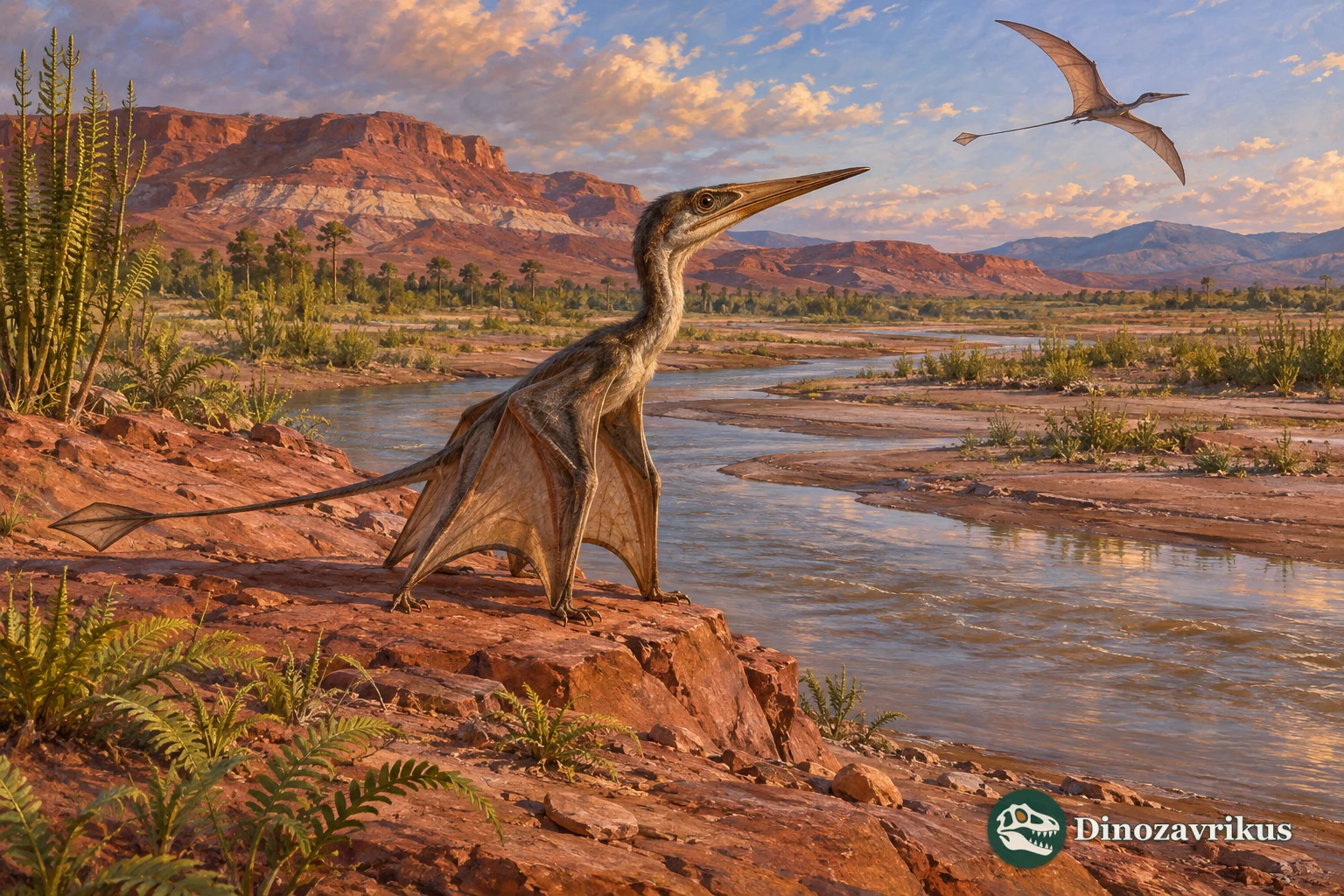
The holotype has no vertebrae, limb bones, wing membrane or gut contents. Wingspan, mass, colour, prey choice and flight behaviour cannot be measured for this genus. A flying pterosaur in a river landscape illustrates a possible member of the group in a continental environment; it is not a record of this individual hunting, flocking or following a particular river.
Frequently asked questions
Was a complete Pachagnathus skeleton found?
No. The genus is based on PVSJ 1080, part of a fused lower jaw lacking its anterior tip. Other pterosaur bones described in the same study are separate finds.
How long was the full jaw?
Only 61.5 mm of the fragment survives. Because its front is missing, total jaw length is unknown.
Why does the Argentine fossil matter?
It is Late Triassic evidence that unmistakable pterosaurs occurred in the Southern Hemisphere.
Is its wingspan known?
No wing bones belong to the holotype, so a numerical wingspan would be speculation from other genera.