

Pachyrukhos was a small notoungulate from Miocene South America. Its compact body and relatively long hind limbs created a rabbit-like outline, but it was not a rodent or lagomorph. The resemblance arose independently within an extinct South American ungulate lineage.
The genus belongs in the ancient mammal catalogue. Its family includes other small-bodied forms such as Paedotherium, although similar proportions do not establish identical behaviour or direct ancestry.
Quick facts
| Scientific name | Pachyrukhos Ameghino, 1885 |
|---|---|
| Recognized species | P. moyani and P. politus in the 2019 revision |
| Group | Notoungulata; Hegetotheriidae, Pachyrukhinae |
| Age | Early to middle Miocene, depending on species and locality |
| Range | Patagonia in Argentina; some records also come from Chile |
| Material | Skulls, jaws, tooth rows, isolated teeth and some limb bones |
| Mass estimate | Around 1.5–2 kg in several model-based estimates |
| Key limitation | Rabbit-like proportions do not imply close relationship to rabbits |
What do Pachyrukhos teeth and jaws show?
The 2019 revision recognizes Pachyrukhos moyani and P. politus. Several older names assigned to P. moyani were treated as junior synonyms, while other names remain uncertain or were excluded.
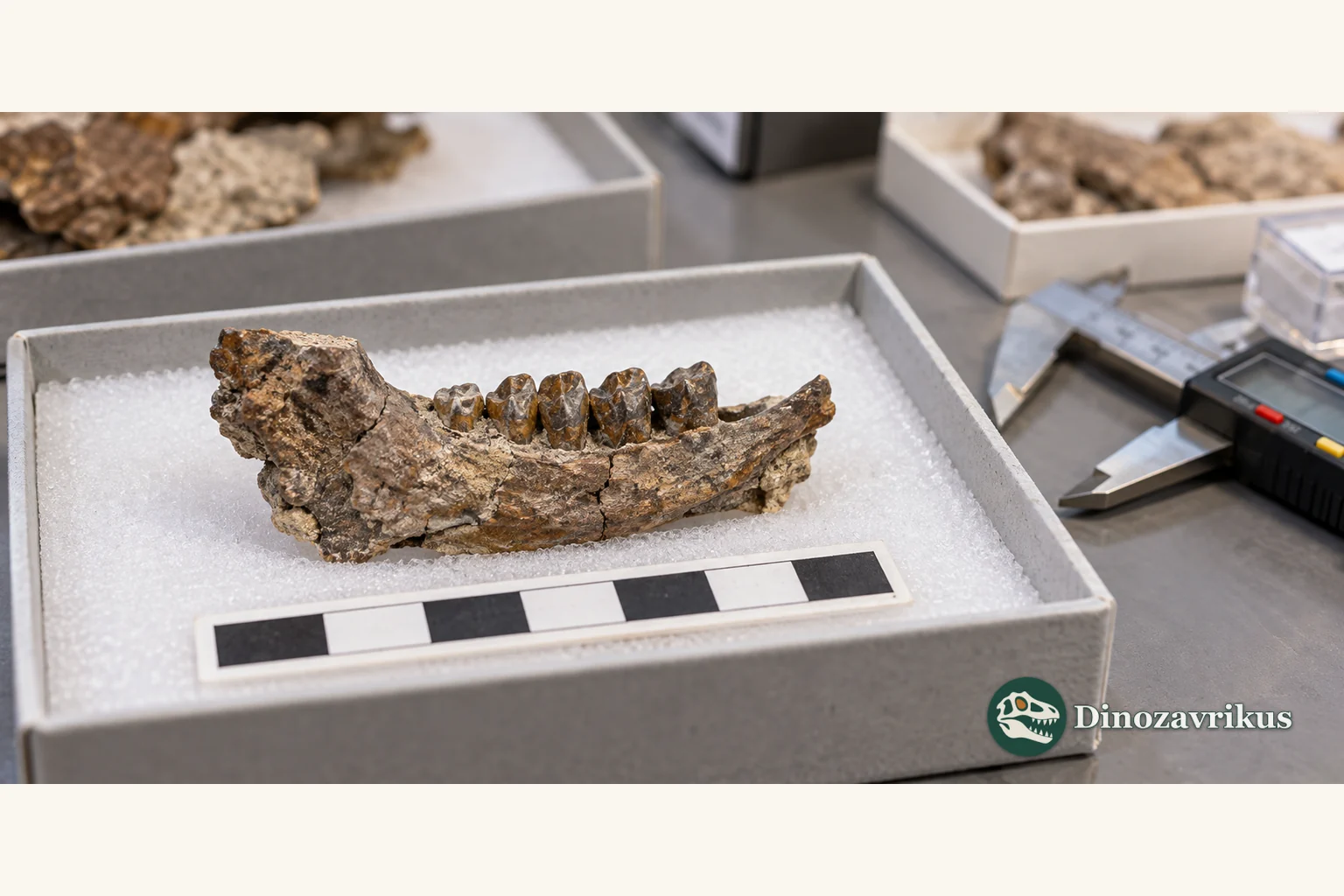
Descriptions emphasize small cheek teeth, straight lingual surfaces and distinct labial grooves. A characteristic diastema can separate cheek teeth from the front of the row, but fragmentary jaws may not preserve it.
Different calculations using skull, teeth or limb bones give a range for adults. Values around 1.5–2 kg are an approximate scale; equations and reference samples influence each estimate.
P. politus is known from early Miocene Sarmiento Formation deposits in Chubut. P. moyani occurs in the Santa Cruz and Collón Curá formations. Occurrences are not evenly distributed through each formation.
Name and taxonomic revision
Florentino Ameghino established Pachyrukhos in 1885 from Miocene material in Patagonia. Its history became complicated as authors named numerous species, often from incomplete tooth rows. Older literature also uses Pachyrucos; the 2019 revision uses Pachyrukhos.
Federico Seoane and Esperanza Cerdeño re-examined the genus in 2019, including previously unpublished museum material. They recognized P. moyani and P. politus. Several names historically applied to P. moyani, including P. absis, P. naevius, P. teres and P. trivius, were synonymized or reassessed. The specimens vary in completeness and locality information and should not be combined into one skeleton without evidence of association.
Two species and different time ranges
Pachyrukhos politus is known from early Miocene deposits of the Sarmiento Formation in Chubut. P. moyani has a broader record in the early to middle Miocene Santa Cruz Formation and the middle Miocene Collón Curá Formation in Río Negro and Neuquén. Some remains have also been reported from Chile, but their identifications depend on what each specimen preserves.
Occurrences within the Santa Cruz Formation are not uniform. South of the Río Coyle, P. moyani has been recorded in upper levels estimated at roughly 17–17.4 million years old. Other localities have separate stratigraphic ranges. A formation-wide age should not be transferred to a bone unless its collecting horizon is known.
Teeth, body size and diet
Descriptions emphasize small lower cheek teeth, nearly straight lingual faces and pronounced grooves on their labial surfaces. A diastema can be informative when a sufficiently complete specimen is preserved. A short tooth-bearing fragment may match some features yet lack enough anatomy to establish the species.
Body mass estimates use different predictors. Studies using cranial, dental and postcranial measurements do not return one identical figure; adult P. moyani values commonly fall around 1.5–2 kg, although some equations produce wider ranges. This is an approximate scale, not a direct weight. The animal was herbivorous, but no stomach contents identify particular plants.
Why the silhouette resembles a rabbit
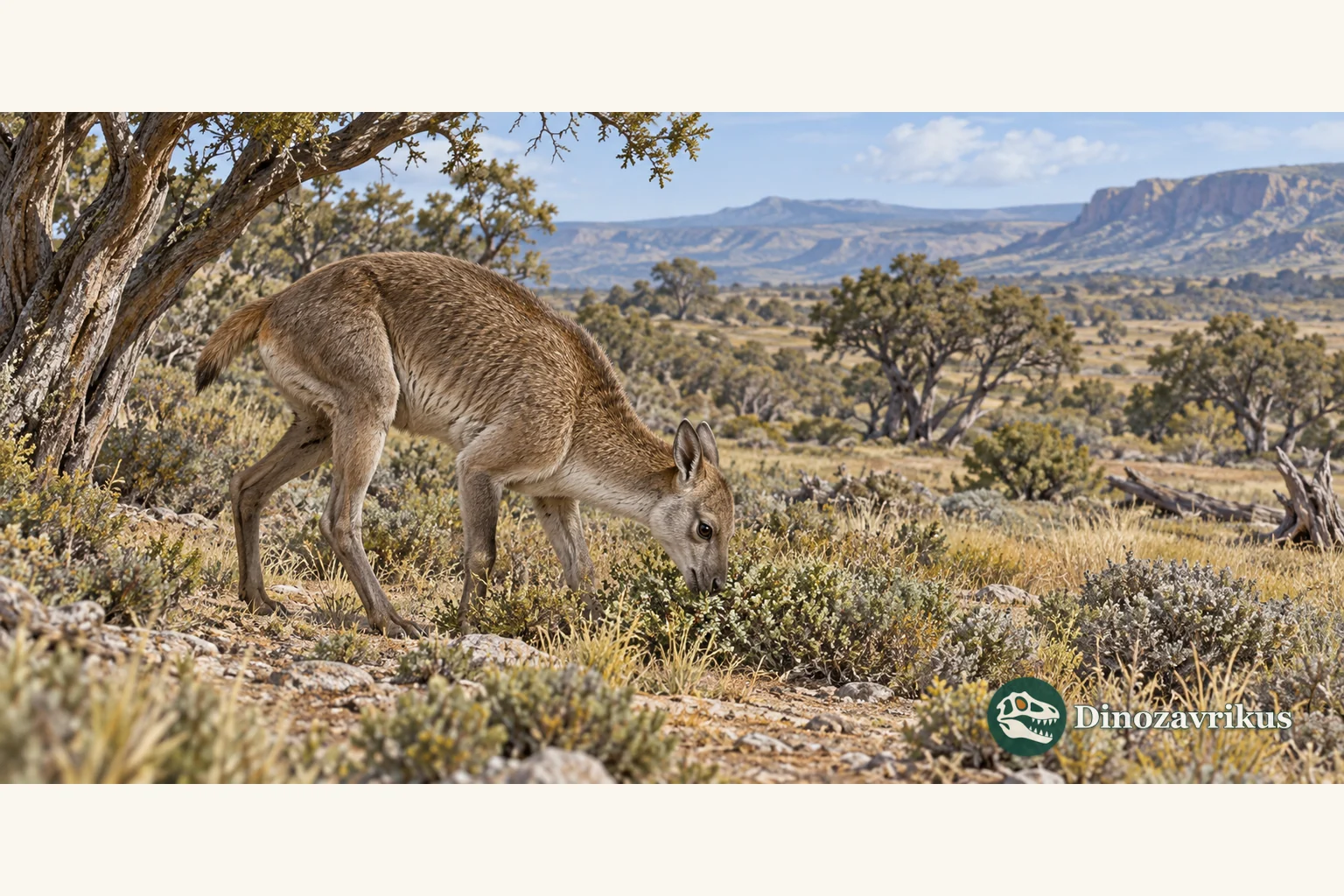
A compact body, short tail and relatively long hind limbs create a rabbit-like outline. Comparisons with living mammals help explore possible movement, but bone proportions cannot establish an exact gait or how often the animal hopped, ran or walked. The fossil record provides no direct observation of behaviour.
Ears, fur and colour are unknown. Long hare-like ears sometimes shown in artwork are artistic choices rather than preserved features. Such decisions should be distinguished from anatomy measured in fossils.
Classification and what remains uncertain
Pachyrukhos belongs to Hegetotheriidae and the subfamily Pachyrukhinae within Notoungulata. These extinct South American ungulates were not close relatives of modern rabbits, despite their independently similar silhouette. Relationships are established from suites of anatomical features, not appearance alone.
Teeth and jaws directly document anatomy; mass values are inferences from comparative equations. Exact movement, preferred habitat, colour and detailed diet remain uncertain. The historical spelling Pachyrucos does not by itself indicate a separate modern genus.
Frequently asked questions
Was Pachyrukhos related to rabbits?
No. It was a notoungulate in an extinct South American ungulate lineage. Its rabbit-like outline evolved independently.
How many Pachyrukhos species are currently recognized?
The 2019 revision recognizes Pachyrukhos moyani and P. politus. Several older names were synonymized, reassigned or left uncertain.
How large was Pachyrukhos?
Model-based adult estimates for P. moyani commonly fall around 1.5–2 kg, though results vary with the measurements and equations used.
What did it eat?
It was herbivorous. Teeth inform comparisons of food processing, but no direct evidence identifies a precise menu or seasonal diet.