

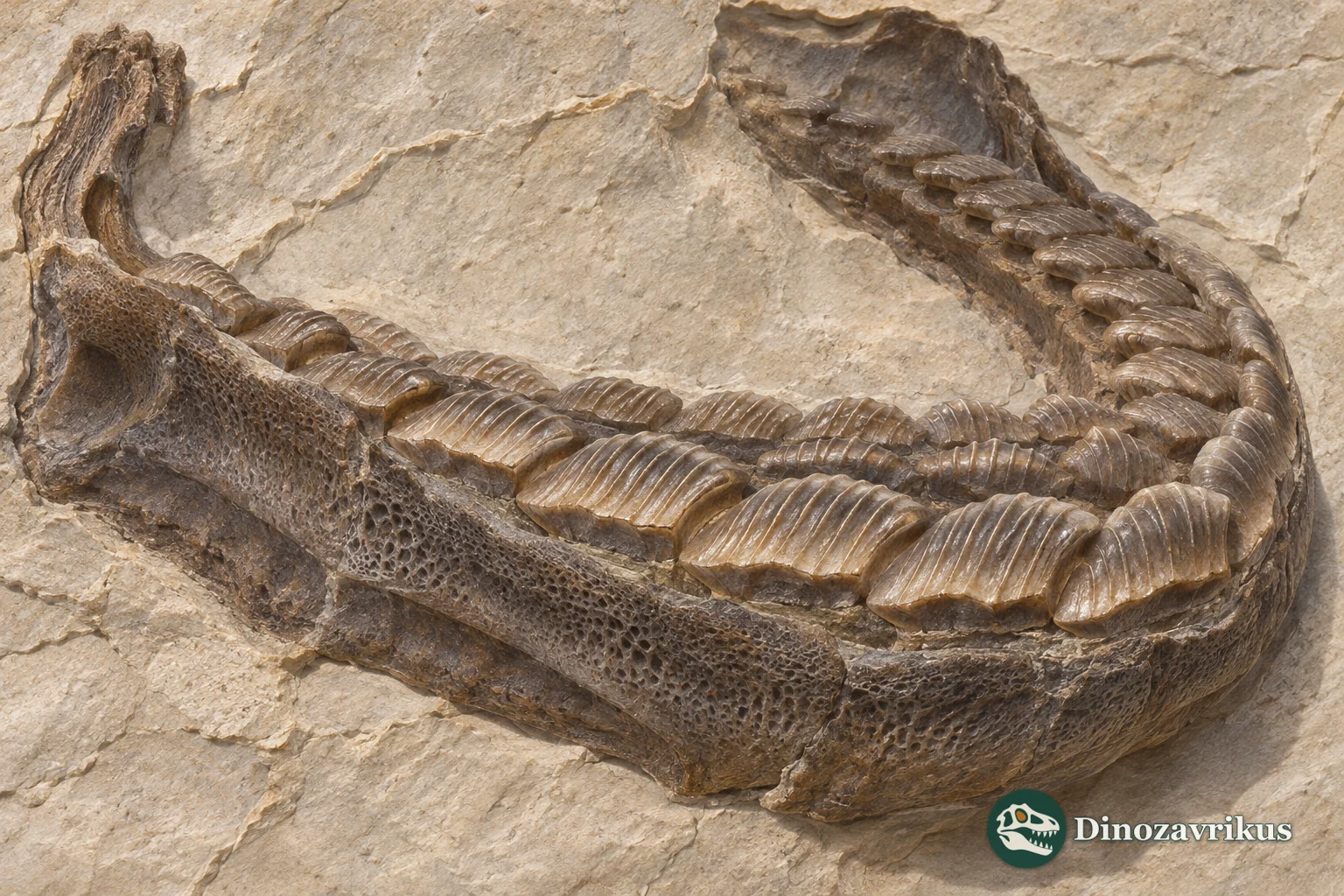
Palaeobates is an extinct hybodont shark. Unlike many ancient sharks known only from separate teeth, a specimen of P. polaris from Spitsbergen preserves part of the lower jaw with teeth and elements of a fin. It reveals dental arrangement as well as crown shape. The cover offers an artistic body reconstruction; its colour and complete outline are not preserved.
Quick facts
| Group | Hybodontiform sharks |
|---|---|
| Well-studied species | Palaeobates polaris |
| Specimen age | Smithian, Early Triassic |
| Locality | Spitsbergen, Svalbard |
| Preserved parts | Lower jaw with teeth and fin elements |
| Length estimate | About 1 m for P. polaris; approximate |
What can the fossils tell us?
A P. polaris specimen preserves a lower jaw branch with teeth and labial cartilage, parts of the hyoid arch and an anterior dorsal fin section.
The associated jaw shows tooth arrangement. Hard-prey feeding is an inference from tooth form, not a documented stomach content.
The fossils permit jaw and fin comparison but do not fix the animal's colour, full outline or list of prey.
The Spitsbergen specimen
Carlo Romano and Winand Brinkmann described a new P. polaris specimen in 2010 from the Smithian fish horizon of Spitsbergen. It is more complete than the species' type material. The left branch of the lower jaw retains associated teeth and labial cartilage, accompanied by parts of the hyoid arch and an anterior dorsal fin section. This is not a whole skeleton, but it lets researchers examine teeth in place.
Three-dimensional preservation of Meckel's cartilage is particularly valuable because cartilage commonly decays before fossilization. The authors used the jaw's dental groove to compare Palaeobates with other hybodonts, adding evidence beyond isolated crowns.
Teeth and feeding
The teeth of P. polaris are low and broad with a sculptured surface. A comparative Early Triassic study reported teeth up to 15 mm. Their shape is compatible with crushing hard food, but no preserved stomach contents identify molluscs or crustaceans as demonstrated prey of this animal.
Romano and Brinkmann found the number and arrangement of tooth files useful in distinguishing the genus. They also cautioned that tooth histology alone cannot settle hybodont relationships. The teeth possess a pulp cavity shared with other Palaeobates species, whereas details of crown ornament differ.
Fin anatomy and relationships
The specimen retains part of the anterior dorsal fin. The researchers compared dorsal fin spines of P. polaris and P. angustissimus with those of Hybodus and Acrodus; Palaeobates spines tend to be more slender. The comparison concerns preserved structures rather than the precise outline of a living fin. Polyacrodus provides another hybodont dental record.
Hybodonts were an extinct branch of cartilaginous fishes, not a family of living sharks. The later Palaeohypotodus illustrates wider fossil shark diversity but does not belong to this genus. Identifying Palaeobates depends on a combination of teeth, jaw and fin-spine characters.
Size and reconstruction
A comparative study gave an approximate length of about one metre for P. polaris. This is an estimate from incomplete material, not a measurement of a complete articulated body. It should not automatically be applied to every species of the genus. Neither swimming speed nor colour is known directly.
The marine Smithian deposits of Spitsbergen document the setting of the studied species. Broad teeth support a hard-prey hypothesis, but direct prey evidence would require additional finds. The cover combines knowledge of the group with the preserved parts of P. polaris and remains an artistic reconstruction.
Frequently asked questions
Was Palaeobates a living shark lineage?
No. It was a member of the extinct hybodontiform sharks.
What was found in the Spitsbergen specimen?
A lower jaw branch with teeth, labial cartilage, parts of the hyoid arch and a section of the anterior dorsal fin.
What did it eat?
Broad low teeth suggest crushing hard prey, but specific food is not confirmed by stomach contents.
How securely is its length known?
About one metre has been estimated for P. polaris; no complete body was available for direct measurement.