

Palaeoproteus was an extinct European salamander. Eocene skeletons from the Geiseltal in Germany preserve its body shape. Older and younger sites generally preserve isolated vertebrae and jaw bones, which allow researchers to identify species from different intervals.
Quick facts
| Group | Salamanders, Batrachosauroididae |
|---|---|
| Age | Paleocene, Eocene, Miocene and Pliocene |
| Region | Europe: France, Germany, Austria and Ukraine |
| Type species | Palaeoproteus klatti |
| Scientific name | Palaeoproteus |
| Diet | Unknown |
What can the fossils tell us?
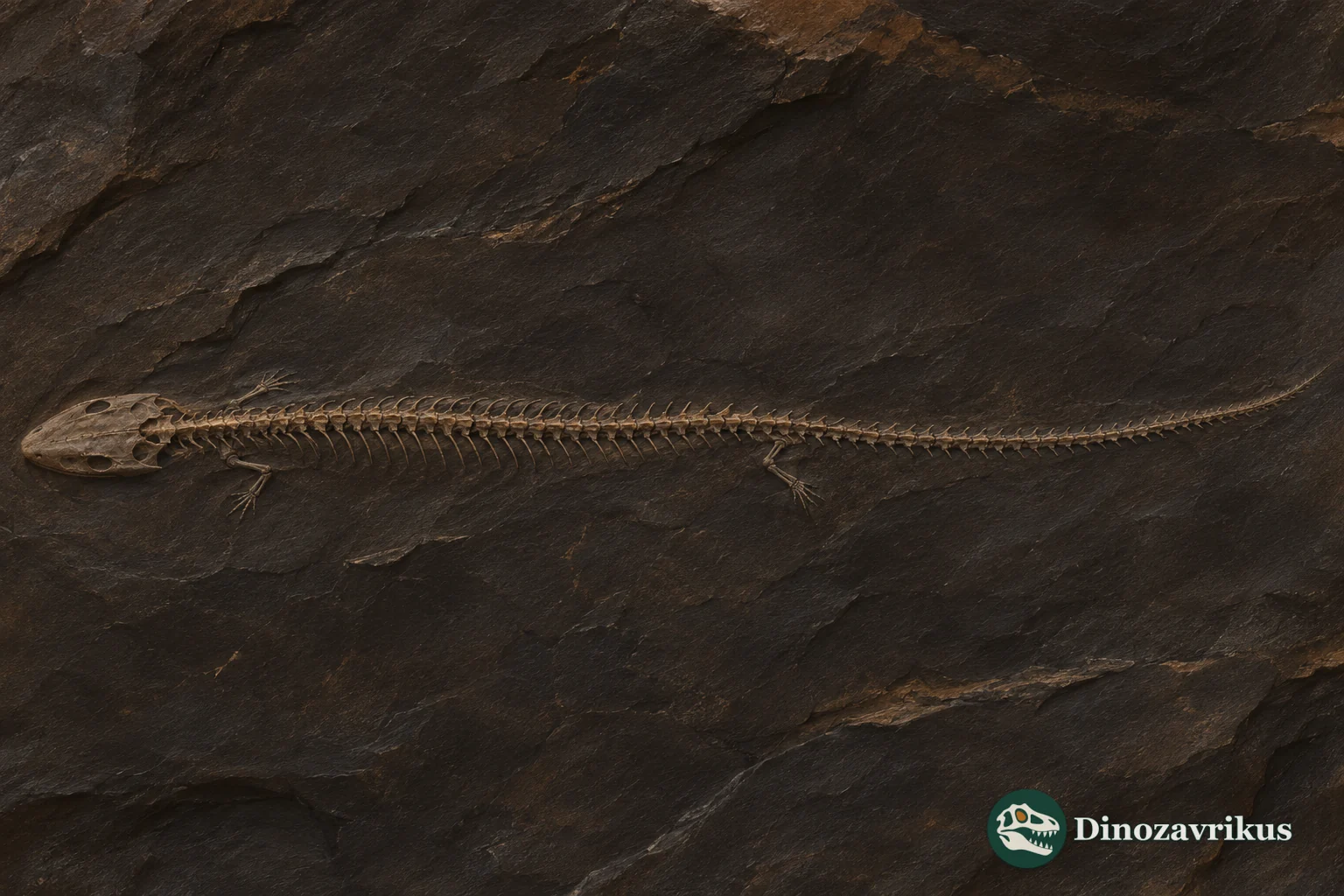
Palaeoproteus klatti is represented by nearly complete skeletons showing an elongated trunk and reduced limbs.
The Miocene material shows distinctive proportions in the vertebrae and lower jaw. These elements let researchers compare sites without articulated skeletons.
The Hambach material was assigned to Palaeoproteus. Its exact assignment to the Miocene species remains provisional.
Eocene skeletons from Germany
Wolf Herre named Palaeoproteus klatti in 1935 based on material from the Geiseltal. Nearly complete skeletons from the Middle Eocene deposits there document an elongated trunk and reduced limbs consistent with an aquatic lifestyle. Palaeoproteus belongs to the extinct family Batrachosauroididae, which also includes North American Batrachosauroides.
From Cernay to the Miocene sites
Late Paleocene P. gallicus was described from isolated bones at Cernay in France. P. miocenicus was named from Austrian and Ukrainian material dating to about 11–9 million years ago. Its holotype is a left dentary from Götzendorf. Vertebrae and jaws from multiple sites allowed a comparison with Paleogene species.
What distinguishes the Miocene species
In P. miocenicus the Meckelian groove inside the lower jaw extends further forward. A projection on the atlas, the first vertebra, also differs. Researchers estimated total lengths of 17–39 cm from the size of vertebral centra. An articulated skeleton has yet to be identified for this species.
The youngest Hambach finds
In 2024 researchers described Palaeoproteus remains from Middle Miocene and Late Pliocene deposits at Hambach in Germany. They provisionally compared material from both horizons with P. miocenicus. The Pliocene finds extend the genus’s record. Their exact relationship to the Austrian and Ukrainian material remains unresolved.
Frequently asked questions
Which fossils best show its body shape?
Nearly complete Eocene skeletons of the German species preserve a long trunk and reduced limbs.
Where was the Miocene species discovered?
Its type specimen comes from Götzendorf in Austria. Other material comes from Austria and Ukraine.
How large was the Miocene species?
Estimates based on vertebral measurements gave a range of about 17–39 cm in total length.
When did the youngest known Palaeoproteus live?
The genus is recorded in Late Pliocene deposits at Hambach. The species-level assignment of that material is provisional.