

Paleryx was a snake from late Eocene southern England. Most specimens are broad trunk vertebrae. Their proportions change along the backbone, a source of confusion when isolated bones were first divided among species.
Quick facts
| Group | Snakes (Serpentes) |
|---|---|
| Age | Late Eocene |
| Region | Europe, United Kingdom |
| Type species | Paleryx rhombifer |
| Scientific name | Paleryx |
| Diet | No direct evidence |
What can the fossils tell us?
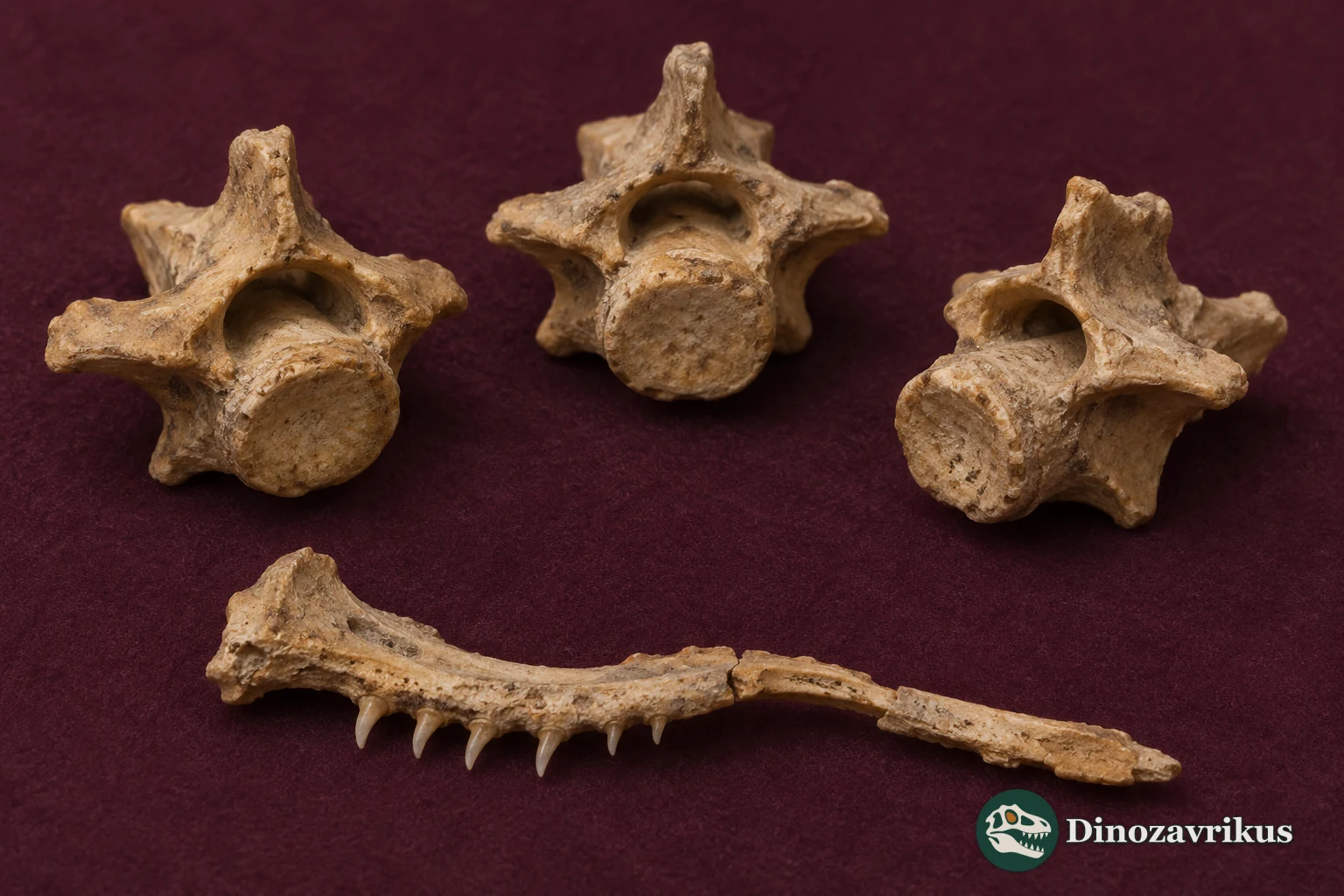
NHMUK PV OR 25259 preserves the front of a trunk vertebra. Other specimens come from the Isle of Wight.
The vertebral bodies are wider than they are long. The arch over the spinal canal is flatter toward the back of the trunk.
A single left palatine was tentatively attributed to Paleryx. It was not found with a diagnostic vertebra.
An incomplete vertebra from Hordle
Richard Owen named the genus in 1850 from a fossil found in the coastal cliff at Hordle, Hampshire. The holotype is held at the Natural History Museum in London. It comes from the Totland Bay Member of the Headon Hill Formation. Other confirmed English records include Headon Hill and Fishbourne on the Isle of Wight.
Why two names came to refer to one species
The low vertebrae once called Paleryx depressus match bones from farther back in the trunk of P. rhombifer. The two names are now treated as synonyms. A third name, Paleryx spinifer, was transferred to Eoconstrictor. Among the differences between the genera is the lower neural spine in the posterior trunk of Paleryx.
A clue from the palate
The tentatively identified left palatine has seven tooth positions and two complete teeth. It also bears an opening absent in the Eoconstrictor material used for comparison. The vertebrae support a place among Constrictores. The exact relationship to living boas and pythons remains uncertain.
The limits of its fossil record
Older reports extended the range of Paleryx into the early Miocene of continental Europe. A revision of the French specimens overturned those identifications. Reliable records are currently confined to late Eocene England.
Frequently asked questions
How large was Paleryx?
Its main fossil record consists of isolated vertebrae. The available specimens do not establish a reliable total length.
Where is the type locality?
The type comes from a coastal exposure at Hordle in Hampshire, often called Hordwell Cliff in older publications.
Is Paleryx depressus a separate species?
Most recent revision work treats it as a synonym of P. rhombifer. Its lower vertebrae came from farther back along the trunk.
Has any part of the skull been found?
A left palatal bone with teeth has been tentatively assigned to the genus. Its identity has yet to be confirmed.