

Paluxysuchus newmani was an Early Cretaceous crocodyliform from what is now Texas. Skull material represents two individuals. The better preserved skull has large, rounded openings in the roof and an unusually long projection on a bone behind the eye socket. These features inform comparisons with other early neosuchians.
Quick facts
| Group | Neosuchia, Paluxysuchidae |
|---|---|
| Age | Late Aptian, Early Cretaceous |
| Locality | Jones Ranch, Hood County, Texas |
| Rock unit | Twin Mountains Formation |
| Holotype | SMU 76601, skull and lower jaw material |
| Body length | Uncertain |
What can the fossils tell us?
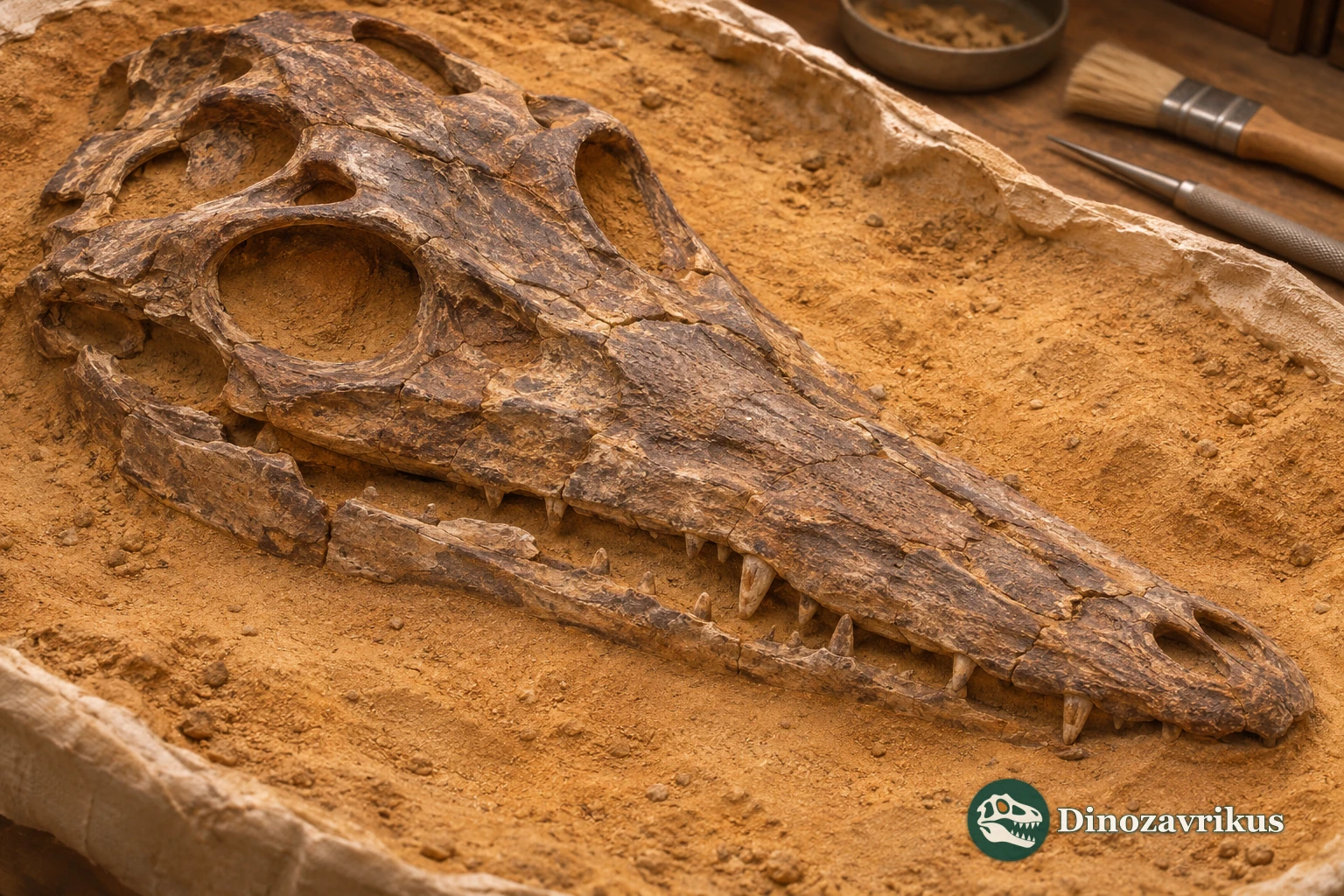
Most of the skull survives. Missing premaxillae and palate bones limit reconstruction of the snout tip and the internal nostrils.
The frontal is excluded from the orbital rim. The postorbital has an unusually long process extending forward and outward.
The second individual is represented by a left angular from the lower jaw and a right ectopterygoid. Both came from the late Aptian Twin Mountains Formation.
The fossils from Hood County
Thomas Adams described the species in 2013 from the Jones Ranch quarry near Tolar. The genus name refers to the Paluxy River. The species name honours Kent Newman, who helped excavate and prepare the fossils.
The main specimen, SMU 76601, consists of a nearly complete skull and parts of the lower jaw. The bones of the second individual, SMU 76602, come from the same locality. Sauropod bones found nearby provide other evidence of the animals represented in the deposit.
What the skull preserves
The skull roof has large, rounded supratemporal openings. The rear branch of the jugal is slender, and the postorbital has an unusually long projection that points forward and outward. The frontal stays clear of the orbital rim. Such bone contacts allow comparisons even in a skull with an incomplete snout.
The holotype lacks the premaxillae, left palatine and pterygoids. The exact outline of the snout tip and the structure around the internal nostrils therefore remain uncertain. The fossils also leave body length and limb proportions unresolved.
Where it fits among neosuchians
The first analysis placed Paluxysuchus close to a branch containing Eusuchia and the family of Goniopholis. Later work incorporating new Deltasuchus material recovered the two Texas genera together as Paluxysuchidae. The family's position relative to goniopholidids depended on the dataset.
The Jones Ranch finds establish the presence of Paluxysuchus in Texas by the late Aptian. Evidence for diet and behaviour is limited, and the body outline in the reconstruction is approximate.
Frequently asked questions
Where was Paluxysuchus found?
The fossils came from Twin Mountains Formation rocks at Jones Ranch near Tolar, Texas.
How many individuals are known from Jones Ranch?
Two. The main specimen includes a skull and part of the lower jaw. Two isolated bones represent the second individual.
Where does the name Paluxysuchus come from?
The genus was named for the Paluxy River, which flows through the same Texas county as the quarry.
How was it linked to Deltasuchus?
Researchers compared anatomical characters across several datasets. Their analyses grouped the two genera together in Paluxysuchidae.