

Pampadromaeus was a small dinosaur from the Late Triassic of southern Brazil. Researchers put its length at about one and a half metres. The parts of its type skeleton came apart before their burial but remained close together in one block. The head, teeth and limbs provide unusually useful evidence about early sauropodomorph anatomy.
Quick facts
| Group | Early sauropodomorphs (Sauropodomorpha) |
|---|---|
| Age | Late Triassic (Carnian) |
| Region | South America (Rio Grande do Sul, Brazil) |
| Diet | Teeth suggest a mixed diet that included plant food |
| Type species | Pampadromaeus barberenai |
| Estimated length | About 1.5 m |
| Holotype | ULBRA-PVT016, disarticulated partial skeleton in one block |
| Deposits | Santa Maria Formation, upper Alemoa Member |
What can the fossils tell us?
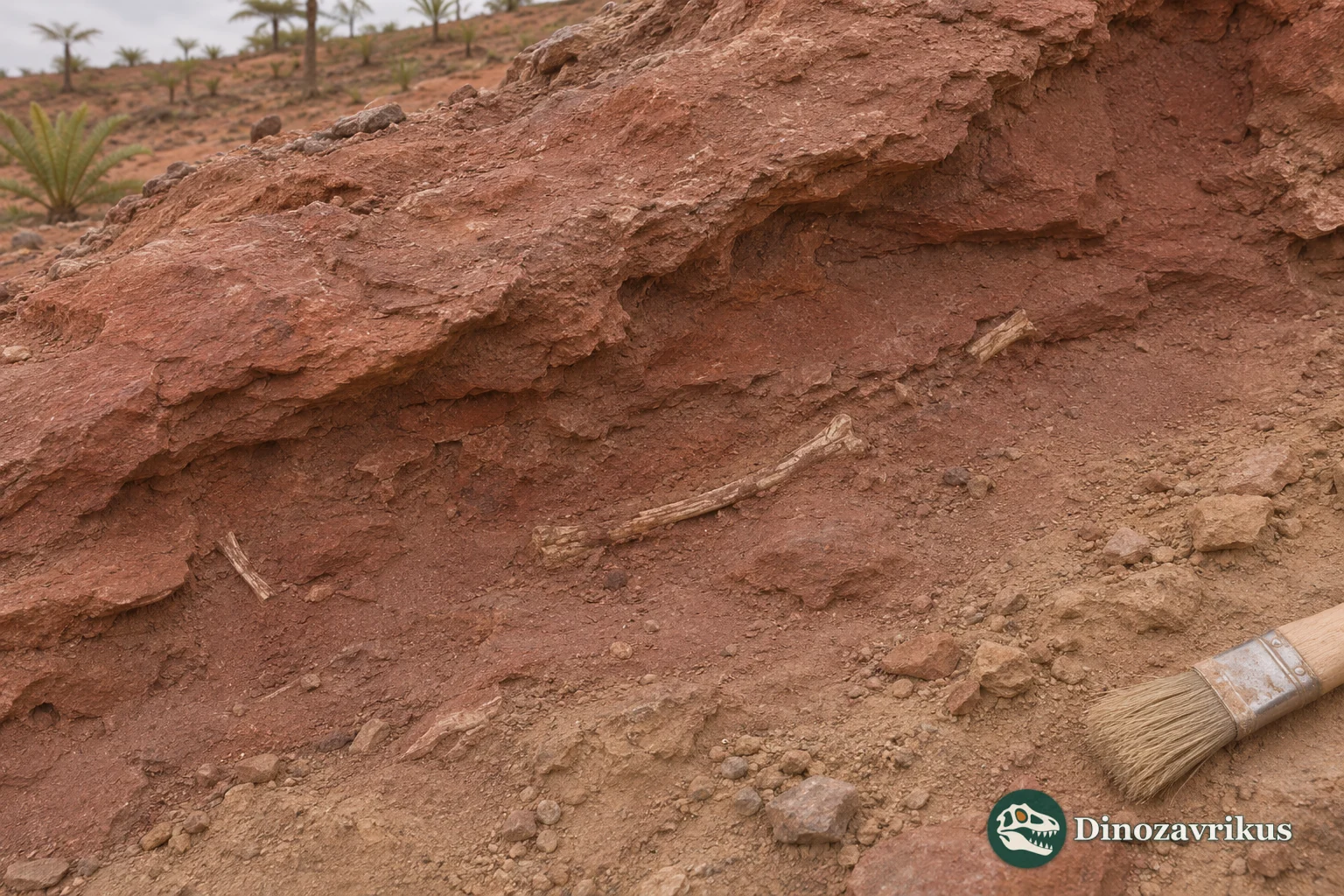
Skull bones, vertebrae and limb bones of ULBRA-PVT016 survive close together in mudstone. The bones often lack their original articulation, and some elements remain difficult to identify.
Many crowns are serrated and leaf-shaped, while some at the front have smooth margins. These forms help assess a mixed diet, but do not identify particular foods.
Complete bones from the foot provide useful measurements. Deformation obscures the original lengths of the thigh and shin bones, limiting estimates of limb proportions.
Bones from the Janner site
Sérgio Cabreira and colleagues named Pampadromaeus barberenai in 2011. The species honours Brazilian palaeontologist Mário Barberena. The specimen, ULBRA-PVT016, came from reddish mudstone at the Janner site west of Agudo and is held at the Natural Sciences Museum of the Lutheran University of Brazil in Canoas.
Some bones at the front of the head remained loosely connected, while most skull bones were scattered across the block. Vertebrae, limb bones and parts of the lower jaw survived alongside them. Max Langer and colleagues redescribed the skeleton in 2019. They based their anatomical comparisons on the holotype because two isolated femora could not be assigned confidently to this dinosaur.
Teeth and possible foods
Some teeth at the very front of the jaws had smooth cutting edges. Broad, leaf-shaped crowns with coarse serrations made up much of the remaining dentition. Small tooth positions are also visible on a pterygoid bone in the roof of the mouth. This combination helps distinguish Pampadromaeus from other small Carnian dinosaurs.
Researchers have suggested that this arrangement fits a mixed diet including vegetation. The inference comes from comparative anatomy. The skeleton has yielded no identifiable meals. Other similarly small early sauropodomorphs in Brazil had different teeth. Buriolestes, for example, had dentition better suited to feeding on animal prey.
Movement and the other dinosaurs of Agudo
Features throughout the skeleton, including expanded sacral ribs and a distinctive contour of the first metatarsal, place Pampadromaeus among early sauropodomorphs. It is usually reconstructed as a biped. Compression distorted the femora and tibiae, so their proportions remain uncertain. The complete fourth metatarsal offers a secure measurement of 70 millimetres.
The Janner mudstones are late Carnian on the basis of stratigraphic and fossil correlations. Remains of the cynodont Exaeretodon are especially common there. The same site yielded Bagualosaurus, another early sauropodomorph with more robust hind limbs. The two show how much size, limb proportions and jaw anatomy already differed among such dinosaurs in the Carnian.
Frequently asked questions
How big was Pampadromaeus?
The detailed anatomical description estimated a body length of about one and a half metres. Missing parts of the skeleton make this an approximation.
Was it related to the later sauropods?
Pampadromaeus represents an early branch of Sauropodomorpha, the broader group to which the later sauropods belonged.
What did Pampadromaeus eat?
Its tooth shapes are compatible with a mixed diet including a plant component. The relative contributions of animal and plant food remain unknown.
Why did scientists examine the same specimen again?
The first study named the species. Detailed re-examination refined the diagnosis and helped separate the well-supported holotype evidence from less secure isolated finds.